
Study on Vehicle Body Vibration Response Based on Modal, FRF, and Damping Characteristics Analysis of a Simplified Bus BIW
Copyright Ⓒ 2026 KSAE / 247-10
This is an Open-Access article distributed under the terms of the Creative Commons Attribution Non-Commercial License(http://creativecommons.org/licenses/by-nc/3.0) which permits unrestricted non-commercial use, distribution, and reproduction in any medium provided the original work is properly cited.
Abstract
The structural configuration of bus body-in-white (BIW) systems differs significantly from that of passenger vehicles, exhibiting a longer body length and higher structural openness. These characteristics amplify the interaction between global bending and torsional modes, thereby exerting a substantial influence on the overall NVH performance of the vehicle. This study aimed to investigate structural modal characteristics and mode coupling phenomena by performing modal analysis, frequency response function (FRF) evaluation, and Rayleigh damping–based damping modeling on a simplified bus BIW model. A comprehensive review of previous studies was conducted to summarize research trends in structural stiffness, NVH behavior, and damping design. Based on this foundation, an integrated analysis framework was established in Abaqus, including system modeling, modal analysis, frequency response evaluation, and damping-sensitivity assessment. Finally, the influence of damping variations on modal damping ratios and FRF peak amplitudes was examined, and structural design guidelines for improving the stiffness and NVH characteristics of bus BIW structures were proposed.
Keywords:
BIW, Torsional mode, Bending mode, Frequency Response Function(FRF), NVH(Noise, Vibration, Harshness), Damping ratio1. Introduction
Compared to other transportation vehicles, the bus body-in-white (BIW) structure is long and open. Consequently, its natural vibration characteristics, including torsional stiffness, bending stiffness, and intermodal influences, determine NVH performance. Various experimental and analytical studies have been conducted to systematically elucidate the vibration characteristics and damping behavior of bus structures.
Kim1) presented an early strategy for improving the overall stiffness of a bus body, quantitatively evaluating the deformation modes of key structural components and demonstrating that torsional and bending stiffness could be improved through reinforcement design. This served as the foundation for subsequent research on bus and body-in-white (BIW) stiffness.
In the early 2010s, modal and stiffness research on bus bodies became fully systematic. Gauchia et al.2) proposed a technique for simultaneous optimization of torsional stiffness and weight for actual bus structures and suggested a design direction for the stiffness of the electrical system. Zhang et al.3) then presented a systematic procedure for body mode design, emphasizing that low-order mode control is key to improving NVH performance. These studies are representative examples that quantitatively demonstrate that local structural improvement directly affects modal characteristics.
Subsequently, with the active development of industrial-based research, interest in analyzing vulnerable areas and optimizing stiffness of actual body-in-white (BIW) structures has grown. Ramachandran et al.4) proposed a methodology for measuring BIW torsional stiffness and an optimal reinforcement technique for vulnerable panels. This presented a stiffness verification process that closely resembles an industry standard.
Since the 2020s, research on modal interactions and damping characteristics has expanded significantly. Sipos5) used Actran-based virtual SEA (VSEA) to quantitatively analyze the effects of optimizing damping pad placement on improving high-frequency NVH performance. Cavaliere et al.6) proposed a non-intrusive NVH parametric analysis technique that allows for evaluating the impact of body parameter changes on modal characteristics and vibration response without model reconfiguration. This technology aligns well with the rapidly increasing demand for parametric design in recent vehicle development. Pinzaru et al.7) analyzed the effects of structural and material damping on modal damping ratios for vehicle hood structures, suggesting the potential for panel-level NVH optimization.
Recent studies have evolved into more complex, multi-objective optimization approaches, driven by the emergence of EV-based body structures and increasing demands for lightweight design. Li et al.8) proposed a design framework that simultaneously satisfies body stiffness, NVH, and lightweight design requirements using collaborative optimization techniques. Özcan9) investigated the impact of lightweight body-in-the-wall (BIW) structures on modal characteristics and specifically presented design tradeoffs between lightweighting and NVH. Furthermore, Hu10) proposed a method to improve the accuracy of experimental modal analysis through structural optimization of a body stiffness test rig, emphasizing the importance of ensuring the reliability of analysis-experiment coupled models.
A limitation of these existing studies is that most of them focused on actual structures or entire BIW models, lacking a systematic analysis of modal coupling and damping effects. In particular, research on the correlation between eigenmodes, FRFs, and damping characteristics using a simplified bus BIW model is very limited.
This study is significant in that it utilizes a model that simplifies the complex BIW while retaining core dynamic characteristics to analyze key parameters affecting structural behavior, thereby providing fundamental data for future NVH performance improvement designs.
2. Theoretical background
2.1 Features of the bus BIW structure
The bus body-in-white (BIW) is primarily composed of longitudinal rails, cross members, roof structures, and pillar structures. These structures, with their overall open-top characteristics, resemble space frames, with a higher longitudinal length and a relatively lower closed-section ratio compared to typical passenger car BIWs. Due to this open structural characteristic, bus BIWs are prone to first- and second-order bending-based modes in the low-frequency range.
Furthermore, because it is difficult to secure sufficient torsional stiffness overall, coupled bending-torsion modes, as well as pure bending or pure torsional modes, can occur. Furthermore, body damping characteristics are significantly influenced by factors such as the stiffness of inter-panel joints, beam-to-panel connection methods, and local structural details. The connection conditions in specific sections can influence the overall structural damping performance. Therefore, in order to accurately predict the vibration and noise behavior of a bus BIW, an analysis that takes into account these structural characteristics and mode shape specificities is essential.
2.2 Modal interpretation theory
Modal analysis is a fundamental technique for identifying the natural vibration characteristics of a structure. It is used to understand the overall dynamic characteristics through natural frequencies, mode shapes, and modal damping characteristics. The equations of motion of a damped system are generally expressed as a mass matrix M, a stiffness matrix K, and a damping matrix C. Specifically, when Rayleigh damping is applied, the damping matrix is defined as a linear combination of mass and stiffness as C = αM + βK, where α and β represent the mass-proportional damping coefficient and the stiffness-proportional damping coefficient, respectively.
Using the Rayleigh damping model, the damping ratio in each mode is determined by the values of α and β which directly affects the magnitude of the peak amplitude and the width of the frequency response for each mode. Therefore, for accurate modal analysis, setting up an appropriate damping model is essential, and a reasonable damping combination that can represent the dynamic response characteristics of the entire structure is required.
2.3 FRF theory
The Frequency Response Function (FRF) is a representative indicator representing the dynamic relationship between the input and output of a structure in the frequency domain. It is defined as the ratio of the displacement, velocity, or acceleration response to the force applied at a specific location. Since the FRF directly reflects the modal characteristics of a structure, it plays an important role in NVH analysis. A typical FRF is calculated by the modal superposition method.
| (1) |
It is expressed in the form of . Here, Φ i represents the i-th mode shape, and mi, ki, ci represent the mode mass, stiffness, and damping, respectively, and it shows the structure in which each mode contributes to the overall response. In particular, near the resonance frequency of the structure, the contribution of the corresponding mode increases rapidly, which appears as a peak in the FRF, and as the damping ratio increases, the size of the peak decreases and the width widens. Therefore, through FRF analysis, the dynamic vulnerable section of the structure can be identified or the change in damping characteristics can be quantitatively compared.
2.4 Attenuation modeling approach in previous studies
In the NVH field, the reliability of damping modeling analysis significantly depends on how realistically it simulates the actual damping characteristics of a structure. Existing studies typically compare damping levels by categorizing them into three categories: low, medium, and high. Low-damping models (target damping ratios of approximately 1 %) utilize very small values of α and β that reflect only the natural damping characteristics of the structure, often simply simulating the inherent damping of the metal structure itself. Medium-damping models (target damping ratios of 3-5 %) reflect the damping levels found in actual vehicle floors, frame joints, and connections such as welded and bolted joints. They often apply realistic damping ratios based on actual vehicle testing or literature data. On the other hand, high-damping (target damping ratio of 10 % or more) models assume the application of damping materials, such as damping pads and Constrained Layer Damping (CLD), and are utilized in design scenarios to actively absorb structural vibration energy, significantly reducing eigenvalue responses and FRF peaks.
Comparing these damping levels is very useful for observing changes in modal and FRF analysis results, and serves as a baseline for determining which damping strategies are effective in improving actual vehicle NVH performance.
2.5 General criteria for determining the damping factor
Rayleigh damping is determined by matching the desired damping ratio ζ at specific frequencies ω1 and ω2. Rayleigh damping equation:
| (2) |
When the damping ratio is specified at two frequencies, it is determined by the following simultaneous equations:
| (3) |
| (4) |
3. Interpretation models and methods
The vehicle in Fig. 1 is a model of a vehicle currently in operation in Korea, and in this study, an analysis model was created based on this model.
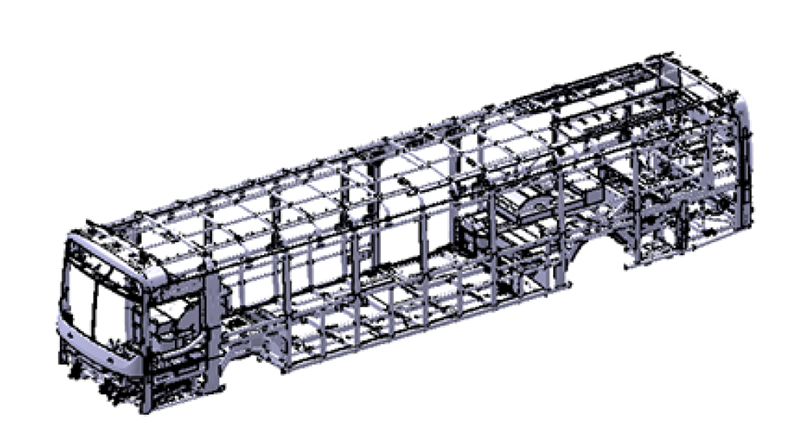
Commercial Bus Model
3.1 Reference Model
The analytical model used in this study (Fig. 2) is a simplified version of the vehicle shown in Fig. 1, excluding doors, seats, and interior materials, and only including the skeletal elements. A frame-and-reinforcement plate-based model was constructed to faithfully reflect the major load transfer paths. All components were assumed to be made of SAPH440 steel, and uniform S4R shell elements measuring 10 mm x 10 mm were used. This simplified configuration aims to maintain the overall compatibility and dynamic characteristics of a real vehicle body while ensuring computational efficiency (Tables 1, 2).
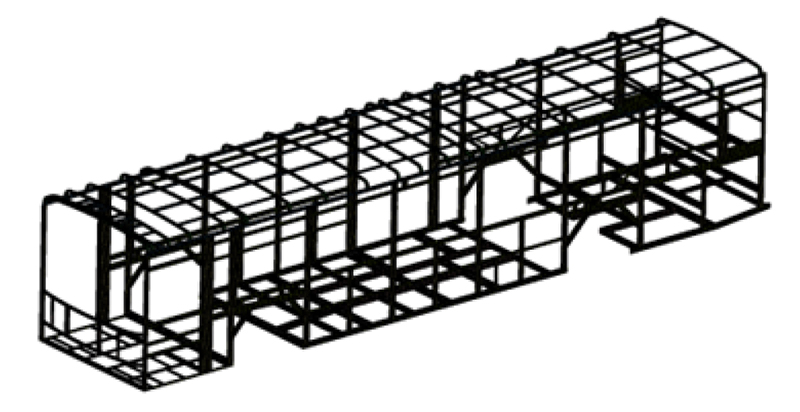
Bus BIW Model

Material properties
FE model information
3.2 Setting boundary conditions and loads
The modal analysis was conducted under Free-Free (free vibration) boundary conditions. To account for peak variations, the damping coefficients were calculated using equations (3) and (4) for low, medium, and high damping cases (Table 3).
Rayleigh variables
For the FRF (Frequency Response Function) analysis to evaluate dynamic characteristics, a single-point excitation method was used. The excitation location was set at the cross-member center node of the front wheel, and the excitation direction was set vertically (Z-direction) to account for the primary vibration direction of the vehicle. These excitation conditions simulate the path of road pressure or powertrain/suspension vibration in an actual vehicle and are suitable for evaluating FRF response characteristics according to changes in structural stiffness. Furthermore, the rear wheel support conditions of an actual vehicle were reflected by fixing the rear wheel, ensuring that the overall vehicle behavior was consistent with the vehicle's mounting conditions.
4. Interpretation Results and Analysis
4.1 Modal interpretation
The Lanczos eigenvalue analysis algorithm was performed, with the analysis interval set to 0-70 Hz, focusing on identifying key bending and torsional modes in the low-frequency region, which are crucial for actual large vehicles. Despite the model simplification, the open structural characteristics of buses were fully reflected, allowing the first, second, and third bending modes to be identified in the low-frequency range.
It was difficult to identify distinct torsional modes. With the exception of the thin roof rail, longitudinal members are absent from the body model. The absence of longitudinal members eliminates the continuous transverse path that resists longitudinal torsion, facilitating torsional deformation. This causes torsional modes to be hidden at low frequencies or difficult to isolate.
The first mode identified is a typical first-order bending mode, in which the entire frame moves up and down as a single curve. The second mode is a second-order bending mode with additional deformation in the center. The fourth mode is a third-order bending mode, in which a groove is formed on both sides of the center (Fig. 3).
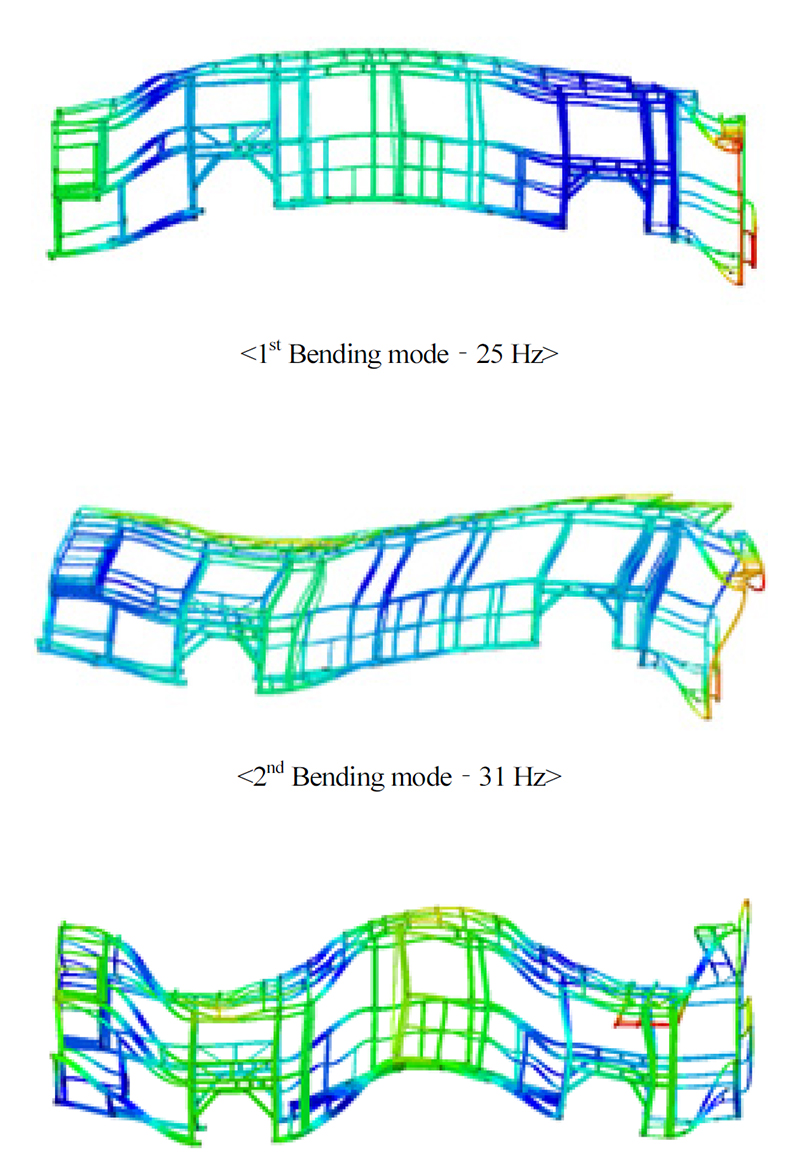
Stress Results
4.2 FRF Analysis
Response Function (RF) analysis was performed to evaluate how structural characteristics derived from modal analysis would respond under actual conditions. The analysis was conducted using the Direct Steady-State Dynamics method, and cavity frequency response characteristics were obtained in the 1–100 Hz frequency range. The peaks did not coincide with the natural frequencies determined from the modal analysis. This is not due to resonance due to bending or torsional forces, which typically occur. It is believed to be due to a mode occurring locally at the peak location (Figs. 4 and 5).
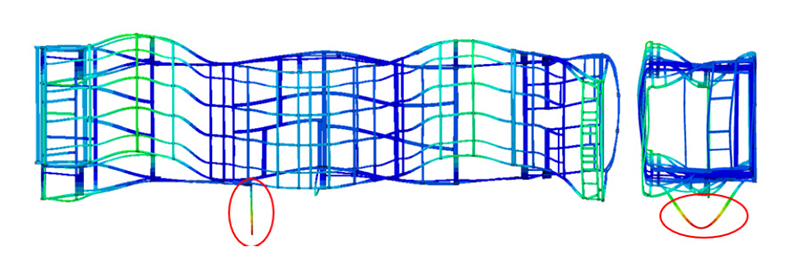
modal result (50 Hz)
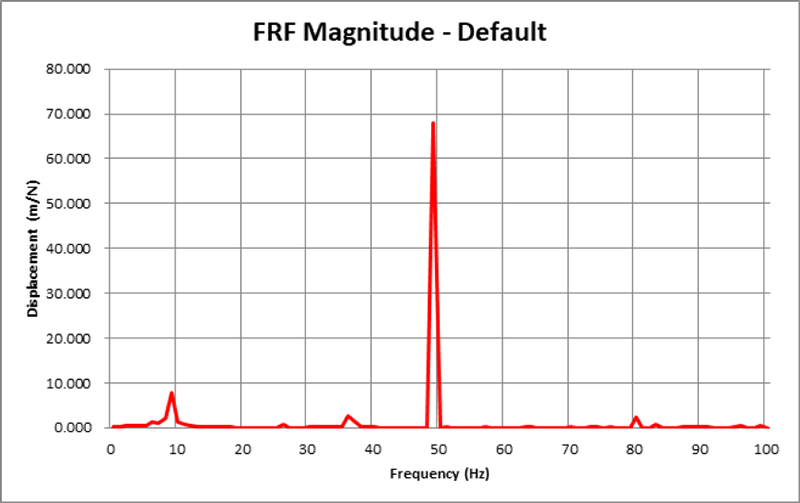
FRF result (No attenuation)
4.3 Damping Effect Analysis
Body damping is a significant factor influencing modal response and FRF peak characteristics. This study analyzed the impact of damping changes on structural response by gradually increasing the Rayleigh damping coefficients α and β. The damping ranges were configured as shown in Table 3, and low, medium, and high damping conditions were compared.
The modal damping ratio naturally increased with increasing damping coefficients, which was directly related to a decrease in peak amplitude at resonance. Furthermore, increased damping reduced intermodal overlap and broadened the Full Width Half Maximum (FWHM), which indicates the width of the resonant region. This indicates that the sharp peak of the vibration response gradually changes as the structure’s energy dissipation capacity increases.
From an FRF perspective, low damping conditions exhibit very sharp peaks and narrow bandwidths, indicating a sensitive response to excitation. Conversely, medium damping conditions exhibited appropriate peak reduction and reduced intermodal interference, resulting in the most desirable response characteristics for NVH performance. In the highly damped region, the peaks were excessively flattened, making the structural eigenmodes unclear. This suggests that excessive damping can obscure the structural design intent.
From a structural design perspective, increasing damping in torsional modes was found to be highly effective in suppressing resonance. In particular, applying damping pads around the side rails or floor panels is expected to significantly reduce torsional resonance peaks. Conversely, the impact of damping was relatively minimal in higher-order modes, such as the second bending mode. In these cases, local reinforcement or cross-sectional shape adjustments should be implemented.
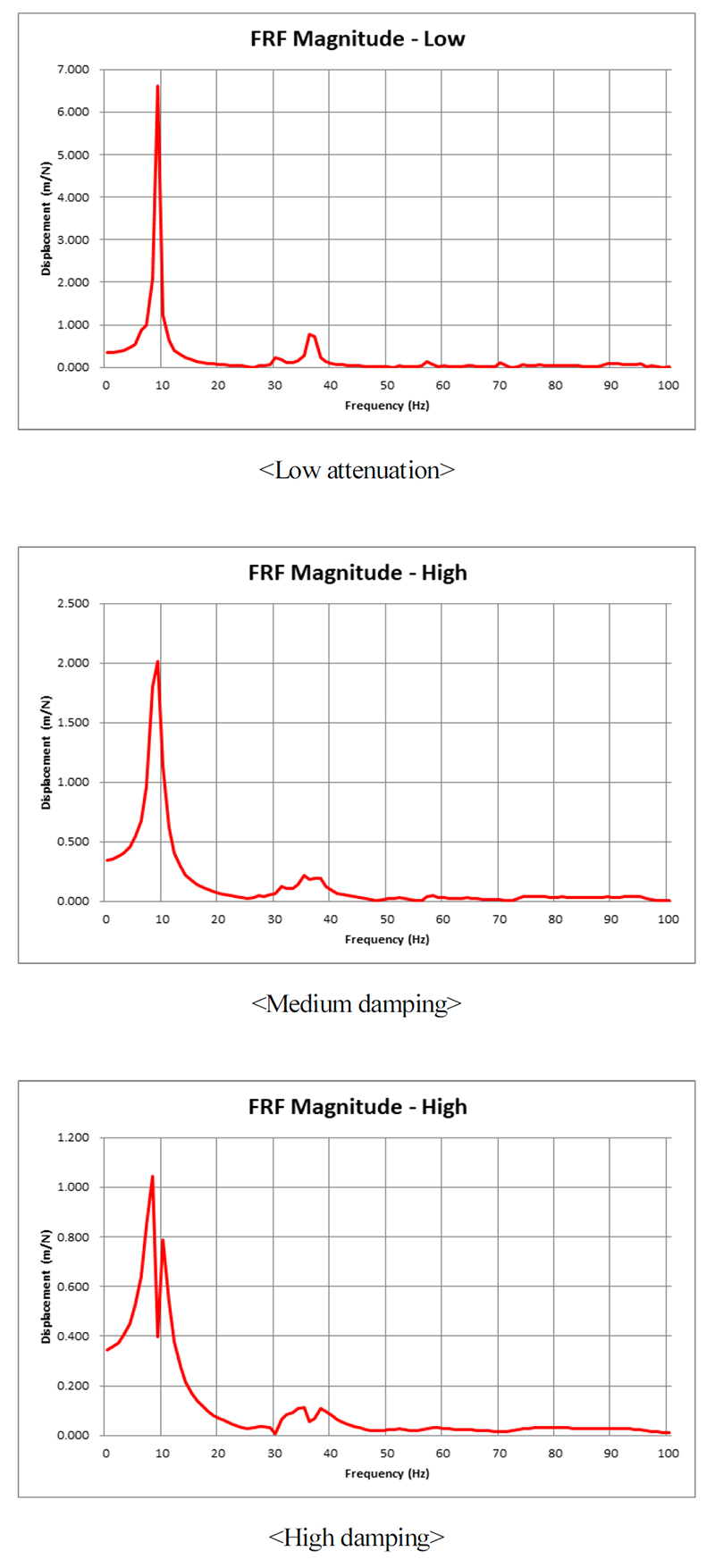
FRF Results
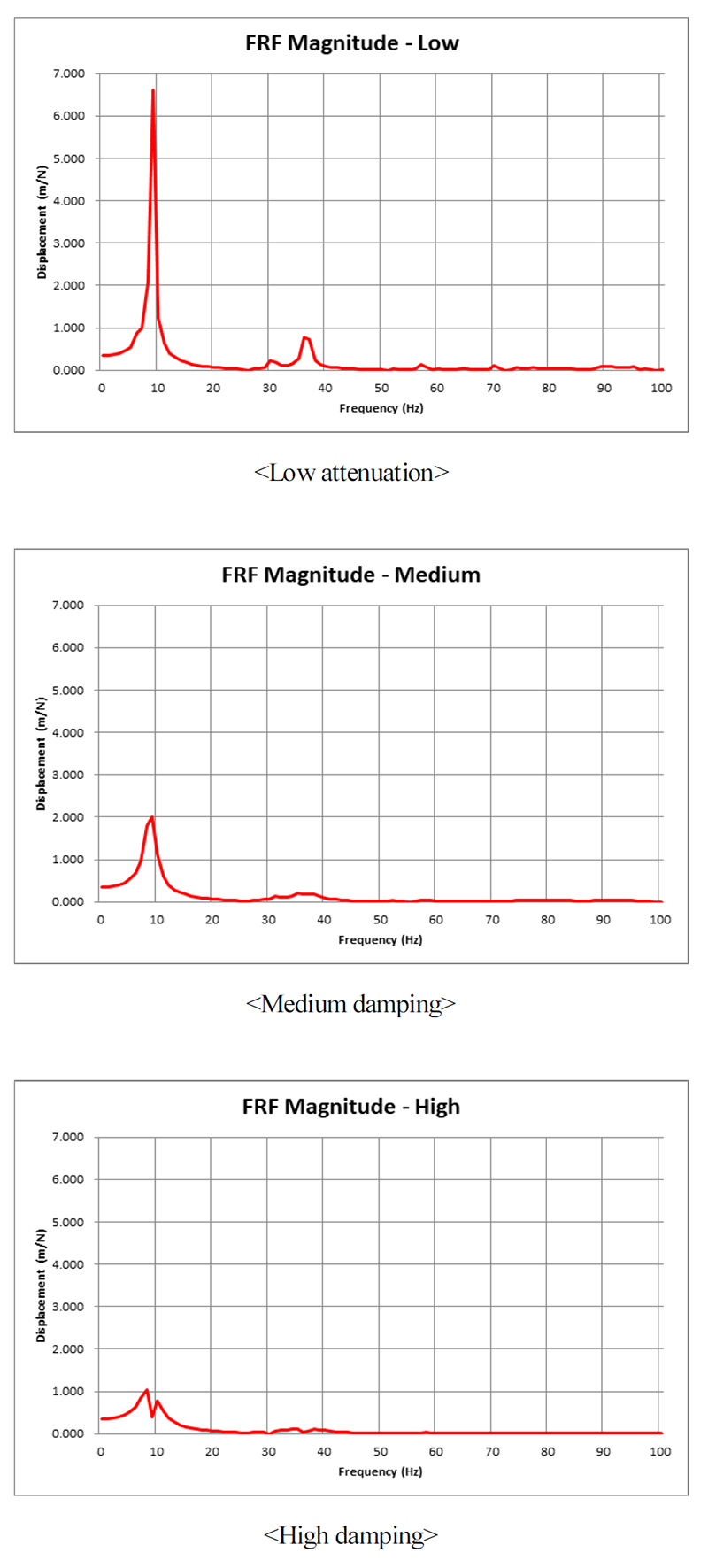
FRF Results (Vertical axis adjustment)
5. Conclusion
This study systematically performed modal analysis, FRF analysis, and damping analysis based on a simplified bus body-in-the-body (BIW) model to comprehensively evaluate key structural behaviors in the low-frequency range. The analysis results revealed that the bus body exhibits strong coupling between the bending and torsional modes due to its structural openness, and that local stiffness variation is a key cause of this coupling. Furthermore, Rayleigh damping played a crucial role in modulating the modal damping ratio and suppressing FRF peaks, and the most excellent vibration response characteristics were observed in the medium-damped region. These integrated analysis results are expected to serve as practical baseline data for establishing reinforcement structure layout, damping pad design, and NVH optimization strategies in future bus body designs.
Acknowledgments
This study was conducted with the support of internal research funds from Joongbu University in 2025.
References
-
T. Kim, “Study on the Stiffness Improvement of Bus Structure,” SAE 931995, 1993.
[https://doi.org/10.4271/931995]

-
A. Gauchia, V. Diaz, M. J. L. Boada and B. L. Boada, “Torsional Stiffness and Weight Optimization of a Real Bus Structure,” Int. J. Automotive Technology, Vol.11, No.1, pp.41-47, 2010.
[https://doi.org/10.1007/s12239-010-0006-4]
-
G. Zhang, G. Zhang, Y. Chen and J. Jin, “Modal Analysis and Local Stiffness Optimization for Body-in-white of Car,” Journal of Highway and Transportation Research and Development (English Edition), Vol.5, No.2, pp.137-141, 2011.
[https://doi.org/10.1061/JHTRCQ.0000079]
-
R. Ramachandran, N. Dehariya, G. Kumar, H. Agarwal and S. Singh, “Methodology to Measure BIW Torsional Stiffness and Study to Identify and Optimize Critical Panels,” SAE 2015-26-0224, 2015.
[https://doi.org/10.4271/2015-26-0224]
- D. Sipos, “Optimization of Damping Pad Distribution on Body-in-White Using Actran Virtual SEA,” Extrica - Structural Dynamics & Vibration, Vol.13, No.1, pp.9-13, 2022.
-
Cavaliere, et al., “Nonintrusive Parametric NVH Study of a Vehicle Body Structure,” Vehicle System Dynamics, Vol.51, No.11, pp.6557-6582, 2023.
[https://doi.org/10.1080/15397734.2022.2098140]
-
V. Pinzaru, et al., “Structural Damping Analysis of a Vehicle Front Hood,” Machines, Vol.12, No.2, Paper No.862, 2024.
[https://doi.org/10.3390/machines12120862]
- H. Li, et al., “Collaborative Optimization Method of Structural Performance for Lightweight Vehicle Body,” Applied Sciences, Vol.15, pp.1-27, 2025.
- A. Özcan, “Lightweight Design and Structural Analysis of a BIW,” Applied Sciences, Vol.15, 2025.
- Z. Hu, “Optimization Design of Body-in-White Stiffness Test Rig for Modal Testing Accuracy Improvement,” Applied Sciences, Vol.15, pp.9-13, 2025.