
EV 배터리팩의 냉각면 구성에 따른 냉각 성능 향상 연구
Copyright Ⓒ 2025 KSAE / 236-05
This is an Open-Access article distributed under the terms of the Creative Commons Attribution Non-Commercial License(http://creativecommons.org/licenses/by-nc/3.0) which permits unrestricted non-commercial use, distribution, and reproduction in any medium provided the original work is properly cited.
Abstract
With the increase in the adoption of electric vehicles(EVs), interest in the safety and fire risks in EV battery packs has grown significantly, spurring active research on battery thermal management systems, temperature balancing between cells, and battery pack design. Particularly, keeping the maximum temperature of the battery pack and reducing the temperature deviation between cells to within 5°C difference are critical challenges in ensuring the driving range and thermal runaway safety of EVs. This CFD study focuses on the design of a dual-sided cooling system for small EV battery packs to determine its effects on the maximum temperature in the battery pack. The performance of the existing model(bottom liquid cooling) was compared with dual-sided cooling systems(bottom liquid cooling + top liquid cooling and bottom air cooling + top liquid cooling). The computational results confirm that the dual-sided liquid cooling system effectively reduced heat, and minimized temperature deviation between cells. Specifically, the dual-sided system that combines bottom air cooling and top liquid cooling utilizes natural airflow during driving to maintain proper temperatures while reducing coolant flow. This approach reduced temperature deviation inside the battery pack.
Keywords:
Electric vehicle(EV), Computational fluid dynamics(CFD), C-rate, Coolant mass flow, Theraml interface material(TIM), Dual-sided cooling system키워드:
전기 자동차, 전산 유체역학, 충ㆍ방전율, 냉각수 질량유량, 열계면소재, 양면 냉각 시스템1. 서 론
전 세계적으로 전기차(EV)의 빠른 보급으로 배터리 시스템의 효율성과 안전성 확보가 중요해지고 있다. 특히, 리튬 이온 배터리는 고출력과 긴 주행거리를 제공하지만, 높은 에너지 밀도로 인해 화재 위험이 증가하고 있다. 배터리 팩의 열관리가 제대로 이루어지지 않을 경우 셀 부풀음(Swelling), 열폭주, 주행거리 감소 등 다양한 문제가 발생하며, 이는 탑승자의 안전을 위협하는 주요 요인 중 하나로 지목된다.1)
배터리의 안전성을 위해서는 셀 간 온도 균형과 최대 온도 관리가 핵심이다.2) 셀 충⋅방전 시 발생하는 열을 효과적으로 제어하지 못하면 성능저하와 화재 위험이 높아질 수 있다.3) 위와 같이 배터리의 열적 문제를 해결하기 위해 다양한 냉각 기술이 연구되고 있으며,4) 그 중 수랭식 냉각 시스템은5) 공랭식 냉각 시스템6) 보다 높은 열전달 성능으로 인해 고온 환경에서도 효과적으로 배터리 팩 온도를 제어할 수 있다.7,8) 이에 따라, 대부분의 EV 차량은 수랭식 냉각 시스템을 채택하고 있다.
기존 EV 수랭식 배터리 팩의 작동 방식은 다음과 같다. 배터리의 충⋅방전 과정에서 전기화학적 반응으로 열이 발생하면 배터리 관리 시스템(BMS)은 실시간으로 배터리 셀 또는 모듈의 온도를 모니터링하며,9,10) 설정된 온도를 초과할 경우 워터펌프를 작동시켜 냉각 시스템을 활성화한다. 워터펌프는 냉각수에 압력을 가해 배터리 팩 내 설계된 냉각 유로를 따라 순환한다. Fig. 1과 같이 배터리 팩의 하단부에는 냉각 유로가 설치되어 있다. 냉각수는 유로를 따라 흐르며, 배터리 모듈과 열 교환을 수행한다. 모듈에서 발생한 열은 냉각수(Coolant)로 전달되고, 냉각수는 열교환기로 이동해 흡수된 열을 외부로 방출한다.
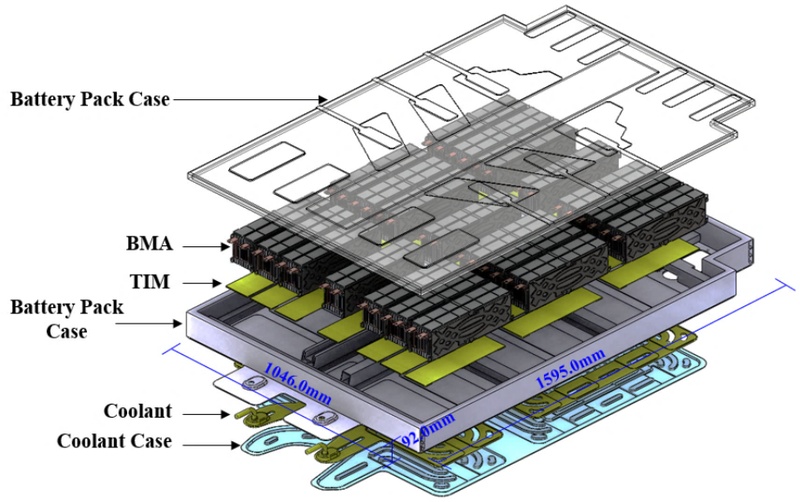
Configuration of liquid cooling battery pack
본 연구는 소형 전기차(EV)를 대상으로, 하단 냉각 시스템 (단면 냉각)과 냉각 성능을 비교하기 위해, 양면 냉각 시스템을 설계하고, CFD 열⋅유동 해석을 수행하였다. 연구의 목표는 배터리의 최적 온도 범위인 25 ~ 40 oC를 유지하면서 배터리 팩의 최대 온도를 감소시키고 셀(Cell) 간 온도 편차를 5 oC 이하로 줄이는 것이다.11)
2. 배터리 팩 설계 구조 및 열⋅유동 해석 조건
2.1 Battery Cell 구조 및 TIM 형태
본 연구의 배터리 팩을 구성하는 배터리 셀은 Fig. 2와 같이 파우치 타입이며 배터리 모듈 내부에는 셀(Cell), 버스바(Busbar), 폴리우레탄 패드(Polyurethane pad, PU) 마지막으로 배터리 모듈의 변형과 외부의 충격을 막아주는 셀 케이스(Cell case)로 구성되어 있다. 본 연구에 사용된 배터리 셀 사이즈는 354 × 101 × 9.5 mm, 모듈 사이즈는 354 × 101 × 92 mm 이다.
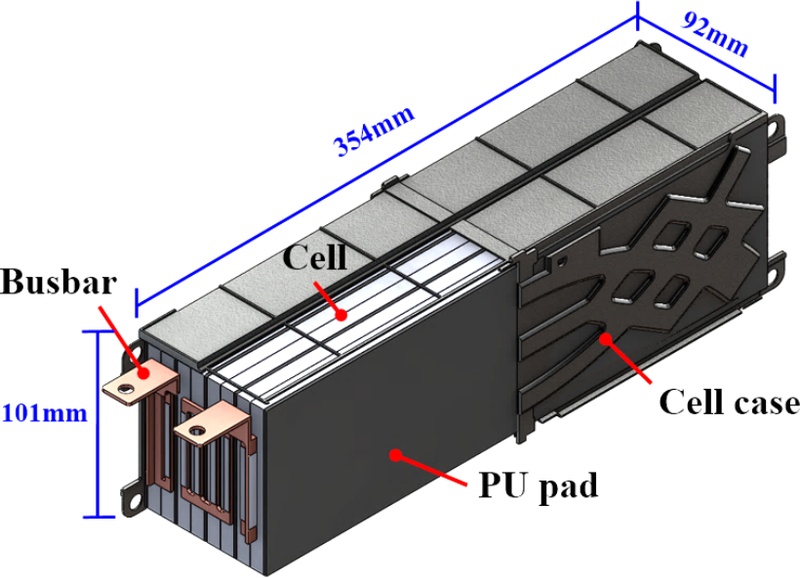
Schematic diagram of battery module and module size
Fig. 3(a)는 Fig. 2의 Section A 부분을 확대하여 자세하게 나타낸 배터리 모듈 구성이다. 한 개의 모듈에는 8개의 셀이 2P4S로 전기적 연결이 되어 있다. 또한, 셀(Cell)과 셀 사이와 셀과 케이스(Battery module case) 사이에는 총 5개의 Polyurethane(PU) pad 가 있어 배터리가 안정적으로 고정되며, 각 배터리 간의 열 간섭과 열 전이를 방지하는 역할을 한다. 배터리 모듈 하단부에 위치한 합성실리콘 재질의 TIM(Thermal interface material)은 셀(Cell)과 냉각판(Cooling plate) 사이의 공기 간극을 줄여 열전달 효율을 높이며, 주요 성분으로는 산화 마그네슘(MgO), 산화 알루미늄(Al2O3)등이 포함되어 배터리 냉각성능을 향상시킨다. Fig. 3(b)는 배터리 모듈의 열교환 과정을 시각적으로 나타낸 단면도로, 각 구성 요소와 열전이 흐름을 보기 쉽게 그림으로 표현하였다. 배터리 모듈에서 발생한 열은 TIM을 냉각판으로 전달되며, 냉각판은 열을 냉각 유체로 전달한다. 냉각 유체는 열을 효과적으로 흡수하고 순환 시스템을 통해 외부로 배출함으로써 배터리 모듈의 과열을 방지하고 안정적인 성능을 확보할 수 있다.
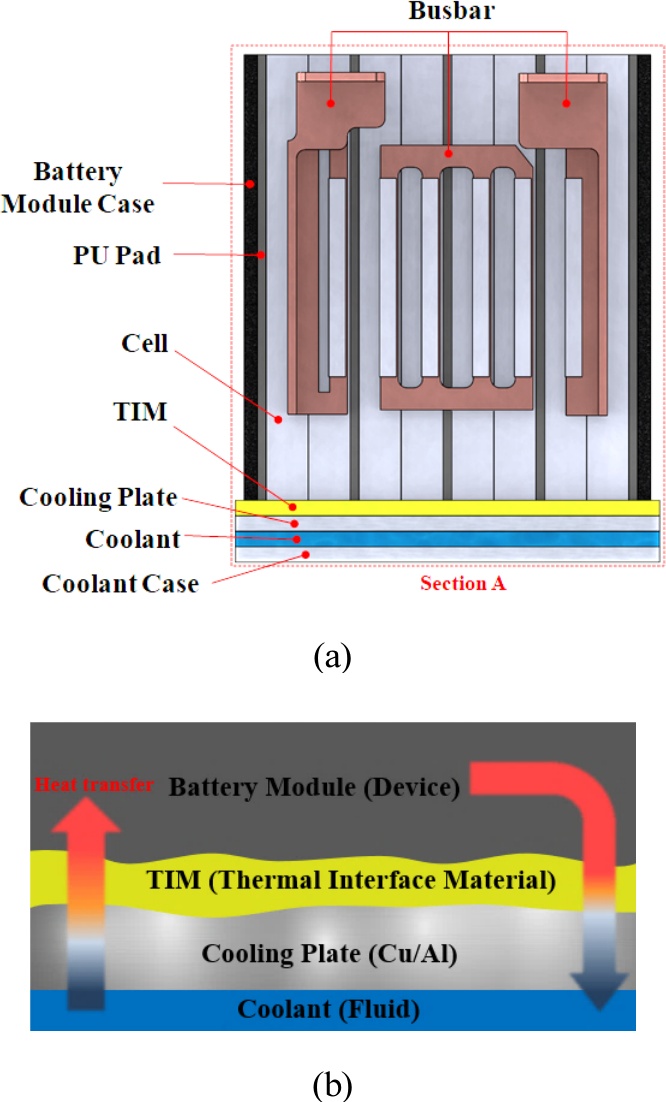
(a) Arrangement of the 2P4S module within the battery pack and (b) battery module heat exchange method
Fig. 4, Fig. 5는 TIM의 페이스트(Paste) 형태와 고체 형태의 모습을 볼 수 있다. 본 연구에서는 해석의 용이성을 위해 두께 3.8 mm의 TIM Pad를 정형화된 형태로 가정하여 실험을 진행하였다.
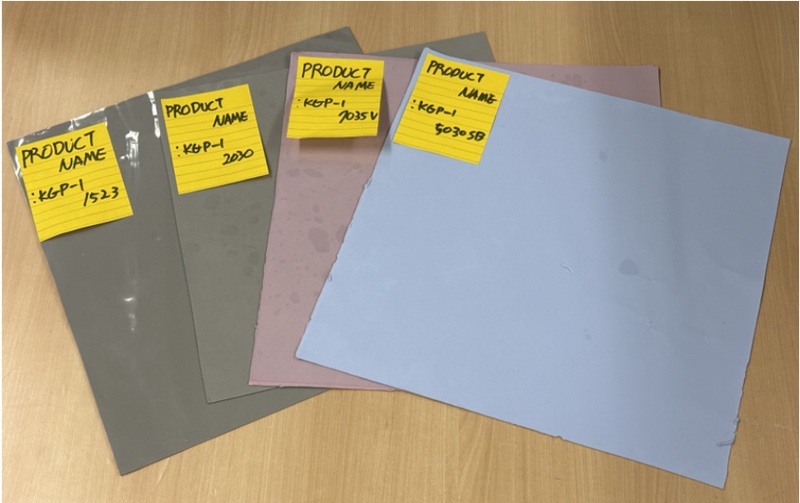
Photograph of thermal interface material(TIM) in solid form
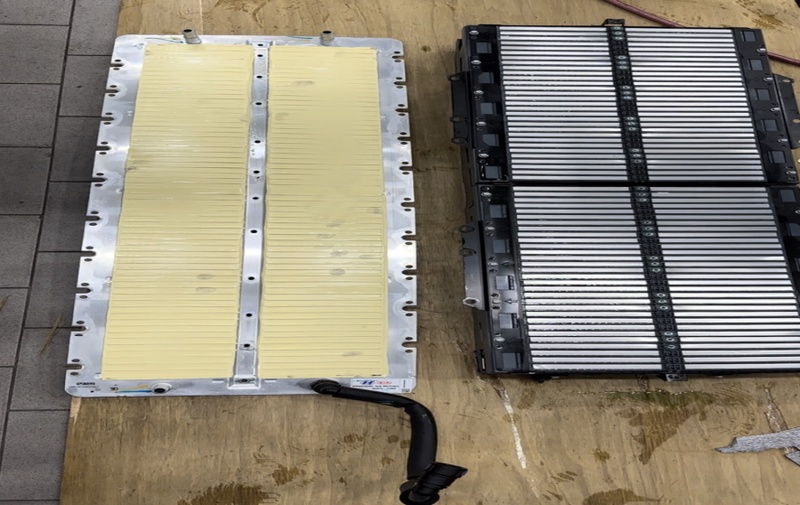
Photograph of thermal interface material(TIM) in paste form12)
2.2 Battery Pack 설계 파라미터 구조
본 연구에서는 3개의 설계 파라미터를 기반으로 배터리 팩의 열 냉각 특성을 배터리 팩 냉각면 변화에 따라 해석하였다. 모든 배터리 팩은 2P84S 구조로 구성되어, 버스바(Busbar)를 통해 전기적으로 연결되어 있다.
첫째, 단면 냉각 시스템 (One-sided bottom coolant cooling)으로 Fig. 6(a), (b)에서 확인할 수 있다. 주요 특징으로는 배터리 팩 하단에 냉각 시스템을 배치하여, 하단에서만 배터리 팩 냉각을 한다.
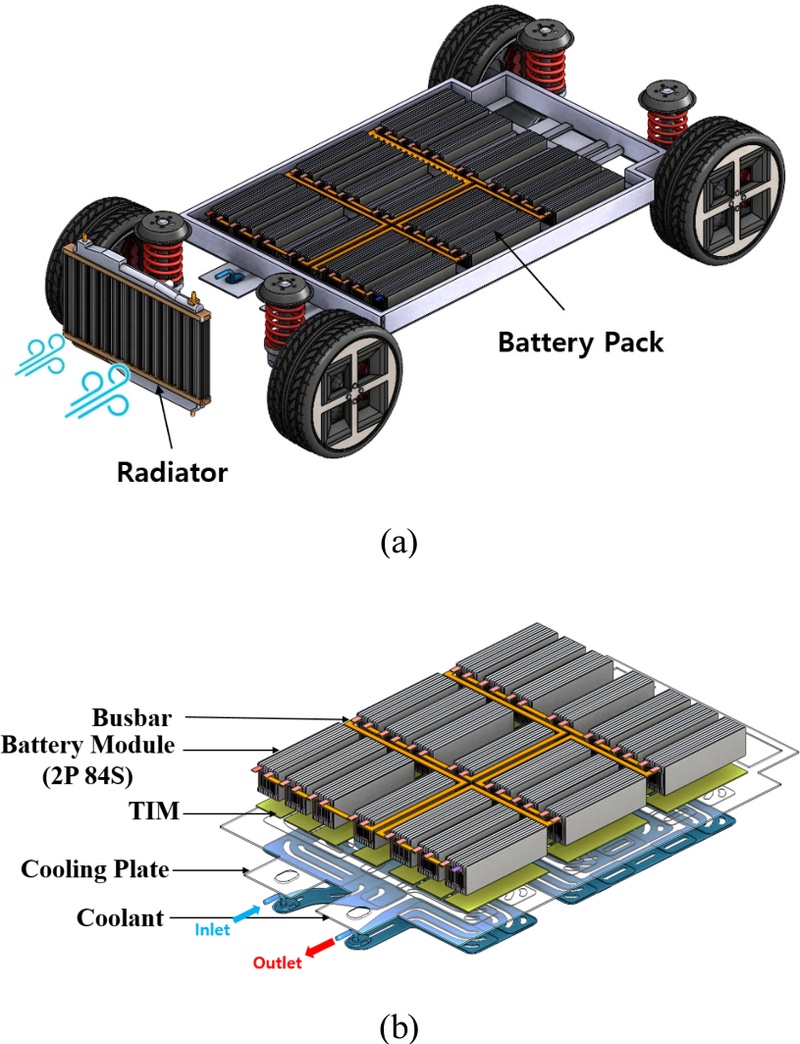
One-sided bottom coolant cooled (a) mounted on the vehicle and (b) schematic representation of a battery pack
둘째, 양면 냉각 시스템(Double-sided top coolant cooled + bottom coolant cooled)으로 Fig. 7(a), (b)에 나타나 있다. 냉각 방식은 배터리 팩 상부와 하부에 냉각수를 사용하여 동시에 냉각한다.
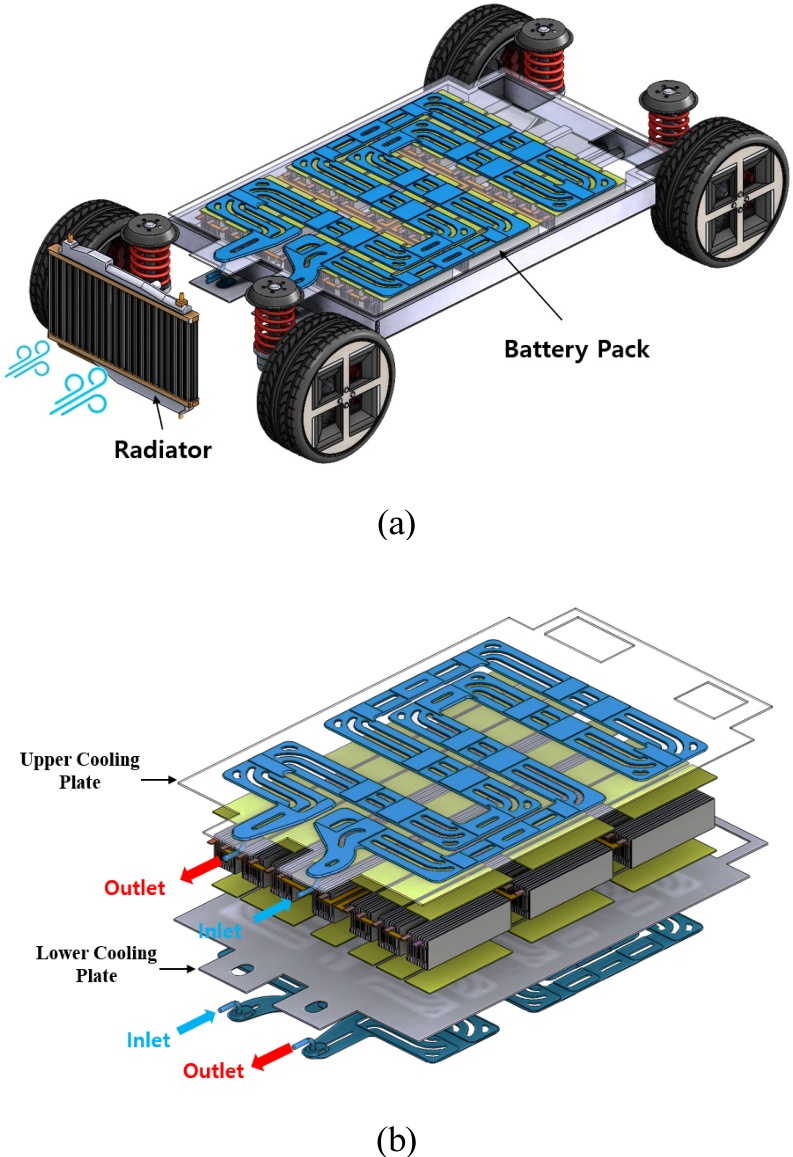
Double-sided top coolant cooled + bottom coolant cooled (a) mounted on the vehicle and (b) schematic representation of a battery pack
셋째, 양면 냉각 시스템(Double-sided top coolant cooled + bottom air cooled)으로 Fig. 8(a), (b)에 나타나 있다. 배터리 팩 상부는 냉각수를 사용하여 냉각하고, 하부는 상황에 따라 냉각 방식을 달리한다. 차량 정차시에는 자연대류를 통해 냉각하고, 주행중에는 강제대류(주행풍)를 통해 배터리 팩을 냉각한다.
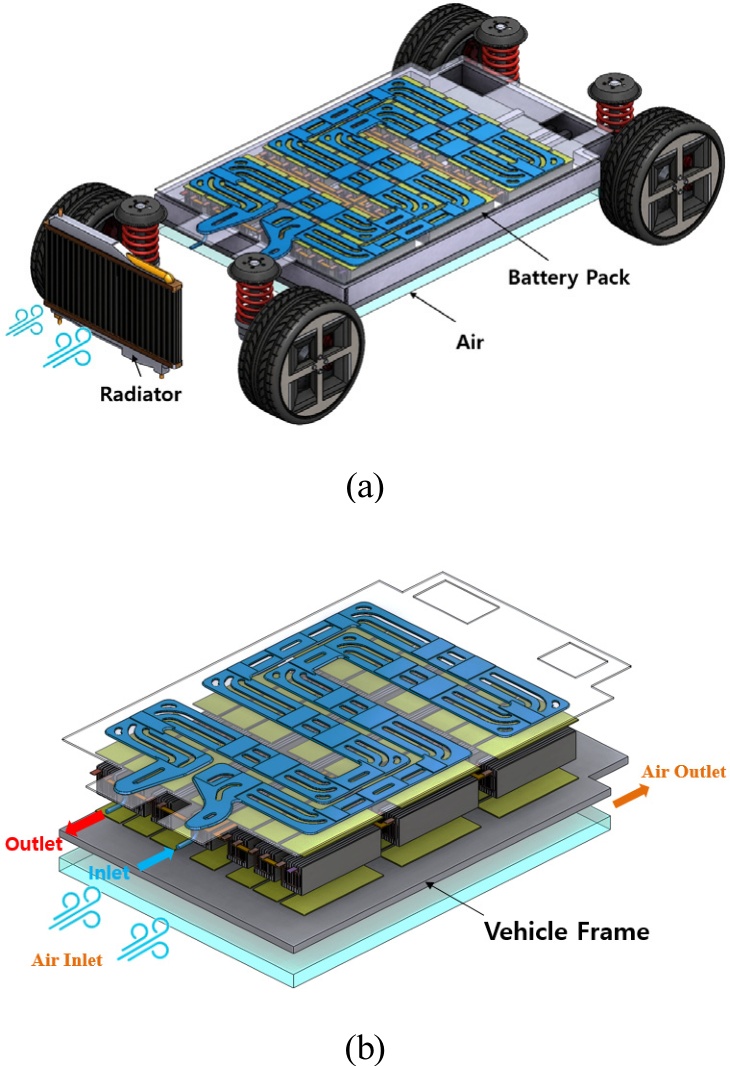
Double-sided top coolant cooled + bottom air cooled (a) mounted on the vehicle and (b) schematic representation of a battery pack
배터리 팩의 냉각 시스템을 단면 냉각과 양면 냉각 방식으로 나누어 분석하였다. 양면 냉각(Double-sided top coolant cooled + bottom coolant cooled)은 상하단 모두를 냉각하여 배터리 온도 편차를 줄이고 냉각 성능저하 개선 및 균일한 열 관리를 가능하게 한다. (Double-sided top coolant cooled + bottom air cooled)상단 냉각수와 하단 주행풍(강제대류) 또는 자연 대류를 활용한 방식은 냉각 효율을 높이고 에너지 소모를 줄여 주행거리를 향상시킨다. 결과적으로 본 연구는 냉각 면적 증대와 다양한 냉각 방식에 따른 성능 및 효율 분석을 목적으로 한다.
2.3 Battery Pack 물성값 및 열⋅유동해석 조건
배터리 팩 수치해석에 사용된 물성은 Table 1에 표기하였다. 열⋅유동 해석을 위해 상용 CFD 프로그램인 ANSYS Fluent를 사용하였으며, 실제 내부 유동을 정확하게 모사하기 위해 RANS(Reynolds-Averaged Navier-Stokes) 모델을 적용하였다. 특히, 벽면 근처의 유동을 정확하게 예측하면서도, 해석 시간을 효율적으로 관리하기 위해 SST K-omega 모델을 사용하였다. 격자 효율성을 높이기 위해 다면체(Polyhedral) 격자를 생성하였다. 단면 냉각 시스템(One-sided bottom coolant cooling)기준 약 4,598,969개의 Polyhedral 격자가 생성되었으며, 생성된 격자의 형태는 Fig. 9(a), (b)에 표기하였다.

Properties of pouch cell12)
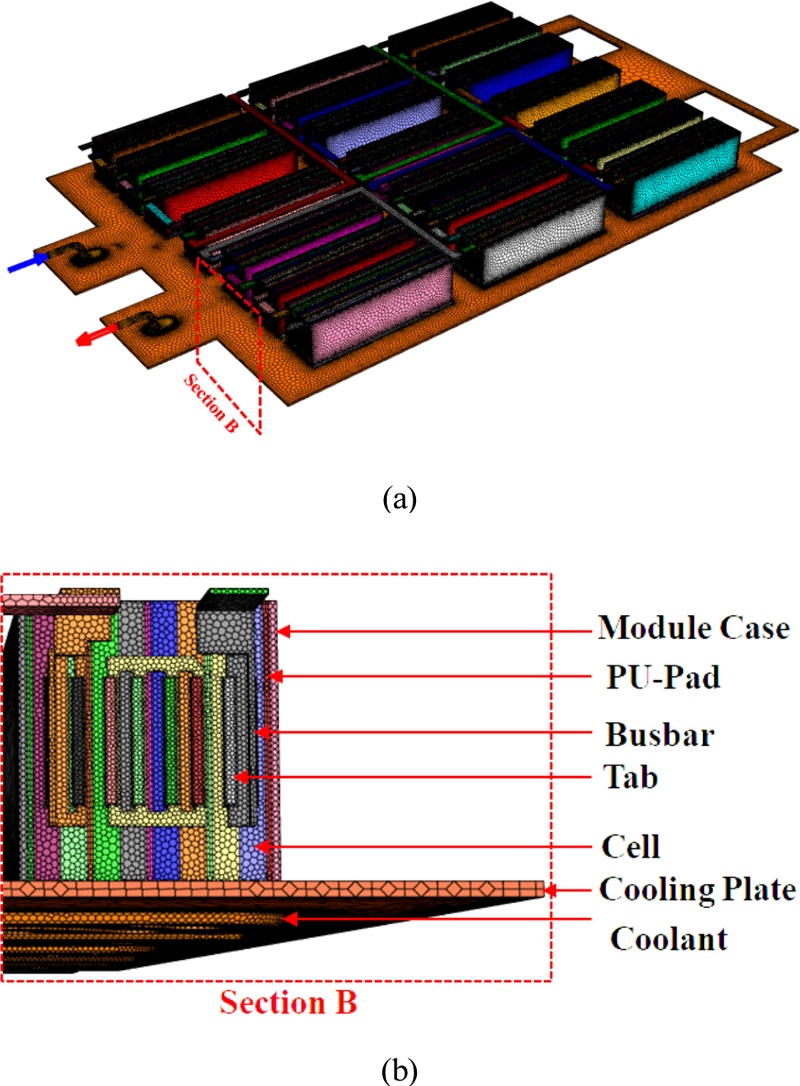
Mesh diagram in the internal space of the battery pack (a) ISO view (b) side view
배터리는 2P84S로 전기적 연결이 되었으며, 해석은 모두 동일한 조건에서 진행되었다. 발열 조건은 2C-rate, 냉각 조건은 냉각수 20LPM 공급으로 설정하였다. 일반적으로 준중형 전기자동차의 SOC 20 %에서 80 %까지 충전할 때의 평균 C-rate를 반영한 값이다.13) 배터리의 용량은 55.6 Ah이며, 발열량은 C-rate 즉 배터리의 정격 용량과 충⋅방전율을 기반으로 계산된다. 배터리 팩의 냉각수 출구(Coolant outlet) 압력 조건은 대기압으로 설정하였다. 또한 해석의 신뢰성을 높이기 위해 다상 유동(Multi-phase flow) 및 중력이 작용하는 조건을 적용하였다. 외부 공기와 접촉이 없는 냉각수 (Coolant)를 제외한 나머지 모든 고체(Solid) 영역의 경우 외부 공기에 노출되어 있어 자연 대류(Natural convection) 조건을 부여하였다. 배터리 팩의 자세한 해석 조건을 Table 2에 표기하였다.
Boundary conditions for CFD analysis
2.4 Battery Pack 냉각수 유동 지배 방정식
냉각수의 유동 해석에 사용된 지배 방정식은 연속 방정식(Continuity equation) (1)과 운동량 보존 방정식(Momentum conservation equation) (2)으로 구성된 Navier-Stokes 방정식, 냉각수의 온도 변화를 반영하기 위해 에너지 방정식(Energy equation) (3)을 이용하여 계산하였으며, 냉각수는 비압축성으로 가정하여 유동 해석을 진행하였다. 식 (1)은 질량 보존 법칙에서 유도된 연속 방정식이다.14)
| (1) |
해당 식에서, ρ는 유체의 밀도, 는 유속 벡터를 의미한다. 식 (2)는 냉각수의 속도, 압력, 점성의 영향을 설명하기 위해 Newton의 제 2법칙을 기반으로 한 비선형 편미분 방정식 Navier-Stokes 방정식을 사용하였다.
| (2) |
해당 방정식에서, P는 정압(Static pressure), v는 냉각수의 동점성계수(Kinematic viscosity), 는 중력 가속도를 의미한다. 식 (3)은 유체의 열전달 및 온도변화를 나타내는 에너지 방정식이다.15)
| (3) |
Cp는 비열, μΦ는 유체의 점성으로 인한 유체 내부의 마찰열의 소산을 의미한다.
2.5 리튬이온 배터리 팩의 발열 모델
본 연구에서 2P84S 배터리 팩의 발열 분석에는 ANSYS FLUENT의 다중 스케일 다중 도메인(MSMD) 모델이 사용되었다. 배터리 셀의 발열 모델은 배터리가 작동 중 과열이나 내부 단락이 발생하지 않는다고 가정하여, 정상 상태 해석 결과를 기반으로 진행하였다. 발열 모델에 적용된 방정식은 아래와 같다.
⋅ Multi-Scale Multi-Dimensional (MSMD) 모델:
| (4) |
| (5) |
| (6) |
식에서 σ+와 σ-는 각각 양극과 음극의 유효 전기 전도도, φ+와 φ-는 양극과 음극의 상 전위를 의미한다. jshort는 내부 단락을 나타내지만, 내부 단락이 없을 때는 0이 된다. 와 는 각각의 배터리 내부에서 생성되는 체적 전류 밀도와 전기화학 반응에 의한 발열 속도를 나타내며, 이러한 값들은 등가 회로 모델(ECM)을 기반으로 계산된다.
⋅ ECM(등가 회로) 모델:
| (7) |
| (8) |
3. 배터리 팩 열⋅유동해석 결과
3.1 Battery Pack 전체 온도 비교 결과
2C-rate, 20LPM 동일한 해석 조건에서 냉각 단면 위치와 개수에 따라 냉각 특성을 분석하고자 한다. Fig. 10은 One-sided cooling(Bottom coolant-cooled)모델, Fig. 11은 Double-sided coolant cooled모델, Fig. 12는 Double-sided top coolant cooled + bottom air cooled(0 km/h)모델, Fig. 13은 Double-sided top coolant cooled + bottom air cooled (25 km/h)모델의 전체 배터리 팩의 온도 분포를 보여준다. 버스바(Busbar) 부근에서 열이 많이 발생하는 것이 확인되었으며, 냉각 효과 비교 결과 가장 우수한 모델은 양면 냉각(수랭식+수랭식) 방식이다. 이는 상단과 하단을 모두 냉각수로 냉각하여 배터리 모듈의 상하단 온도를 고르게 유지했기 때문으로 보인다. 반면, 가장 냉각이 취약한 모델은 단면 냉각으로, 구조적인 한계로 인해 상단 냉각이 불가능하여 냉각 효율이 낮고 온도 편차가 다른 모델보다 큰 것으로 나타났다.
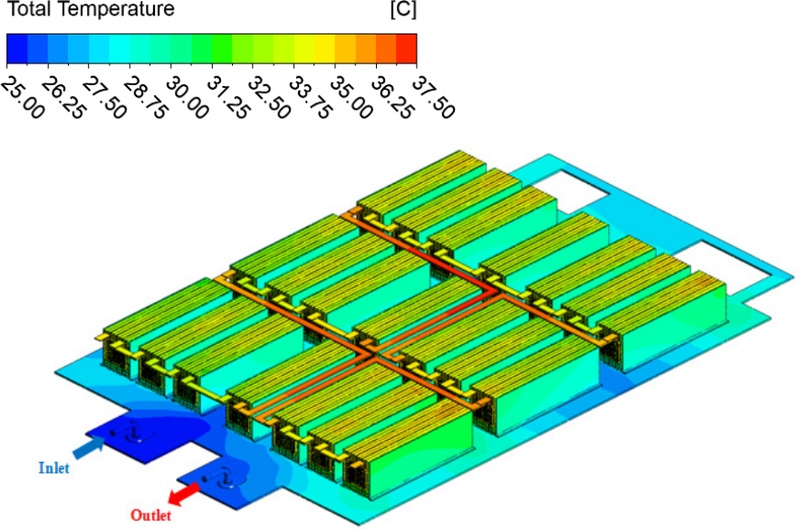
One-sided cooling (bottom coolant-cooled) all temperature (2C-rate, 20LPM, 0 km/h)
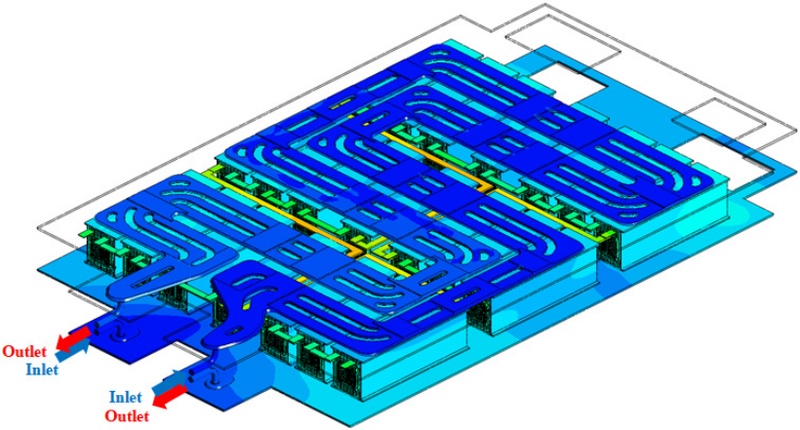
Double-sided coolant cooled all temperature (2C-rate, 20LPM, 0 km/h)
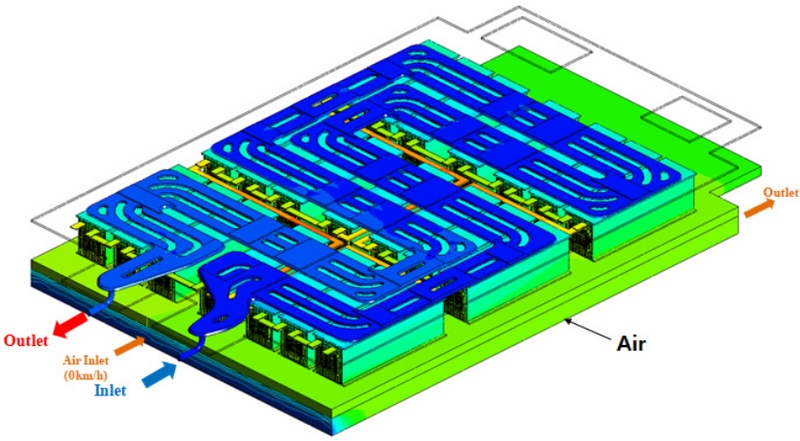
Double-sided top coolant cooled + bottom air cooled (0 km/h) all temperature (2C-rate, 20LPM, 0 km/h)
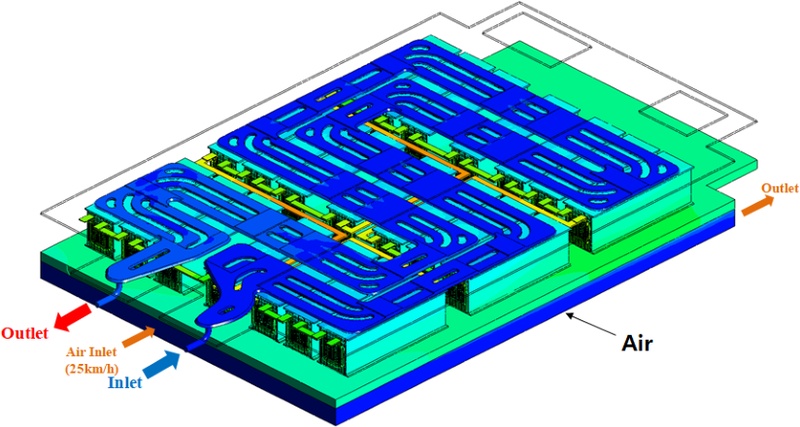
Double-sided top coolant cooled + bottom air cooled (25 km/h) all temperature (2C-rate, 20LPM, 25 km/h)
3.2 Battery Cell 전체 온도 비교 결과
Figs. 14 ~ 17은 배터리 셀 온도 분포를 자세히 분석하기 위해 비교한 결과이다. Fig. 14 출구 부근에서 배터리 모듈의 냉각이 취약하며, 상단이 전혀 냉각되지 않는 것을 확인할 수 있다. 반면 Fig. 15에서는 배터리 모듈이 상하부 모두 골고루 냉각되는 모습을 확인할 수 있다.
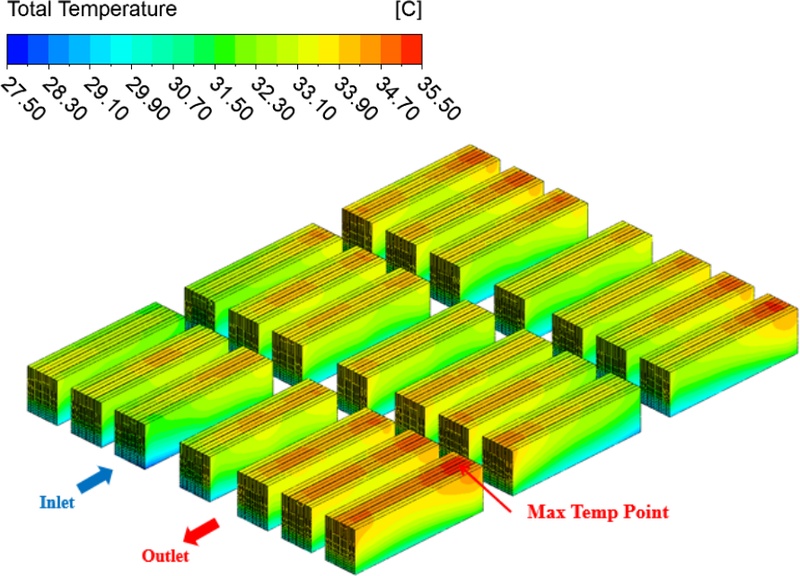
One-sided cooling (bottom coolant-cooled) cell temperature (2C-rate, 20LPM, 0 km/h), (Ave Temp. 32.33 oC, Max Temp. 35.39 oC, Min Temp. 27.93 oC)
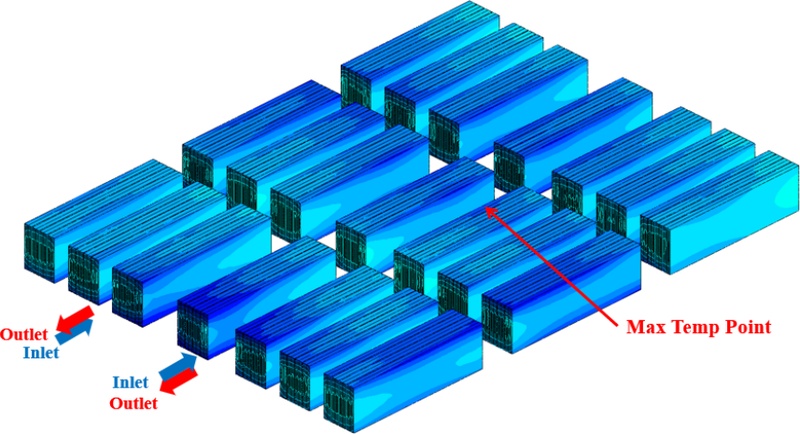
Double-sided coolant cooled cell temperature (2C-rate, 20LPM, 0 km/h), (Ave Temp. 29.16 oC, Max Temp. 30.47 oC, Min Temp. 27.05 oC)
Fig. 16과 Fig. 17을 비교해 보면, 차량 정차 시 자연대류를 통해 배터리 온도 편차를 줄이고 냉각되는 모습을 확인할 수 있다. 주행 중에는 주행풍으로 인해 냉각 성능이 더욱 향상되는 것을 확인할 수 있으며, 이러한 결과는 배터리 팩의 온도 분포 개선에 주행풍이 중요한 역할을 한다는 점을 보여준다.
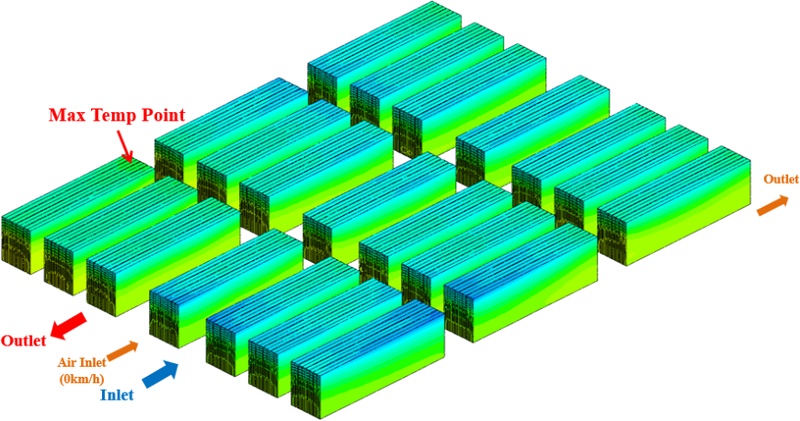
Double-sided top coolant cooled + bottom air cooled (0 km/h) cell temperature (2C-rate, 20LPM, 0 km/h), (Ave Temp. 31.96 oC, Max Temp. 33.58 oC, Min Temp. 28.23 oC)
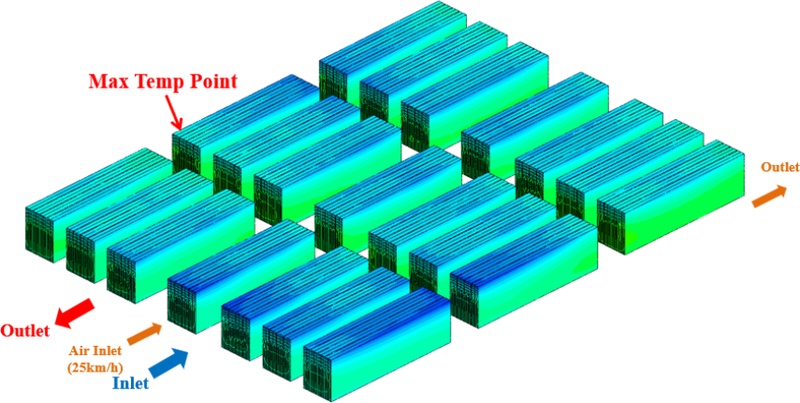
Double-sided top coolant cooled + bottom air cooled (25 km/h) cell temperature (2C-rate, 20LPM, 25 km/h), (Ave Temp. 30.84 oC, Max Temp. 32.02 oC, Min Temp. 27.67 oC)
3.3 Battery Pack 유선(Streamline)특성과 압력 비교
그림 Fig. 18(a)는 Coolant 유로 내 리브(Rib) 형상에 따라 유선의 흐름이 변화하는 모습을 보여준다. Fig. 18(b)는 압력이 가장 낮은 출구 부근에서도 유선의 흐름이 원활하도록 설계되었으며, 모퉁이 부분에 리브 형상을 적용하여 와류를 억제하고 유선이 모퉁이 끝까지 고르게 분포되는 것을 확인할 수 있다.
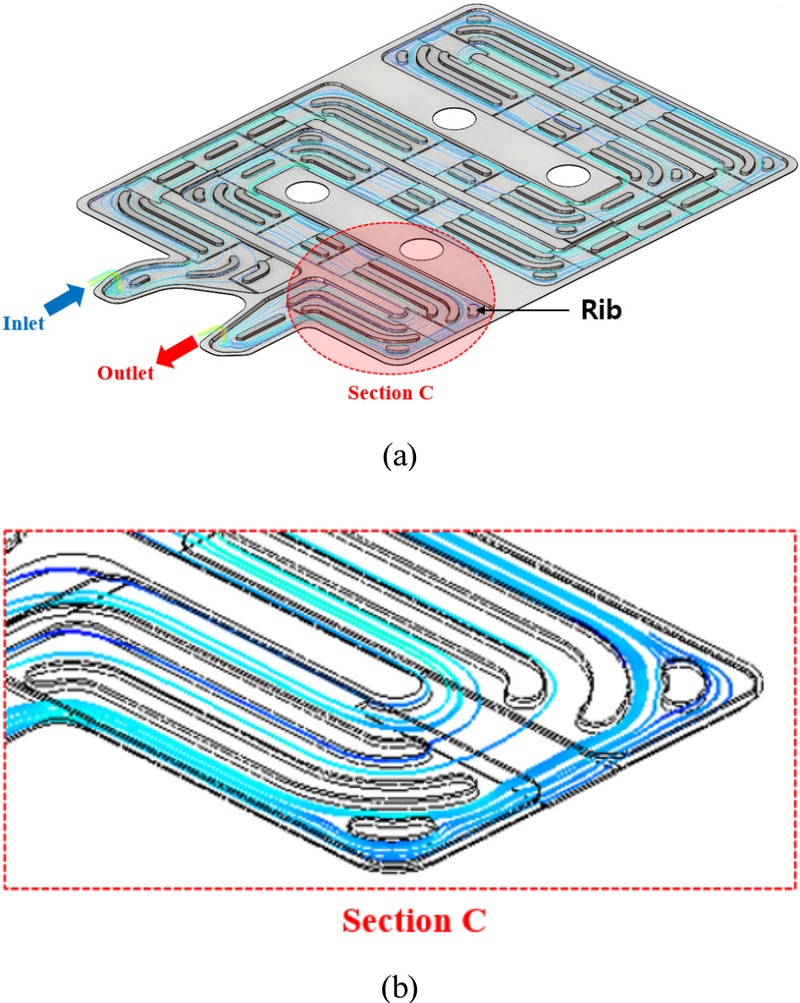
Streamline features (a) rib shape and (b) Streamline flow
One-sided cooling(Bottom coolant-cooled) (Fig. 19, Fig. 20)모델, Double-sided coolant cooled (Fig. 21, Fig. 22)모델, Double-sided top coolant cooled + bottom air cooled (0 km/h) (Fig. 23, Fig. 24)모델, Double-sided top coolant cooled + bottom air cooled (25 km/h) (Fig. 25, Fig. 26)모델의 유선(Streamline)과 압력 분포의 해석 결과를 비교한다. 이를 통해 냉각 유로를 따라 냉각수가 순환하며 배터리를 효과적으로 냉각하는 것을 확인할 수 있다. 또한, 냉각회로상 냉각수 압력 분포는 입구에서 높고 출구에서 낮은 형태를 나타내어, 냉각수가 유로를 따라 원활히 흐르고 있음을 확인할 수 있다.
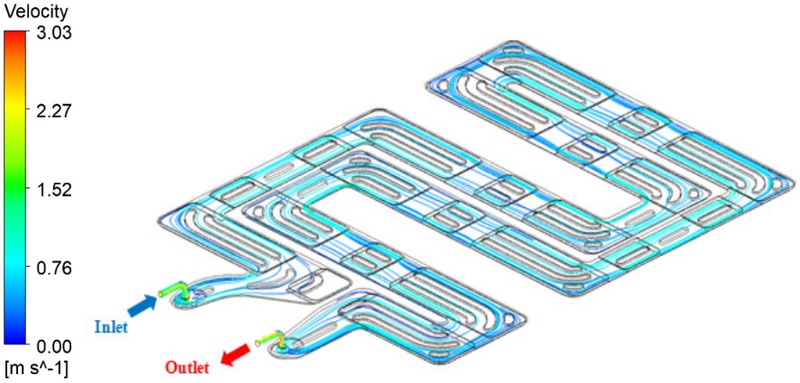
One-sided cooling (bottom coolant-cooled) coolant streamline
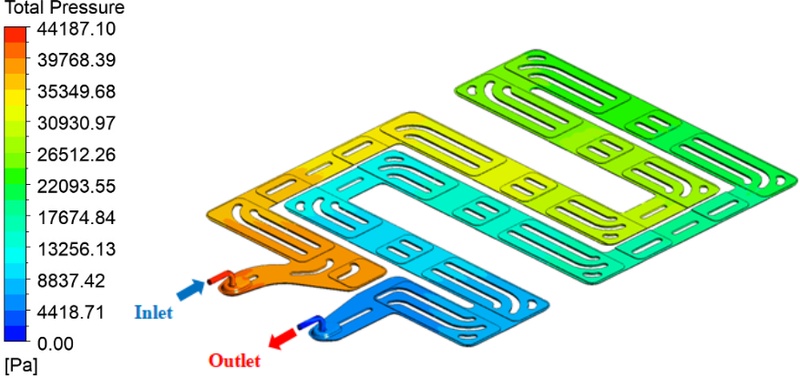
One-sided cooling (bottom coolant-cooled) pressure
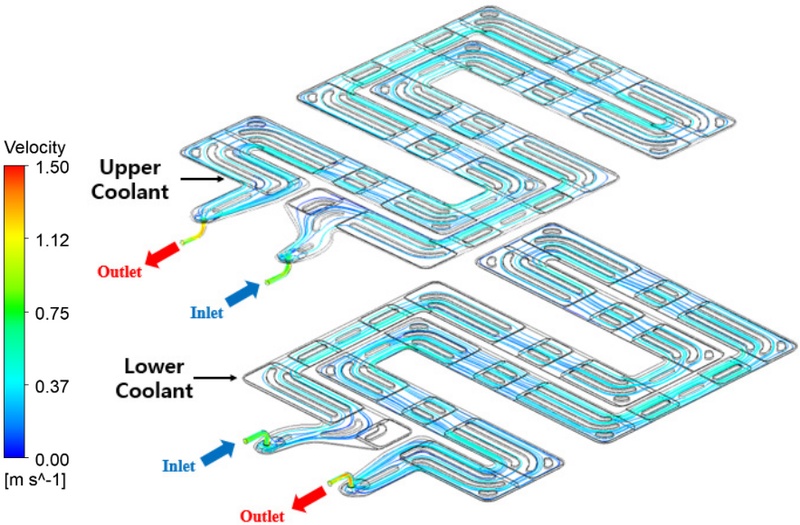
Double-sided coolant cooled streamline
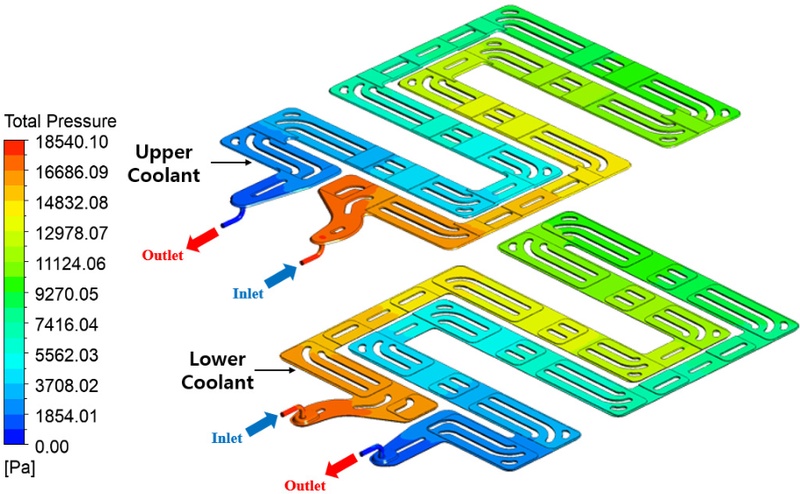
Double-sided coolant cooled pressure
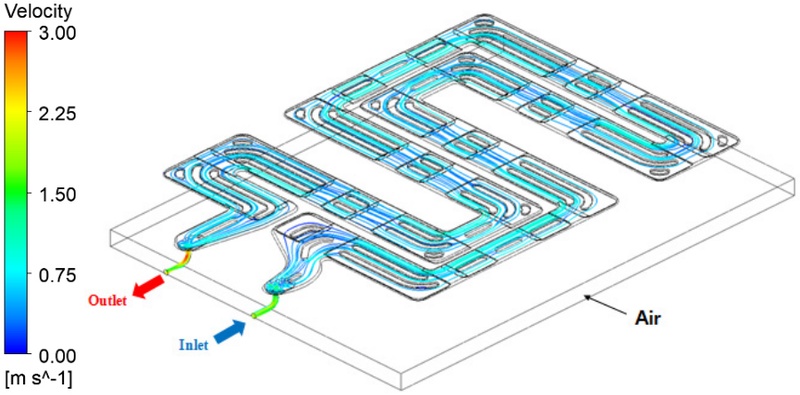
Double-sided top coolant cooled + bottom air cooled (0 km/h) coolant streamline
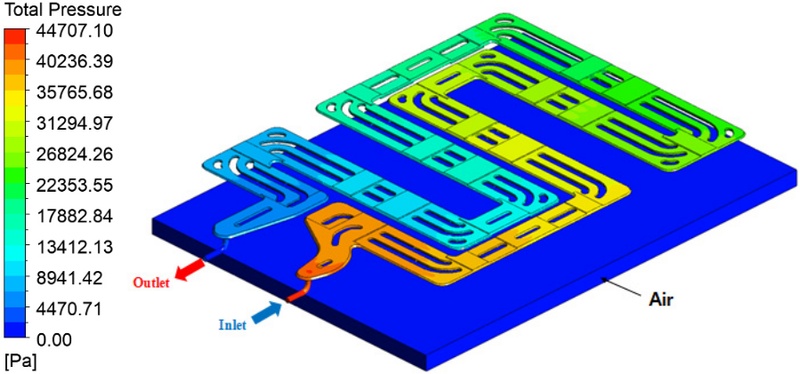
Double-sided top coolant cooled + bottom air cooled (0 km/h) pressure
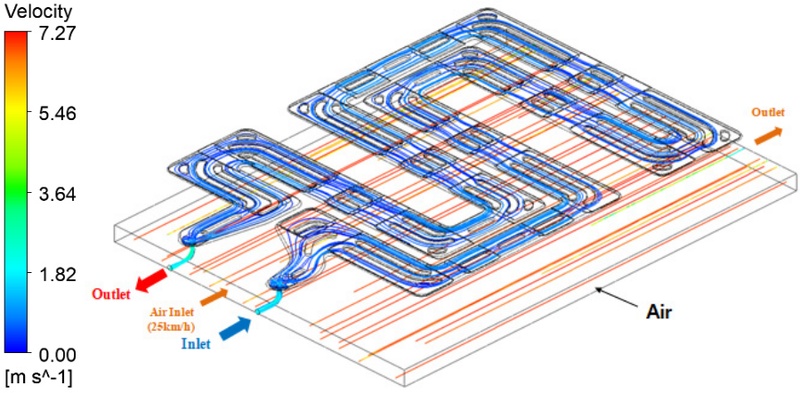
Double-sided top coolant cooled + bottom air cooled (25 km/h) coolant streamline
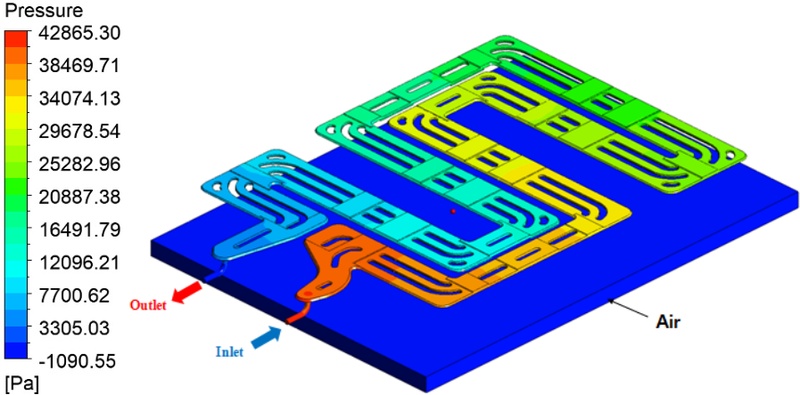
Double-sided top coolant cooled + bottom air cooled (25 km/h) pressure
Double-sided coolant cooled 모델에서는 냉각 유로를 상하 대칭으로 배치하고, 냉각수량을 다른 모델들과 동일하게 하기 위해 상단과 하단에 각각 10LPM씩 주입하였다. 냉각수 냉각회로 입구와 출구또한 상하 대칭으로 설계되었으며, 이를 통해 냉각이 취약했던 출구 부근의 모듈까지 효과적으로 냉각되는 것을 확인할 수 있었다.
3.4 Battery Pack 열 해석 결과 비교 그래프
Fig. 27은 2C-rate 발열 조건에서 20LPM 냉각수 유량 조건에서 리튬이온 배터리 팩의 4가지 냉각 방식에 따른 냉각 성능을 보여준다. 그래프는 각 케이스에 대해서 평균 온도(TAve), 최대온도(TMax), 최소 온도(TMin, 온도 편차(∆T = TMax - TMin)을 나타낸다.
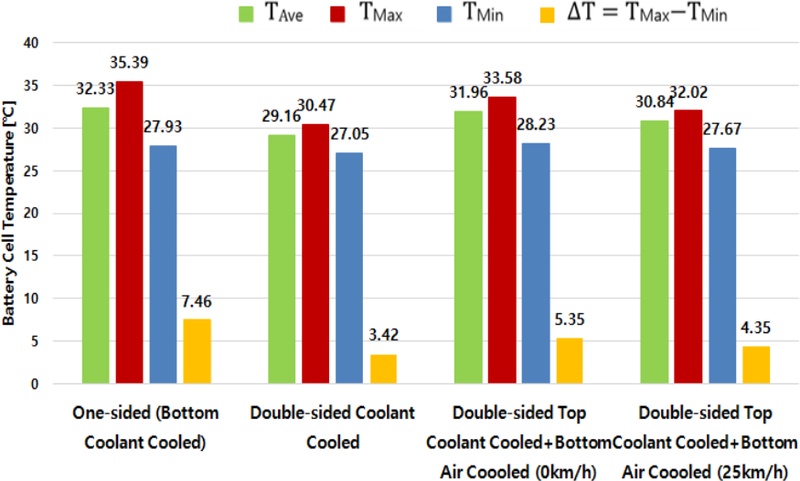
Average(AVE), Max, Min temperature and temperature difference (ΔT = TMax - TMin) of battery cells for all models
One-sided(Bottom coolant cooled) 모델의 경우 평균 온도 32.33 oC, 최대 온도 35.39 oC, 최소 온도 27.93 oC로 나타났으며, 온도 편차는 7.46 oC로 가장 높았다. 이는 단면 냉각의 냉각 구조의 한계로 인해, 냉각이 상단에서 이루어지지 않아 배터리 셀 온도 편차가 크게 나타난 것을 확인할 수 있었다.
Double-sided coolant cooled의 경우 평균 온도 29.16 oC, 최대 온도 30.47 oC, 최소 온도 27.05 oC로 나타났다. 온도 편차는 3.42 oC로 감소하여 온도 분포가 균일한 결과를 보였다. 상단과 하단을 모두 냉각수로 냉각하는 구조를 통해 배터리 모듈의 열을 효율적으로 냉각시키고, 온도 편차 또한 줄이는 데 효과적인 냉각 성능을 보였다.
Double-sided top coolant cooled + bottom air cooled (0 km/h)의 경우 평균 온도 31.36 oC, 최대 온도 33.58 oC, 최소 온도 28.23 oC로 나타났다. 온도 편차는 5.35 oC로 비교적 균일한 냉각 효과를 보였다. 하단의 공랭식이 정차 상태(0 km/h)에서도 자연 대류에 의한 냉각으로 단면 냉각보다 우수한 성능을 보였다.
Double-sided top coolant cooled + bottom air cooled (25 km/h) 모델의 경우 평균온도 30.84 oC, 최대온도 32.02 oC, 최소온도 27.67 oC로 나타났다. 온도편차는 4.35 oC로 하단의 공랭식이 주행 상태(25 km/h)에서 주행풍 효과를 받아 냉각 성능이 향상되었으며, 배터리 모듈의 온도 편차를 효과적으로 줄이는 데 기여한 것으로 나타났다.
Fig. 28은 각 케이스의 최대 온도를 나타낸 그래프로, 최대 온도가 발생한 모듈의 위치도 함께 표기하였다. Fig. 29(a), (b)는 배터리 팩 내부에서 최대 온도가 발생하는 모듈의 위치를 냉각 유로와 함께 표기하였다.
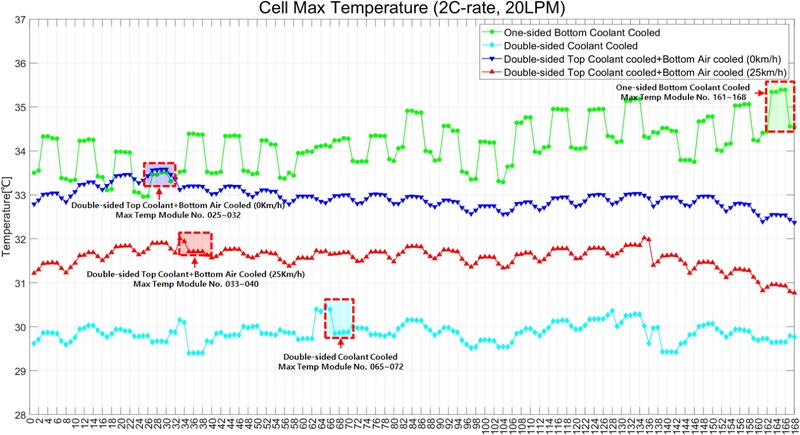
Each case Max temperature value graph
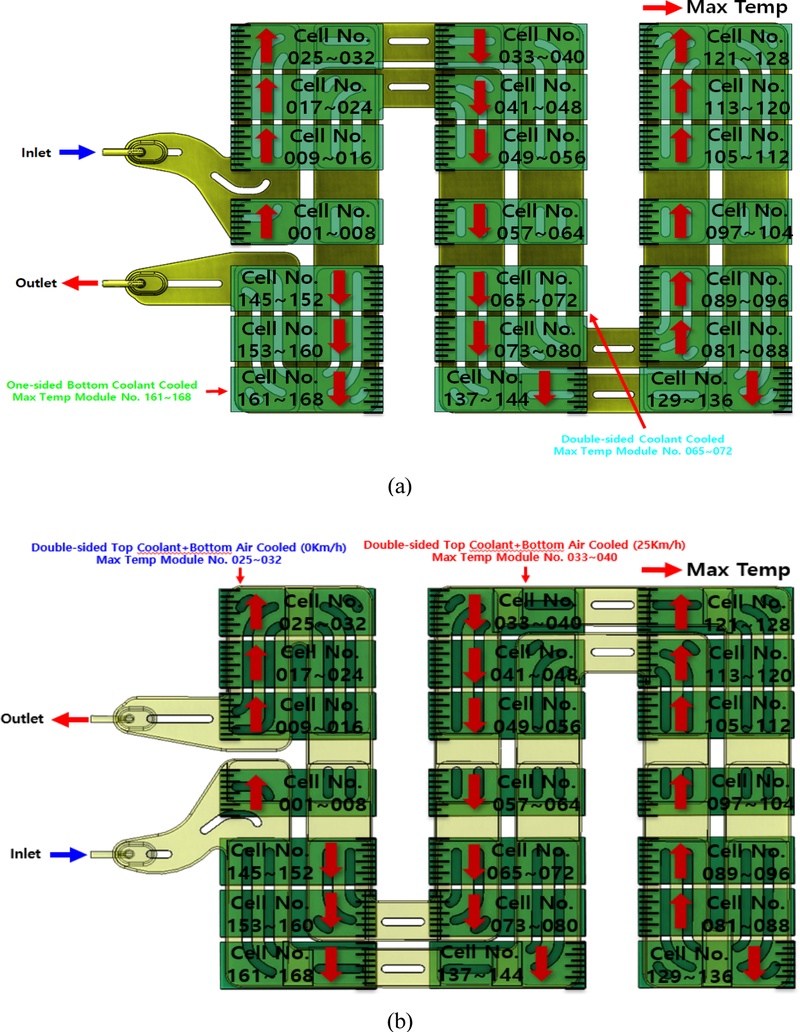
Battery cell number position (a) cooling channel location under the battery pack and (b) cooling channel location above the battery pack
4. 결 론
본 연구에서는 BEV 수랭식 배터리 팩의 냉각 성능을 비교하기 위해 4가지 케이스의 냉각 성능을 비교하였다. 2C-rate(발열조건)과 20LPM(냉각조건)조건이 배터리 냉각 성능에 미치는 영향을 분석하였으며, 본 연구의 주요 결론은 다음과 같다.
- 1) 배터리 팩의 발열 온도 분포 분석 결과, 냉각 취약 부분은 냉각수 출구 근처와 배터리 모듈 상단으로 확인되었다. 이는 단면 냉각 방식의 한계로, C-rate가 증가할수록 냉각 효과가 감소할 가능성이 높다. 향후 다양한 조건에서 추가 연구가 필요하다.
- 2) 따라서, 냉각 방식을 기존 단면 냉각에서 양면 냉각으로 변경하면, 냉각수 출구 부근과 배터리 모듈 상단의 냉각이 가능해져 냉각 성능이 향상되는 이점을 확인할 수 있었다.
- 3) 따라서, 양면 냉각 방식 중 (공랭식+수랭식)은 기존 단면 냉각에서 냉각수를 배터리 팩 상단으로 재배치하고, 하단은 차체 구조와 접촉하여 공기 대류를 활용한 자연 냉각 시스템으로 설계되었다. 열⋅유동 해석 결과, 이 방식은 단면 냉각에 비해 더 나은 냉각 성능을 보여주었다.
- 4) 결과적으로, 기존 단면 냉각 방식과 동일한 비용과 무게 조건에서 더 향상된 냉각 효과를 얻을 수 있었다. 차량의 속도가 증가하거나 대기 온도가 낮아질수록 냉각 성능이 더욱 개선될 것으로 보인다.
차량은 다양한 주행 환경에서 운행되므로, 향후 연구에서는 차량 속도와 온도 조건에 따른 냉각 성능을 분석하여 배터리 냉각 효과를 확인할 필요가 있다.
Nomenclature
| ρ : | density, kg/m3 |
| ν : | kinematic viscosity, m2/s |
| P : | static pressure, pa |
| v : | kinematic coefficient |
| g : | gravity, m/s2 |
| T : | temperature, oC |
| t : | time, s |
| Cp : | specific heat, J/kg⋅oC |
| k : | thermal conductivity, W/m⋅k |
| μ : | dynamic viscosity, kg/m⋅s |
| Φ : | dissipation function, W/m3 |
| L : | length |
| φ+ : | effective electric conductivity of positive electrode, S/m |
| φ- : | effective electric conductivity of negative electrode, S/m |
| : | heat transfer rate per unit volume by electrochemical reaction, W/m3 |
| J : | current density, A/m2 |
| jEch : | volumetric current transfer rate, A/m3 |
| jshort : | volumetric current transfer rate due, A/m3 |
| QNominal : | nominal capacity, Ah |
| Qref : | reference capacity, Ah |
| Vol : | volume, m3 |
| I : | electric current, A |
| U : | internal energy, J |
| V : | voltage, V |
| OCV : | open-circuit voltage, V |
| q : | heat transfer rate, W |
| i : | x-axis vector component |
| j : | y-axis vector component |
| x,y,z : | directional Cartesian coordinates |
Acknowledgments
본 연구는 한국산업기술진흥원(P00205362024 산업혁신 인재성장 지원사업), BK21 사업(5199990814084), 및 2024 자동차 기술개발 사업(그린카 20022377)의 지원을 받았다.
References
-
M. W. Park, W. B. Jang, S. H. Hong and D. M. Choi, “Characteristics of Thermal Runaway Generation of Pouch-Type Lithium-Ion Batteries by Overcharging,” Fire Science and Engineering, Vol.34, No.6, pp.8–13, 2020.
[https://doi.org/10.7731/kifse.bf002ba0]

-
M. A. Elmi and P. Zhao, “Review of Thermal Management Strategies for Cylindrical Lithium-Ion Battery Packs,” Batteries, Vol.10, No.2, Paper No.50, 2024.
[https://doi.org/10.3390/batteries10020050]
-
L. D. Tai, K. S. Garud, S. G. Hwang and M. Y. Lee, “A Review on Advanced Battery Thermal Management Systems for Fast Charging in Electric Vehicles,” Batteries, Vol.10, No.10, Paper No.372, 2024.
[https://doi.org/10.3390/batteries10100372]
-
A. Rahmani, M. Dibaj and M. Akrami, “Recent Advancements in Battery Thermal Management Systems for Enhanced Performance of Li-Ion Batteries: A Comprehensive Review,” Batteries, Vol.10, No.8, Paper No.265, 2024.
[https://doi.org/10.3390/batteries10080265]
-
Z. Zhang, Z. Zhu, Z. Yang and L. Sheng, “Numerical-Experimental Method to Devise a Liquid-Cooling Test System for Lithium-Ion Battery Packs,” Journal of Energy Storage, Vol.63, Paper No.107096, 2023.
[https://doi.org/10.1016/j.est.2023.107096]
-
Z. Lu, X. Yu, L. Wei, Y. Qiu, L. Zhang, X. Meng and L. Jin, “Parametric Study of Forced Air Cooling Strategy for Lithium-Ion Battery Pack with Staggered Arrangement,” Applied Thermal Engineering, Vol.136, No.25, pp.28–40, 2018.
[https://doi.org/10.1016/j.applthermaleng.2018.02.080]
-
M. Akbarzadeh, T. Kalogiannis, J. Jaguemont, L. Jin, H. Behi, D. Karimi, H. Beheshti, J. V. Mierlo and M. Berecibar, “A Comparative Study Between Air Cooling and Liquid Cooling Thermal Management Systems for a High-Energy Lithium-Ion Battery Module,” Applied Thermal Engineering, Vol.198, No.5, Paper No.117503, 2021.
[https://doi.org/10.1016/j.applthermaleng.2021.117503]
- T. Han, B. Khalighi, E. C. Yen and S. Kaushik, “Li-Ion Battery Pack Thermal Management: Liquid Versus Air Cooling,” ASME Journal of Thermal Science and Engineering Applications, Vol.11, No.2, Paper No.021009, 2019.
- T. Stuart, F. Fang, X. Wang, C. Ashtiani and A. Pesaran, “A Modular Battery Management System for HEVs,” SAE Transactions, Vol.111, pp.777–785, 2002.
-
Y. Xing, E. W. M. Ma, K. L. Tsui and M. Pecht, “Battery Management Systems in Electric and Hybrid Vehicles,” Energies, Vol.4, No.11, pp.1840–1857, 2011.
[https://doi.org/10.3390/en4111840]
- S. Arora, “Selection of Thermal Management System for Modular Battery Packs of Electric Vehicles: A Review of Existing and Emerging Technologies,” Journal of Power Sources, Vol.400, No.1, pp.621–640, 2018.
- J. Koo, H. K. Kim and S. Jang, “Study of Cooling Performance of Liquid-Cooled EV Battery Module According to the TIM Compression Ratio,” Int. J. Automotive Technology, Vol.26, No.2, pp.359–373, 2024.
- M. Kane, “Hyundai Ioniq5 Amazes: Real Fast Charging Session Data Analyzed,” http://insideevs.com/news/503522/hyundai-ioniq5-fast-charging-analysis/, , 2021.
- D. F. Young, B. R. Munson, T. H. Okiishi and W. W. Huebsch, Introduction to Fluid Mechanics, 5th ed.
- G. Ji, M. Zhang, Y. Lu and J. Dong, “The Basic Theory of CFD Governing Equations and the Numerical Solution Methods for Reactive Flows,” IntechOpen, 2023.
- ANSYS Inc., “Contains Proprietary and Confidential Information,” https://ansyshelp.ansys.com/account/secured?returnurl=/Views/Secured/corp/v242/en/flu_th/flu_bat_MSMD_sec_theory_ECM_model.html, , 2024.