
Enhancing Automotive Child Presence Detection Using PCA-Based Spatial Descriptors on FMCW Radar Point Clouds
Copyright Ⓒ 2026 KSAE / 249-04
This is an Open-Access article distributed under the terms of the Creative Commons Attribution Non-Commercial License(http://creativecommons.org/licenses/by-nc/3.0) which permits unrestricted non-commercial use, distribution, and reproduction in any medium provided the original work is properly cited.
Abstract
Child Presence Detection (CPD) systems are increasingly critical for preventing fatal heatstroke incidents involving unattended infants in vehicles, driven by stringent safety regulations such as Euro NCAP. While millimeter-wave FMCW radar is a promising sensing modality, conventional respiration-based or micro-Doppler methods degrade significantly when infants exhibit irregular motion and are prone to false positives caused by vibrating inanimate objects. To overcome these limitations without exceeding the strict real-time and power constraints of edge processors, we propose a geometry-centered classification framework that augments existing CPD pipelines using Principal Component Analysis (PCA) of 3D radar point clouds. By computing the eigenvalues of the spatial distribution of detected points, the proposed method efficiently captures the instantaneous 3D geometry of occupants. Experimental validation in a controlled mid-size SUV cabin using a 60 GHz FMCW radar demonstrates that the temporal variance of the second principal component accurately discriminates awake infants from confounding objects (e.g., sloshing water bottles), while baseline periodicity analysis remains highly effective for deep-sleep scenarios. The proposed PCA-based descriptor requires negligible computational overhead, consuming approximately 1.3 kB of memory and executing in 6 μs per frame on an embedded ARM core. This hybrid approach offers a robust, low-cost enhancement to current CPD systems across diverse occupant behavioral states.
Keywords:
Child Presence Detection(CPD), FMCW radar point cloud, Principal Component Analysis(PCA), In-cabin monitoring, Real-time edge processing1. Introduction
Over the past decade, car technology has advanced rapidly from driver assistance systems (ADAS) to early versions of self-driving cars greatly improving passenger safety while driving. As a result, public and regulatory attention has expanded to focus more on in-cabin safety when the car is not moving. One of the most urgent issues is preventing accidents involving children left alone in parked cars. Heatstroke and other related dangers still claim dozens of young lives every year, sometimes even in mild weather, and can become life-threatening within minutes after the engine is turned off. These risks have led safety organizations, including Euro NCAP, to require Child Presence Detection (CPD) systems in new passenger vehicles.1)
Millimeter-wave frequency-modulated continuous-wave (FMCW) radar has been widely studied for vehicle-driving signal processing,2) yet it is also a promising technology for CPD because it protects privacy, operates through blankets or clothing, and remains reliable under different lighting conditions or when objects are partially hidden.3) However, the limited space inside a car creates technical and hardware challenges that many existing radar-based human detection methods cannot fully overcome.
State‑of‑the‑art radar classifiers typically exploit micro‑Doppler signatures or activity patterns arising from regular body motion.4) Such motion‑centric features work well when the target is moving but degrade sharply for stationary or minimally moving subjects.5) Another common approach retrieves periodic physiological signals most often respiration to detect a still infant.6) This works during stable deep sleep breathing but fails when the child is awake and moving irregularly, as the non‑periodic motion obscures the weak periodic component. A practical CPD system must therefore handle both extremes deep sleep and active movement without sacrificing reliability in either case.
A further challenge is the presence of small, highly reflective inanimate objects (e.g., water bottles) whose point‑cloud signatures can resemble those of a small human body. Such objects can trigger false positives in motion‑based detectors, especially when infant respiration signals are weak or occluded. At the same time, any CPD algorithm must run on low‑power edge processors under strict real‑time constraints. Large convolutional neural networks with millions of parameters typically exceed these budgets and are difficult to certify for safety‑critical applications.7,8)
To address these shortcomings, we propose a geometry‑centered classification framework that augments conventional periodicity‑based CPD pipelines. Instead of relying solely on motion periodicity or Doppler features, our method encodes the instantaneous spatial structure of the radar point cloud using principal component analysis (PCA)9,10) eigenvalues, which quantify the three‑dimensional spread and shape of the detected cluster. This geometric representation enables reliable discrimination between living occupants and inanimate objects, even when motion cues are weak, non‑periodic motion, or partially occluded targets. The PCA descriptor is computationally lightweight, requiring only centroid estimation, covariance matrix computation, and eigenvalue decomposition per frame. These operations can be executed in real time on low‑power embedded processors such as the ARM Cortex‑R5F, permitting a complete radar front‑end including range–angle FFT, constant‑false‑alarm‑rate (CFAR) detection, and PCA computation to operate within 200 ms on the AWRL6843.11) The proposed framework is designed as a complementary module that preserves the strengths of baseline respiration‑based CPD in deep sleep scenarios while enhancing detection robustness in irregular‑motion conditions and reducing false positives from reflective static objects.
The remainder of this paper is structured as follows. Section 2 presents the radar system architecture and end‑to‑end signal processing pipeline, with emphasis on integrating PCA‑based spatial descriptors into an existing CPD framework. Section 3 describes the experimental setup, simulated infant behavioral states, and confounding object scenarios, followed by quantitative analysis of PCA variance patterns and computational feasibility. Section 4 concludes with the main contributions and outlines directions for future work, including expanded validation and multi‑feature fusion strategies.
2. Methodology
In this section, we describe details the sensing hardware configuration, overall signal‑to‑decision processing flow, and the rationale behind adopting a PCA‑based spatial descriptor within the CPD pipeline. We begin by describing the radar system design and parameter selection tailored for the in‑cabin infant‑detection scenario, followed by an overview of the end‑to‑end processing stages. Particular emphasis is placed on the shortcomings of conventional CPD approaches under irregular motion, motivating the integration of PCA‑derived geometric features into the high‑level classification logic. Fig. 1 shows the overall radar pre‑processing and CPD pipeline.
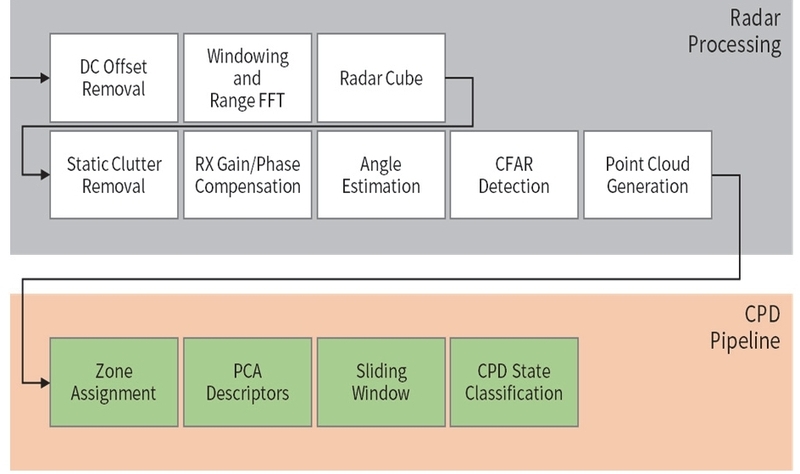
Overall radar signal processing and CPD pipeline
2.1 Radar System
The sensing platform is built on the Texas Instruments AWRL6843 FMCW radar chipset, operating in the 60 GHz band with a 3TX–4RX MIMO antenna configuration. This arrangement was chosen to balance three critical requirements: high spatial resolution in the confined interior of a vehicle, sensitivity to extremely low‑velocity motion, and the ability to localize reflections in three dimensions. A range resolution of 0.052 m enables the separation of closely spaced scatterers such as limbs from nearby objects, while a velocity resolution of 0.017 m/s captures micro‑motions including infant respiration. The virtual aperture created through MIMO provides sufficient azimuth and elevation resolution to distinguish between different body parts and between occupants and adjacent clutter. Bandwidth and chirp parameters were selected to achieve the required resolution without exceeding the power budget, and the frame periodicity of 200 ms was set to capture both periodic respiratory motion and irregular movements effectively. The full system configuration is summarized in Table 1. This hardware setup provides the measurement precision necessary for fine-grained point-cloud analysis while ensuring that real-time constraints are met on the AWRL6843 embedded processing cores.

Radar system configuration parameters
2.2 Overview of Processing Flow
The proposed CPD processing pipeline begins with the acquisition of raw ADC samples as the radar transmits frequency-modulated chirps. In the pre-processing stage, DC offset removal, range FFT, MIMO demodulation, and static clutter suppression are applied to produce a clean multi-antenna range spectrum. Angle-of-arrival estimation and CFAR-based peak detection then generate a 3D point cloud, with each point carrying its spatial coordinates, SNR, and Doppler velocity. All higher-level occupant classification is performed on this point-cloud representation.
Conventional CPD approaches rely heavily on periodicity analysis of respiratory signals or micro-Doppler features. While effective when the infant is in deep sleep with stable breathing, these methods degrade sharply when the subject is awake or moving irregularly, as the respiration signal becomes unstable or is masked by other motion. Fig. 1 illustrates this limitation: deep sleep produces a clean periodic SNR pattern, whereas irregular motion during awake states disrupts periodicity, making reliable detection difficult. Furthermore, reflective inanimate objects such as water bottles can produce point-cloud densities and motion magnitudes similar to those of an infant, resulting in false positives.
PCA is applied to each frame’s 3D distribution of points to obtain eigenvalues that describe the object’s spread and orientation in space. These descriptors allow discrimination between living occupants and rigid inanimate objects, even when their motion magnitudes are comparable, while preserving the accuracy of respiration-based detection in deep sleep scenarios. Fig. 2 demonstrates the discriminative value of this approach: despite similar motion, the spatial structure revealed by PCA differs markedly between an awake infant and a hand-shaken water bottle, enabling reliable classification. The combination of periodicity analysis and PCA-based spatial descriptors thus offers robust performance across a wide range of behavioral states without exceeding real-time processing budgets.
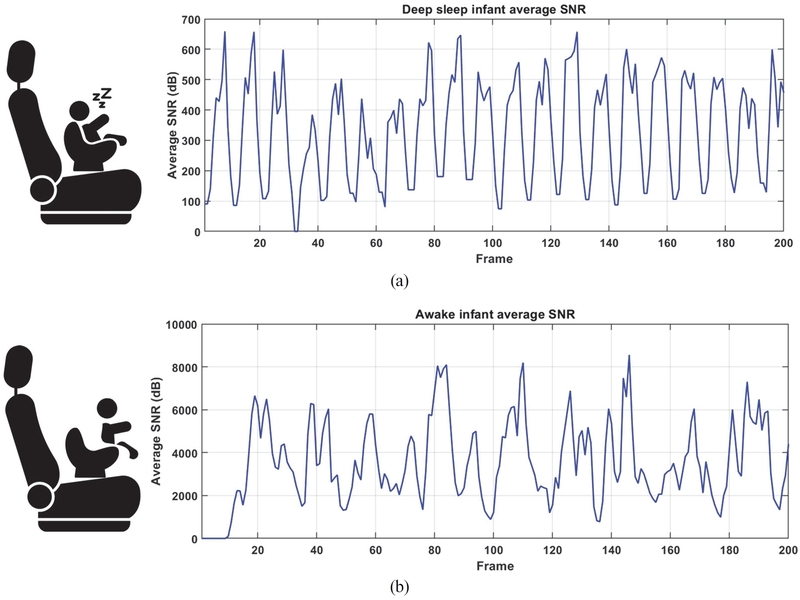
Comparison of average SNR patterns extracted from radar signals of an infant
2.3 CPD Pipeline
Once the front-end pipeline has produced a three-dimensional point cloud, the CPD system must decide whether a given seat or region of the cabin contains an occupant. This high-level processing step partitions the point cloud into pre-defined three-dimensional cuboids (zones) and analyses the temporal variability of the point clusters. The logic described below follows the cuboid-based state machine suggested in the CPD documentation and augments it with a PCA to distinguish between static and dynamic occupants.
Let the point cloud detected in frame i be: Pi = {pi,j = (xi,j, yi,j, zi,j) ∈ ℝ3; j = 1, …, Ni} where each point encodes the estimated Cartesian position derived from the range–azimuth–elevation measurement. The cabin is partitioned into K disjoint cuboid regions: = [xmin,k, xmax,k] × [ymin,k, ymax,k] × [zmin,k, zmax,k]. A point pi,j is assigned to zone k if it lies within the boundaries of Zk; points that are not associated with any zone are discarded. For each zone and frame, we collect the set of assigned points: Pi,k = {pi,j ∈ Pi : pi,j ∈ Zk} and their corresponding signal-to-noise ratios si,j . The cardinality |Pi,k| and average SNR: are the primary inputs to the subsequent state machine.
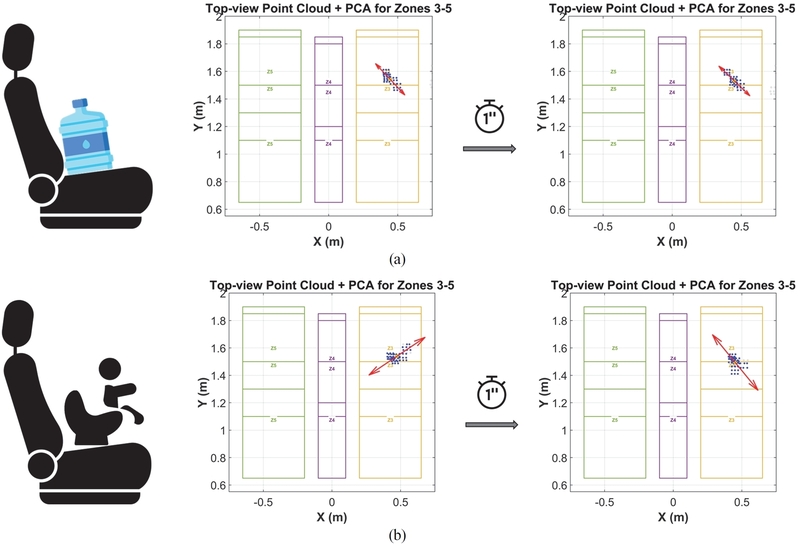
Principal Component Analysis (PCA) applied to radar point clouds for each frame for target shape analysis
The CPD documentation recommends a two-stage thresholding procedure. To enter the occupied state, zone k must exceed a minimum point count Tpts,1 if this criterion is met, the average SNR is compared against a threshold TSNR,1. Remaining in the occupied state uses possibly different thresholds Tpts,2 and TSNR,2 to incorporate hysteresis. When a certain points and SNR value are exceeded, the state for the occupied state is counted, and if this count exceeds a threshold, the zone is considered occupied. Fig. 4 shows how to divide the area for the actual seat into cuboids and distinguish the incoming points within the area as detected objects.
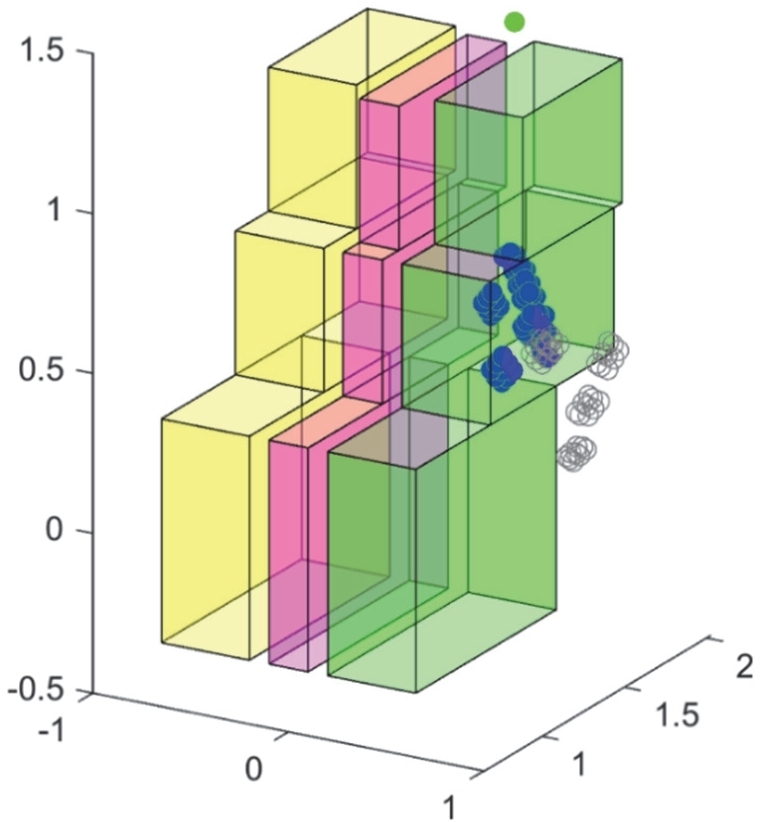
Zone mapping for in-cabin occupant detection. The seat area is partitioned into predefined three-dimensional cuboids (zones). Points outside the zones (gray) are excluded, and only points inside the zones (blue) are used
Traditional CPD pipelines often rely on point count and average SNR as indicators of occupancy. While these metrics are effective for detecting large, highly reflective occupants such as adults, they are less reliable for children or infants whose movements are small in both amplitude and spatial extent. In such cases, the generated point clouds are sparse and exhibit limited motion cues, making it difficult to distinguish a child from background clutter or inanimate objects.
This limitation is particularly problematic in CPD contexts, where the system must detect not only the presence of a small body, but also infer its dynamic state awake, asleep, or absent under diverse conditions. Large objects with broad spatial profiles naturally generate many radar reflections, thereby exceeding the point-count thresholds easily. In contrast, small and irregular motions from a sleeping or quietly awake infant may yield only a handful of points, often insufficient to surpass the static detection thresholds. Moreover, certain reflective inanimate objects, such as water bottles or metallic containers, may falsely trigger detection by producing dense point clouds with high SNR, despite being non-living.
To overcome these challenges, we incorporate a geometric analysis of the spatial structure of the detected points within each zone. Specifically, we apply three-dimensional Principal Component Analysis (PCA) to characterize the shape and dispersion of the point cloud. For zone k in frame i, the points Pi,k are centred by their centroid:
| (1) |
The sample covariance matrix is then computed as:
| (2) |
Let ≥ ≥ ≥ 0 denote the eigenvalues of Ci,k. These eigenvalues summarise the shape of the point cluster: a static occupant seated in a seat typically produces an elongated cluster with a dominant first eigenvalue and two small eigenvalues, whereas irregular motion or the presence of multiple scatterers increases . Physically, the second eigenvalue represents the spatial spread of the radar point cloud along the direction orthogonal to the dominant principal axis. When the target motion is mostly confined to a single direction, such as regular breathing or damped unidirectional oscillation of a water bottle, the point distribution remains elongated mainly along one axis, so stays small. In contrast, irregular infant motion involves asynchronous movement of multiple body parts, which broadens the point cloud not only along the dominant axis but also in an orthogonal direction. As a result, and its temporal variance become more sensitive indicators of irregular multi-directional motion. In the CPD context, this geometric encoding is particularly advantageous because it enables discrimination between living occupants and reflective inanimate objects without relying solely on motion periodicity. Moreover, the PCA computation comprising centroid estimation, covariance calculation, and eigen-decomposition is lightweight enough to run in real time on low-power embedded processors, making it suitable as a complementary module alongside conventional respiration-based detection pipelines.
Fig. 5 illustrates PCA eigenvalue characteristics. Blue dots indicate detected 3D scatter points visualized in 2D projection plane, while the shaded ellipses represent the spatial extent defined by the principal components. Red and green arrows depict the first and second principal eigenvectors, respectively, with lengths proportional to the square roots of their corresponding eigenvalues. Between frames, the second eigenvector undergoes a notable change in orientation and magnitude, reflecting irregular, multi-directional motion.
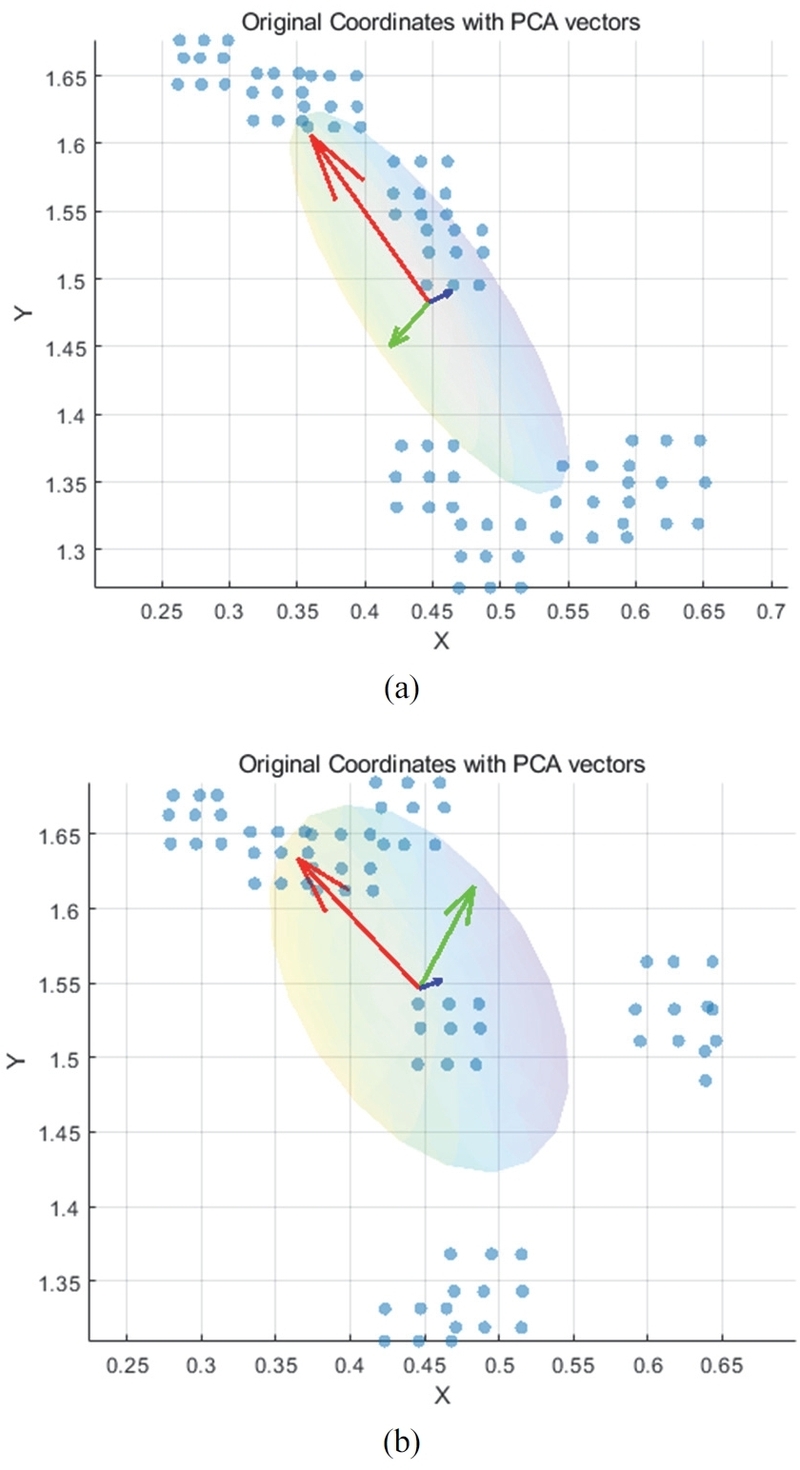
Comparison of PCA results for two consecutive frames of an awake infant’s radar point cloud
In this work, PCA is not intended to fully represent the kinematics of highly complex nonlinear body motion. Rather, it is used as a lightweight geometric descriptor that captures changes in the spatial dispersion of the radar point cloud. This makes it suitable as a complementary module to respiration-based periodicity analysis, particularly when irregular motion weakens or obscures the periodic breathing pattern.
To detect breathing or sporadic movement, the PCA descriptors are tracked across frames using a sliding window of length N. For zone k at frame i, the variance of each eigenvalue over the window i - N + 1, ..., i is computed as:
| (3) |
where d ∈ {1,2,3} indexes the eigenvalues. When a zone contains a stationary occupant, the largest eigenvalue remains approximately constant and the variances (i), (i), (i) are small. Breathing causes low-amplitude oscillations in λ(1), while irregular or limb movements induce larger fluctuations in λ(2).
The variance of the second components is used within a multi-stage CPD state machine to refine occupant classification. First, coarse occupancy is determined from the mean SNR and point count in each zone. If the zone is classified as Occupied and corresponds to the seat-center cuboid without head-region points, the occupant is provisionally labeled as an Infant Candidate. For Infant Candidates, two analyses are performed:
Respiration-based periodicity analysis: If the SNR time series exhibits stable oscillations within the respiration frequency band, the occupant is classified as a Regular Breathing Infant (Deep Sleep).
PCA variance analysis: If the periodicity criterion is not met, the temporal variance of λ(2) is evaluated over a sliding window. High variance primarily in the second eigenvalue component indicates multi-directional irregular motion consistent with an Awake Infant, whereas low variance across all components suggests a Non-living Object (e.g., reflective water bottle).
Additionally, detection of sufficient points in the head cuboid triggers classification as Adult, bypassing PCA analysis.
3. Experimental Setup and Results
In this section, we present the experimental design, implementation, and evaluation of the proposed infant detection framework, with a focus on validating its performance under realistic in-cabin conditions. The experiments were carried out in a controlled yet representative environment to replicate real-world deployment scenarios, including various infant behavioral states and confounding inanimate objects. By combining quantitative feature analysis with hardware-level cost assessment and state-machine integration, this section demonstrates both the discriminative capability and practical feasibility of the proposed PCA-based spatial descriptor as a complementary module to conventional periodicity-based CPD systems.
3.1 Experimental Environment
To evaluate the proposed infant detection framework under realistic conditions, we constructed a controlled testbed replicating the interior of a standard mid-size SUV. The sensing module is built around the Texas Instruments AWRL6843 FMCW radar chipset, integrated into a USRR-10C module operating at 60 GHz, equipped with a 3TX–4RX antenna configuration. The radar was mounted vertically downward from the center of the sunroof to provide optimal coverage of the second-row passenger seat. Fig. 6 illustrates the sensor mounting configuration designed for robust coverage of the target zone.
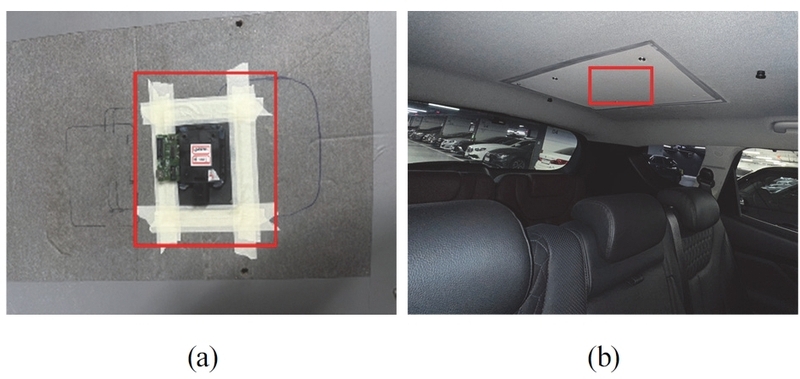
Experimental sensor mounting configuration: (a) USRR-10C, (b) equipped in sunroof
To replicate realistic deployment conditions, all experiments were conducted with the vehicle stationary and the engine switched off. Measurements were performed in an underground parking lot to ensure high signal clarity and consistent environmental conditions across trials. The experimental subjects were as follows. The 4 A infant dummy is designed to mimic the body structure and respiratory patterns of a child. Two behavioral states were simulated: Deep Sleep, characterized by minimal body motion and stable periodic breathing and Awake, involving irregular and spontaneous motion to simulate active behavior. In addition, a 20-liter plastic water bottle was used as a highly reflective inanimate object capable of confusing motion-based detectors. All recordings focused on Zone 3 (left-hand second-row seat). For each scenario, 120 radar frames were captured, and to ensure reproducibility, each scenario was repeated two times under identical configurations. Fig. 7 shows the 20-L water bottle and the simulable 4 A infant dummy used in the real scenario.
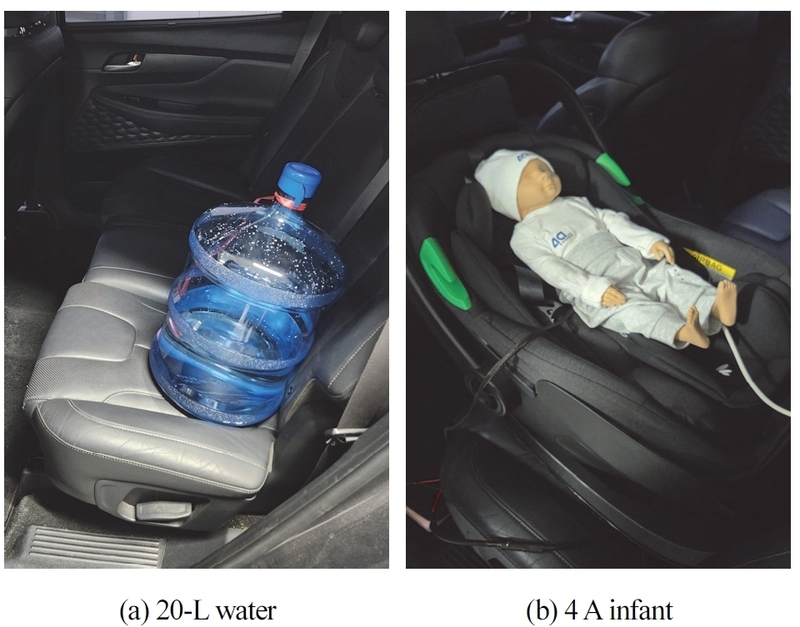
Experimental subjects used for CPD evaluation: (a) water (20 L), (b) 4 A infant
3.2 Experimental Methodology
To evaluate the proposed PCA-based spatial descriptor, radar point clouds were collected for three representative scenarios: an awake infant, a deeply sleeping infant, and a 20-liter water bottle undergoing simple oscillatory motion.
The analysis included frame-wise PCA eigenvalue trajectories, sliding-window variance analysis for temporal stability, and quantitative comparison of variance values across scenarios.
The analysis shows that mean SNR time series are effective for detecting deep sleep states but insufficient for separating awake infants from vibrating inanimate objects. Fig. 8 presents both the frame-by-frame mean SNR signals (left column) and the corresponding PCA eigenvalue trajectories (right column) for three scenarios: awake infant (top row), deeply sleeping infant (middle row), and a 20-liter water bottle (bottom row).
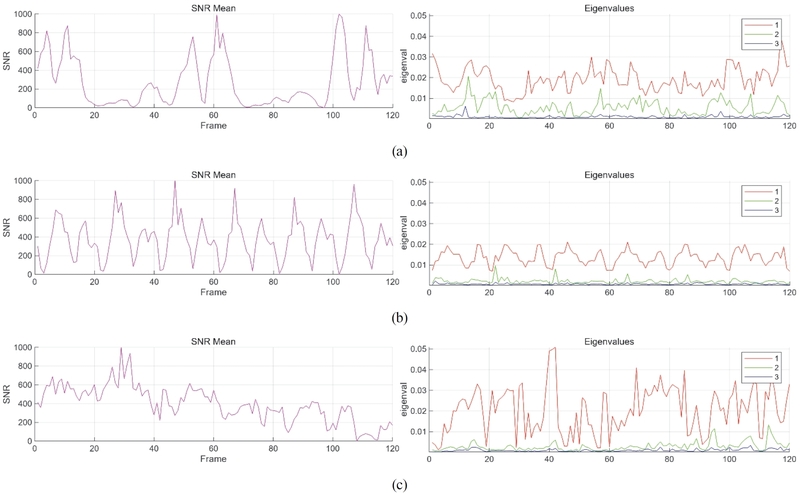
Mean SNR and PCA eigenvalue trajectories across frames: (a) awake infant, (b) deep sleep infant, (c) water (20 L)
In the awake infant case, irregular multi-limb movements produce an SNR waveform that is highly erratic, with large amplitude fluctuations and little discernible periodicity. The corresponding PCA plot shows that the second eigenvalue λ(2) is consistently elevated with large temporal variation, reflecting multi-directional irregular motion. The deeply sleeping infant exhibits stable, repetitive amplitude modulations aligned with respiratory cycles, yielding a clear periodic pattern in the SNR signal. The PCA eigenvalues remain low and stable, especially λ(2) and λ(3), indicating constrained motion along a single axis consistent with breathing. In contrast, the water bottle, a strong reflector undergoing damped unidirectional oscillation shows a gradual attenuation in SNR as internal fluid motion stabilizes. The PCA plot reveals that λ(2)remains low, consistent with damped unidirectional oscillation typical of sloshing fluid in a container. These observations indicate that while SNR-based analysis is effective for detecting regular breathing (e.g., deep sleep), it lacks sufficient discriminative power for distinguishing awake infants from vibrating inanimate objects. In contrast, the second eigenvalue λ(2) demonstrates the strongest class-separating potential among the PCA components, particularly in identifying irregular motion patterns.
Fig. 9 illustrates the temporal variance profiles of the three PCA eigenvalues (λ(1), λ(2), λ(3)) computed over a sliding window of 60 frames for the awake infant, deep-sleep infant, and water-bottle scenarios. For intuitive comparison of scale differences across components, all eigenvalues were multiplied by 1000 prior to variance computation.
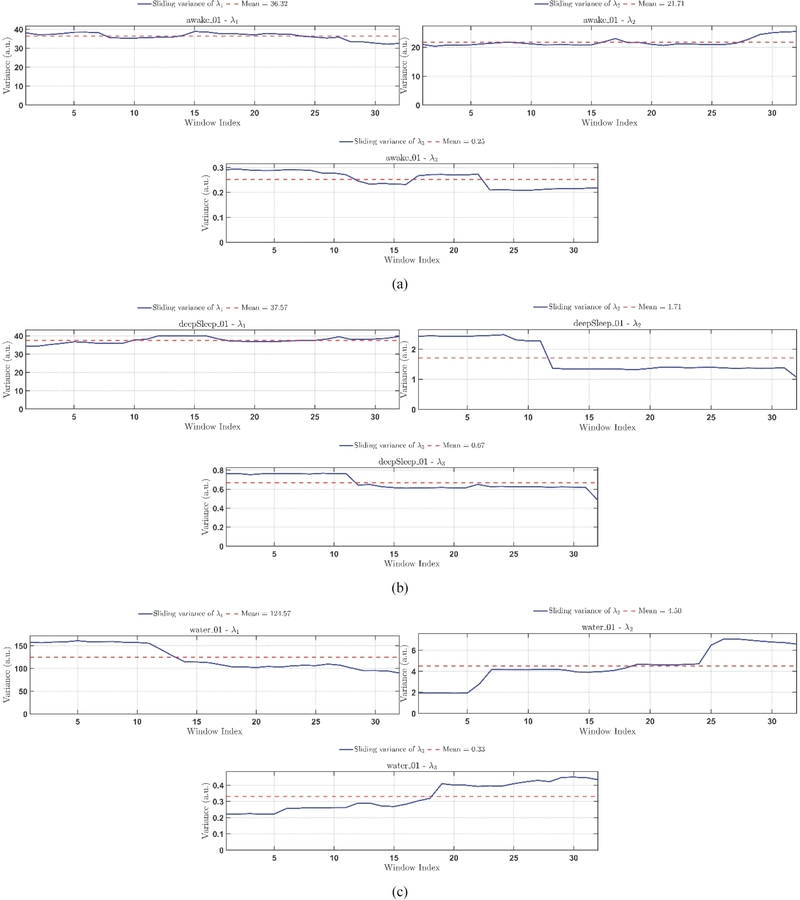
Sliding-window variance analysis of PCA eigenvalues: (a) awake infant, (b) deep sleep infant, (c) water (20 L)
For σ2,(1) (principal-axis extent), both awake and deep sleep infants maintain moderate, stable variance values (~36–38), reflecting consistent body geometry with minor fluctuations from breathing or movement. In contrast, the water bottle exhibits substantially higher σ2,(1) variance (~125) during the initial frames, followed by a gradual decline as internal water motion dissipates. This suggests that σ2,(1) variance captures large-scale oscillations typical of rigid bodies with internal fluid movement, providing a useful auxiliary cue for distinguishing inanimate objects from sleeping infants.
For σ2,(2) (orthogonal spatial spread), the awake infant shows markedly elevated and stable variance (~21.7) compared to the deep sleep infant (~1.7) and the water bottle (~4.5). This variance pattern reflects the presence of multi-directional, irregular motion in the awake state, which significantly increases the orthogonal dispersion of scattering points. In contrast, both deep sleep and water scenarios yield low σ2,(2) variance due to motion constrained to a single axis or minimal breathing movement. σ2,(2) variance thus emerges as the primary discriminative metric for identifying awake infants.
For σ2,(3)(minor-axis spread), all three scenarios present very small variance values (<1), indicating that the third component contributes minimally to overall shape dynamics and offers limited discriminatory power. To further provide quantitative evidence beyond the qualitative trends in Fig. 9, Table 2 summarizes the scenario-wise mean, standard deviation, and range of the sliding-window variance features. The awake infant shows the highest σ2,(2) value (20.10 ± 2.28), whereas the deep-sleep infant and the water bottle exhibit substantially lower values (5.31 ± 4.51 and 4.29 ± 0.29, respectively). In contrast, the water-bottle case yields the largest σ2,(1) value (92.03 ± 46.02), reflecting large-amplitude but predominantly one-axis oscillation. Overall, these results confirm that σ2,(2) is the most reliable descriptor for differentiating awake infants from non-living objects, while σ2,(1) provides a secondary cue for separating deep-sleep infants from large reflective objects.
Statistical summary of sliding-window variance features for each test scenario group.
3.3 Computational Cost Analysis
The computational load and memory footprint of the PCA-based spatial descriptor were estimated for a single seat, assuming approximately 50 points per frame after CFAR detection and cuboid-based zone mapping. The implementation target is the ARM Cortex-R5F core of the TI AWRL6843 operating at 200 MHz.
In the embedded implementation, the PCA features are computed per zone by first accumulating the centroid and covariance terms directly from the detected 3D points using an online update scheme. The resulting covariance matrix is a real symmetric 3×3 matrix, and its principal values are obtained using the single-precision SVD routine. Because the covariance matrix is symmetric and positive semidefinite, its singular values are equivalent to its eigenvalues. Therefore, the “eigenvalue decomposition” cost reported in Table 3 corresponds to a fixed-size 3×3 SVD-based eigensolver suitable for embedded real-time execution.
Computational cost of PCA feature extraction
The processing consists of three sequential steps: (1) centroid calculation, (2) covariance matrix computation, and (3) eigenvalue decomposition. Table 3 summarizes the estimated floating-point operations (FLOPs), execution time, and memory usage for each step.
At a frame rate of 10 fps per seat, the total PCA processing time amounts to approximately 60 µs, which is negligible compared to the available compute budget of the R5F core. The small memory footprint (~1.3 kB per frame) allows multiple seats to be processed in without impacting the radar front-end or baseline periodicity analysis. These results confirm that the PCA descriptor can be continuously executed alongside the respiration-based detection pipeline while remaining well within the 200 ms total latency.
3.4 CPD State Machine Implementation
The CPD framework integrates the PCA-based spatial descriptor into a state machine that refines detection from occupancy to detailed classification. For each zone, the state changes from empty to occupied if point count and average SNR exceed thresholds for several frames. If they fall below relaxed thresholds, the state reverts to empty.
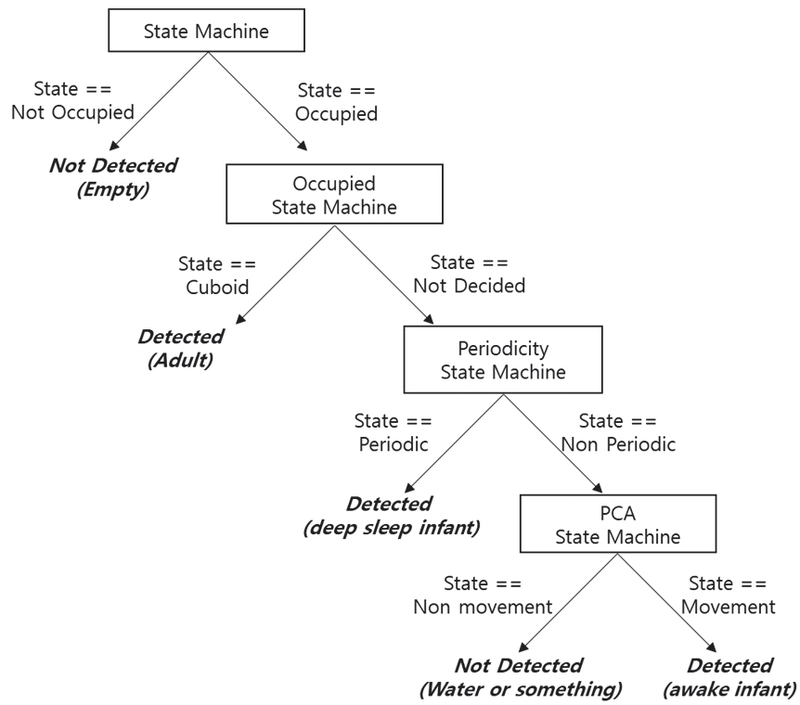
CPD state machine integrating PCA-based spatial descriptors
In the Occupied state, the point cloud is split into anatomical cuboids. Head-cuboid points classify the occupant as Adult; otherwise, seat-center points indicate an Infant Candidate. Infant Candidates are analyzed by: (1) Respiration-based periodicity - stable oscillations in mean SNR within the breathing frequency band indicate a Regular Breathing Infant; (2) PCA-based motion variance - variance of scaled eigenvalues (mainly the second component) detects irregular multi-directional motion. High variance without periodicity indicates an Awake Infant, while low variance in all components indicates a Non-living Object.
4. Conclusion
This paper introduced a PCA-based spatial feature extraction framework for infant detection in automotive cabins under irregular motion conditions. By encoding the instantaneous 3D geometry of radar point clouds via principal-component eigenvalues, the proposed method complements respiration-based periodicity analysis, improving detection robustness for awake infants and reducing false positives from reflective inanimate objects. Experimental validation using an in-cabin radar testbed demonstrated that PCA descriptors particularly the variance of the second eigenvalue are strong discriminators for irregular motion states. The approach incurs negligible computational overhead, enabling real-time execution on embedded processors, and its integration with cuboid-based zone mapping and periodicity analysis yields a hybrid CPD system that maintains robustness across diverse behavioral states. Future work will proceed along two main directions:
- 1) Expanded experimental validation - We will collect a larger and more diverse dataset covering multiple seating positions, varying occlusion levels, and different inanimate object types. This will address the current limitation of limited quantitative evaluation and provide stronger statistical evidence for regulatory compliance.
- 2) Multi-feature fusion - We will explore combining PCA-derived features such as eigenvalue ratios, eigenvector orientations, and temporal variances with baseline CPD features to determine optimal configurations for distinguishing all relevant classes, including adults, infants (awake or asleep), and non-living objects. The aim is to produce a more reliable and generalizable CPD system.
Nomenclature
| Pi,k : | point cloud in zone k in frame i |
| : | center point of Pi,k |
| Ci,k : | covariance matrix of |
| : | eigenvalues of Ci,k |
| (i) : | variances of eigenvalues |
| Subscripts | |
|---|---|
| i : | frame index |
| k : | zone index |
| D : | component number |
Acknowledgments
This work was supported by the Technology Innovation Program (RS-2024-00443542, Development of High-Capacity Sensing Data Transmission Sensor Module and Centralized Integrated Cognitive Software) funded by the Ministry of Trade, Industry and Resources (MOTIR, Korea).
References
- Forciot, “Euro NCAP Assessment 2025 on Child Presence Detection,” Forciot Website, 2023.
-
K. Yoo, K. Kang, Y. Han and H. Ryu, “Doppler-Peak Concentration via Folding in DDM-Based MIMO FMCW,” Transactions of KSAE, Vol.33, No.12, pp.1075-1081, 2025.
[https://doi.org/10.7467/KSAE.2025.33.12.1075]

-
A. Caddemi and E. Cardillo, “Automotive Anti-abandon Systems: A Millimeter-Wave Radar Sensor for the Detection of Child Presence,” 2019 14th International Conference on Advanced Technologies, Systems and Services in Telecommunications (TELSIKS), pp.94-97, 2019.
[https://doi.org/10.1109/TELSIKS46999.2019.9002193]
-
A. Hanif, M. Muaz, A. Hasan and M. Adeel, “Micro-Doppler Based Target Recognition with Radars: A Review,” IEEE Sensors Journal, Vol.22, No.4, pp.2948-2961, 2022.
[https://doi.org/10.1109/JSEN.2022.3141213]
-
S. Sreekumar, S. K. Shashank, P. Srihari, G. S. Vandana, B. Pardhasaradhi and L. R. Cenkeramaddi, “Adult and Child Classification Using Automotive Radar for In-cabin Monitoring,” 2024 IEEE International Conference on Electronics, Computing and Communication Technologies (CONECCT), pp.1-6, 2024.
[https://doi.org/10.1109/CONECCT62155.2024.10677125]
-
G. Beltrão, R. Stutz, F. Hornberger, W. A. Martins, D. Tatarinov, M. Alaee-Kerahroodi, U. Lindner, L. Stock, E. Kaiser, S. Goedicke-Fritz, U. Schroeder, B. Shankar M. R. and M. Zemlin, “Contactless Radar-Based Breathing Monitoring of Premature Infants in the Neonatal Intensive Care Unit,” Scientific Reports, Vol.12, Paper No.5150, 2022.
[https://doi.org/10.1038/s41598-022-08836-3]
-
H. Abedi, M. Ma, J. He, J. Yu, A. Ansariyan and G. Shaker, “Deep Learning-Based In-cabin Monitoring and Vehicle Safety System Using a 4-D Imaging Radar Sensor,” IEEE Sensors Journal, Vol.23, No.11, pp.11296-11307, 2023.
[https://doi.org/10.1109/JSEN.2023.3270043]
-
K. Sato, S. Wandale, K. Ichige, K. Kimura and R. Sugiura, “Millimeter-Wave Radar-Based Vehicle In-Cabin Occupancy Detection Using Explainable Machine Learning,” IEEE Sensors Journal, Vol.24, No.15, pp. 24288-24298, 2024.
[https://doi.org/10.1109/JSEN.2024.3413775]
-
A. Maćkiewicz and W. Ratajczak, “Principal Components Analysis (PCA),” Computers & Geosciences, Vol.19, No.3, pp.303-342, 1993.
[https://doi.org/10.1016/0098-3004(93)90090-R]
- G. Kim, B. Choi, H. Jeong, Y. Yoon, H. Kim and G. Yun, “CNN-Based Analysis of Electric Vehicle Acoustic Vehicle Alerting System in Automotive Inspection Station Environments,” Transactions of KSAE, Vol.33, No.12, pp.1083-1090, 2025.
- Texas Instruments, AWRL6843/AWRL6844 Single-Chip 57 to 64 GHz Automotive Radar Sensor, Datasheet, 2023.