
An Assessment Standard Research for Vehicle Dynamics Model Verification Based on the Coefficient of Determination
Copyright Ⓒ 2026 KSAE / 245-07
This is an Open-Access article distributed under the terms of the Creative Commons Attribution Non-Commercial License(http://creativecommons.org/licenses/by-nc/3.0) which permits unrestricted non-commercial use, distribution, and reproduction in any medium provided the original work is properly cited.
Abstract
Vehicle dynamics models play a key role in the development of a vehicle, a vehicle module or a controller. To verify a vehicle model accuracy, generally coefficient of correlation (Pearson’s correlation) and determination are used mixed together. However, using the determination is correct to verify a vehicle model. And the determination can lose its reliability when a low varication data is used because the definition of determination is ‘a statistical measure that represents the proportion of the variance in the dependent variable that can be explained by the independent variable in a regression model’. Therefore, in this study, the reasons why the determination has to be used are explained with some formula and a vehicle model result. (The formal proof is already widespread in the internet. So the formula is just introduced in this paper.) Then the problem of the determination is issued, and the standard index is suggested to avoid the problem with 3 vehicle test results.
Keywords:
Vehicle test, Vehicle model verification, Correlation coefficient, Coefficient of determination, Criteria for vehicle model data1. Introduction
Most automotive original equipment manufacturers (OEMs) and Tier 1 automotive vendors follow the V-Cycle development process to develop vehicles or their control logic.1-3) This development process utilizes various simulation stages depending on the purpose, and is generally divided into two categories: offline simulation and real-time simulation. Offline simulation is employed during the early stages of development and operates asynchronously, independent of real-time progression. At this stage, rapid structural validation of control logic and seamless integration assessment of newly developed systems or modules can be performed. The accuracy of the vehicle dynamics model utilized in this process significantly impacts initial design reliability and development efficiency. Real-time simulation, on the other hand, represents the final phase of simulation within the V-cycle development process and refers to a simulation environment that operates in synchronization with real-time execution. This phase, which includes environments such as Hardware-in-the-Loop System (HILS) and ECU-in-the-Loop System (EILS), is employed to test and verify controllers, ECUs, and new modules under conditions most similar to actual vehicles. Moreover, in this phase, the more accurate the vehicle model, the greater the benefits, such as increased development reliability, reduced vehicle test (real-world testing conducted using the target vehicle) verification costs, and shortened development periods. Therefore, securing an accurate vehicle dynamics model constitutes a critical factor in the development of vehicle controllers, individual modules, and overall vehicle systems. Accordingly, this paper proposes a set of criteria for evaluating the accuracy of a vehicle model using vehicle test data and vehicle model data based on vehicle models used in actual fields.
In statistics, regression model evaluation methods are applied to numerically evaluate accurate vehicle models. Some common methods for vehicle model evaluation can be categorized into the following groups: First, the Mean Absolute Error (MAE), Mean Squared Error (MSE), and Root Mean Squared Error (RMSE) simply measure the difference between actual and model data. However, these methods suffer from scale dependence, making them insufficient as evaluation criteria for accurate vehicle models.4-6) Furthermore, the Mean Absolute Percentage Error (MAPE) and Mean Percentage Error (MPE) are metrics used to assess the proportional deviation between actual and modeled data. However, these methods have the drawback that their values can diverge when the denominator approaches zero.7-9) Therefore, in statistics, the Correlation Coefficient (Pearson’s correlation) and the Coefficient of Determination (CoD) methods are mainly used for model verification. In this paper, we will explain the mathematical/definitional differences between the two methods, as well as the differences in results through test data (Since the differences between the two methods, as expressed by their formulas, have been reported in several papers and websites, this paper provides an overview of the formulas and cites the corresponding results.)10-12)
The paper’s focus is on the use of the coefficient of determination to evaluate the accuracy of vehicle models, along with the potential issues that may arise and proposed criteria to address them. To elaborate on this issue, when verifying the accuracy of a vehicle model using the coefficient of determination, there are cases in which both the vehicle and model data exhibit a nearly constant waveform with very small variations. In these cases, even if the vehicle model tracks the actual vehicle data almost perfectly, the coefficient of determination still suggests a low modeling accuracy. This is because the coefficient of determination is defined based on data variation, making data with little variation inappropriate for assessing model accuracy. Therefore, when verifying a vehicle dynamics model, it is necessary to go beyond simply using the coefficient of determination and establish quantitative criteria to determine which data are suitable for coefficient of determination-based evaluation. This study utilizes three types of vehicle test data to present quantitative criteria for determining valid data for vehicle model verification. Through this, we aim to address structural issues arising from coefficient of determination-based vehicle model evaluation and support the standardization of future vehicle model verification processes.
2. Differences Between Coefficient of Determination and Correlation Coefficient
In vehicle modeling verification, the coefficient of determination and correlation coefficient are frequently used interchangeably to measure model accuracy. However, these methods are inherently distinct, with equivalence arising solely under conditions that satisfy the assumptions of linear regression. Therefore, in statistics, where linear regression analysis predominates, these methods are often used interchangeably without distinction. However, when it comes to vehicle modeling verification, there are specific approaches. This chapter summarizes the definitional and mathematical differences between the two methods and presents how these differences manifest themselves through actual vehicle model results.
2.1 Mathematical Differences Between the Coefficient of Determination and the Correlation Coefficient
In terms of terminology, the coefficient of determination (CoDe) is also referred to as R-squared or R-squared score. CoDe is defined as the “measure of the extent to which the variability or variation of one variable is shared by other variables.”13) The formula for numerically verifying a vehicle model using the CoDe is as follows:
| (1) |
Here, the standard for judging the accuracy of the vehicle model is 100 % accurate (perfect prediction) when R2 = 1, 0 % accurate (model does no better than predicting the mean) when R2 = 0, and absolutely inaccurate (model is worse than a constant predictor) when R2 < 0. The formula is mainly expressed in abbreviations. Total Sum of Squares (SST) is defined as the sum of the squares of the deviations (the total variability in the observed data), as in Equation (2), and Error (or Residual) Sum of Squares (SSE) is defined as the sum of the squares of the residuals (the part not captured by the model), as in Equation (3). Here, if linear regression analysis is performed using this formula, the Regression Sum of Squares (SSR), which is the sum of the squares of the regression (the variability explained by the regression model), can also be defined and expressed, as demonstrated in Equation (4).
| (2) |
| (3) |
| (4) |
Among the formulas used to verify modeling, the correlation coefficient method exists. The correlation coefficient generally refers to Pearson's correlation. The correlation coefficient is defined as “an indicator of the degree of linear relationship between two variables.”13) If the correlation coefficient is used to numerically verify a vehicle model, the formula is as follows:
| (5) |
Here, the criteria for judging the accuracy of the vehicle model are categorized as a perfect positive linear correlation when r = 1, a positive correlation when 0 < r < 1, no linear relationship when r = 0, a negative correlation when -1 < r < 0, and a perfect negative linear correlation when r = -1.
In Equation (5), the Cov (covariance) function can be used as a model judgment criterion even when used alone (the Cov judgment criterion and r judgment criterion are the same). However, using Cov alone makes the absolute magnitude of the relationship incomparable. (e.g., if the reference data and model data are multiplied by 10, the relationship between variables does not change, but the covariance becomes 100 times.) Therefore, Pearson's Correlation, which is a correlation coefficient formula calculated by dividing the covariance by the standard deviation, is generally used.
Before deriving the equation that connects the coefficient of determination to the correlation coefficient equation, we first examine the equations used as its assumptions. This begins with the derivation of the first-order regression function, a frequently used equation in statistics. The first-order regression function derivation equation is as follows:
| (6) |
| (7) |
The above equation (6) is a regression equation, and Equation (7) is a cost function equation. That is, the purpose is to find the linear function coefficient β1 and constant β0 that has the minimum cost function to derive a linear function that can represent actual data. Here, to find a solution, if we differentiate with respect to β0 and β1, we can obtain Equations (8) and (9) that minimize the cost function. Then, from Equation (8), we can obtain , and by substituting Equation (6) into Equation (9), we can obtain . Through this, we can check whether the important conditional expression (10) to be used later is established. Considering that = constant and considering the terms obtained from Equations (8) and (9), we can see that Equation (10) is established.
| (8) |
| (9) |
| (10) |
We now present the derivation of the correlation coefficient formula from the coefficient of determination formula.
First, the coefficient of determination formula is organized as in Equation (11) by adding a term equal to zero. to the numerator term of Equation (1).
| (11) |
To express the correlation coefficient in Equation (11) as a square equation, the terms are separated as in Equation (12).
| (12) |
If we add a term equal to zero to the numerator of the first term of Equation (12), the first term is organized as in Equation (13).
| (13) |
In conclusion, the coefficient of determination formula can be organized as in Equation (14).
| (14) |
Equation (14) shows that the coefficient of determination is the difference between the square of the correlation coefficient and the square of . Therefore, if the condition of Equation (10) holds, we can confirm that the coefficient of determination and the correlation coefficient are equivalent.
Here, we will further explain the expression method using the SST, SSE, and SSR functions frequently used in statistics. Using Equations (1) and (12), we can organize the equation as shown in Equation (15).
| (15) |
In statistics, the conditional equation SST = SSE + SSR is frequently used, and it can be confirmed that this presupposes the condition in Equation (10).
Hence, since the primary goal of statistics is to derive regression functions for linear data, the coefficient of determination and correlation coefficient are used interchangeably. However, in the context of vehicle model verification, nonlinear models are used (the estimated output data for input data, i.e., the vehicle model is nonlinear); therefore, verification must be performed using the coefficient of determination method, as in Equation (1).
2.2 Comparison of Results Using Vehicle Models for Coefficients of Determination and Correlation Coefficients
Before comparing the results using vehicle models for coefficients of determination and correlation coefficients, we will briefly explain the general vehicle model design method and examine the validation results. Since this study primarily aims to compare the validity of validation metrics, not the modeling methodology itself, detailed descriptions of the modeling algorithms have been kept to a minimum.
Typically, designing a vehicle model requires first conducting a real-world vehicle test of the target vehicle, measuring the vehicle's input and output for each scenario. The minimum test scenarios for designing a vehicle model can be presented as follows: First, acceleration and deceleration tests are required to design a longitudinal dynamics model. Acceleration tests are conducted by pressing the acceleration pedal at constant 50 % and 100 % acceleration. Deceleration tests are conducted by driving at 80 km/h and applying a braking pedal force that maintains Ax at constant 0.4 g and 0.8 g. Second, double lane change (DLC) and J-turn tests are required to design a lateral dynamics model. DLC tests involve driving straight at 80 km/h and then passing through a designated DLC course. J-turn tests involve driving straight at 80 km/h and applying a steering force that maintains Ay at 0.4 g. After obtaining these scenario data, basic specifications, such as vehicle size and mass, are reflected in the vehicle model. When inputs similar to those in the vehicle test are applied to the vehicle model, the model is designed by tuning the key parameters until the model produces outputs similar to those in the vehicle test. During the tuning process, the primary parameters considered are those associated with the vehicle dynamics model.14) This is because the vehicle dynamics model consists of key parameters that affect dynamics.
Fig. 1 shows part of the vehicle test conducted on the Hyundai G80 EV (2023 model).15,16) The left side of Fig. 1 captures a photo of the setup for the vehicle test, and the right side shows a photo of the DLC test.
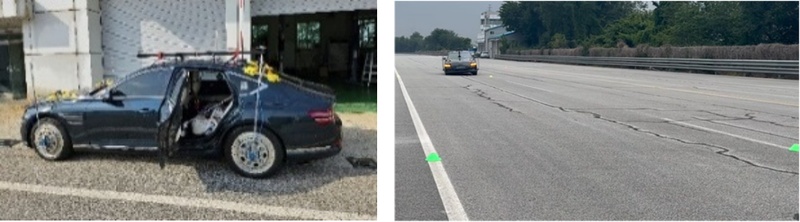
Vehicle test environment(left), DLC scenario(right)
After data collection on vehicle test results according to scenarios was completed, the G80 EV specifications were applied to the vehicle model, and model tuning was performed. Typically, vehicle models input wheel driving torque through the driving module according to the APS, wheel braking torque through the braking module according to the BPS, and wheel steering angle through the steering module according to the SAS, and the output parameters are compared. However, in this test, we designed a vehicle model that directly inputs more accurate driving/braking torque to the wheels using a wheel force transducer (WFT), excluding the driving and braking modules.
Figs. 2–7 are comparative graphs of the vehicle model designed for the G80 EV and vehicle test data, presented by scenario. Specifically, Figs. 2–5 are comparative verification graphs for longitudinal scenarios. Considering the characteristics of the twin drive motor of the target vehicle, the G80 EV, the front/rear torque was input to the wheels, and Ax and Vx were compared as dynamic parameter outputs for comparison. The lateral dynamics in the third row were not considered, but the graphs are shown for additional explanation in Chapter 3. Then, Figs. 6–7 are comparative verification graphs for lateral scenarios. The lateral input was the steering wheel angle, and Ay and yaw rate were compared as dynamic parameter outputs for comparison. The longitudinal dynamics in the third row were not considered, but the graphs are shown for additional explanation in Chapter 3.
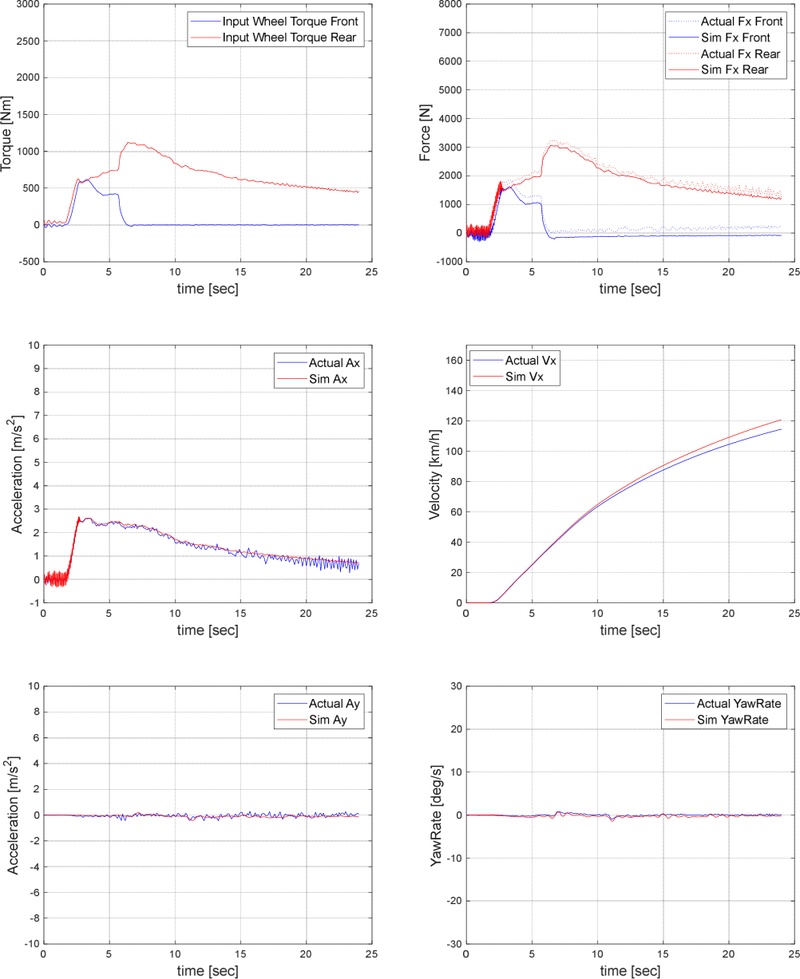
Vehicle model result in Accel. 50 % test scenario
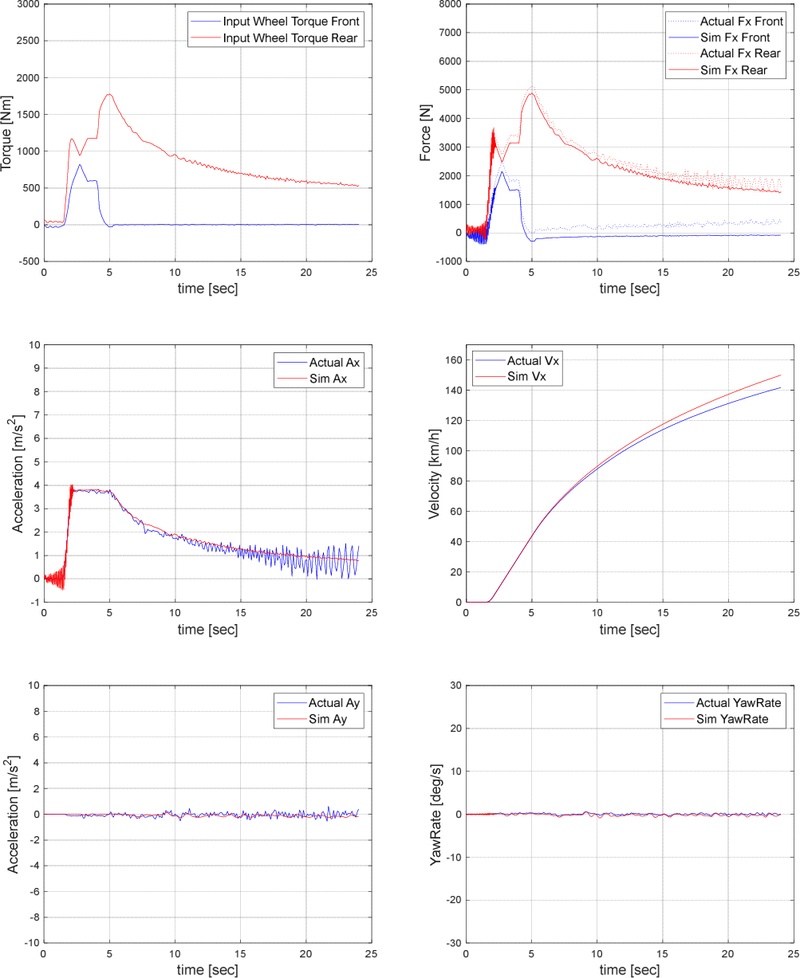
Vehicle model result in Accel. 100 % test scenario
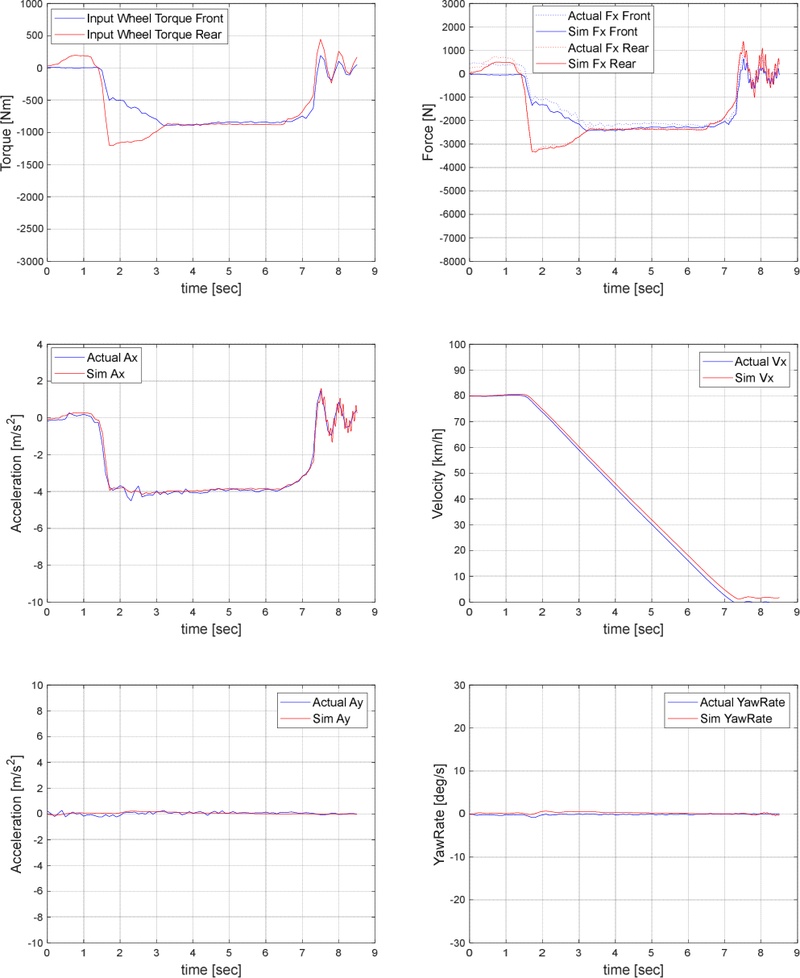
Vehicle model result in Decel. 0.4 g test scenario
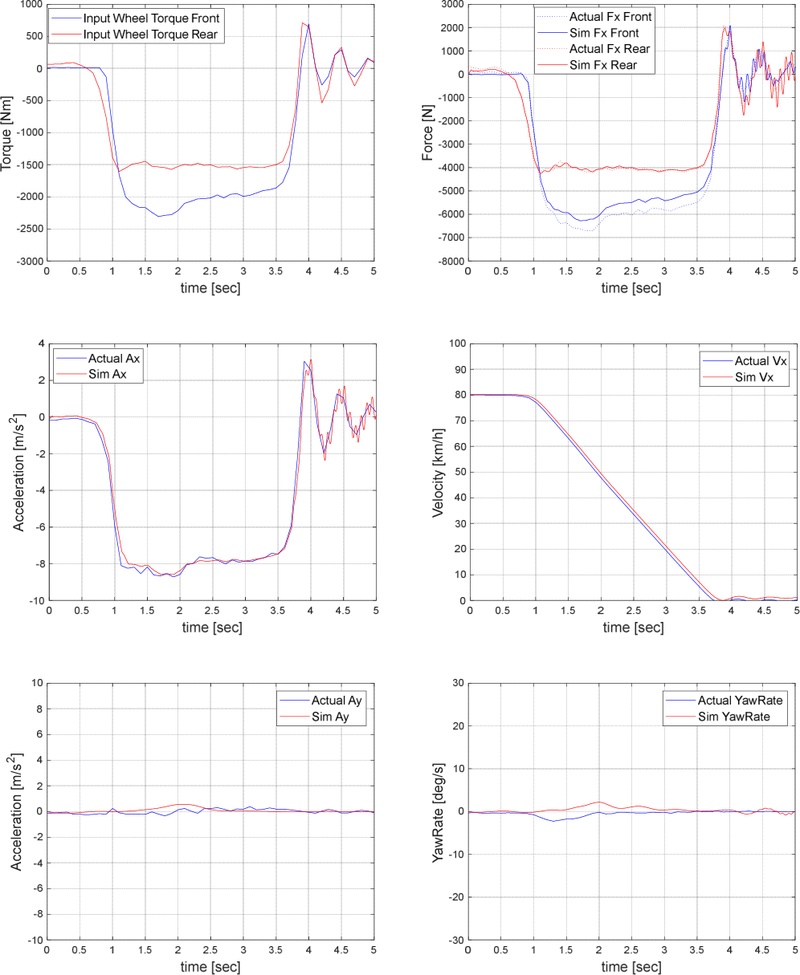
Vehicle model result in Decel. 0.8 g test scenario
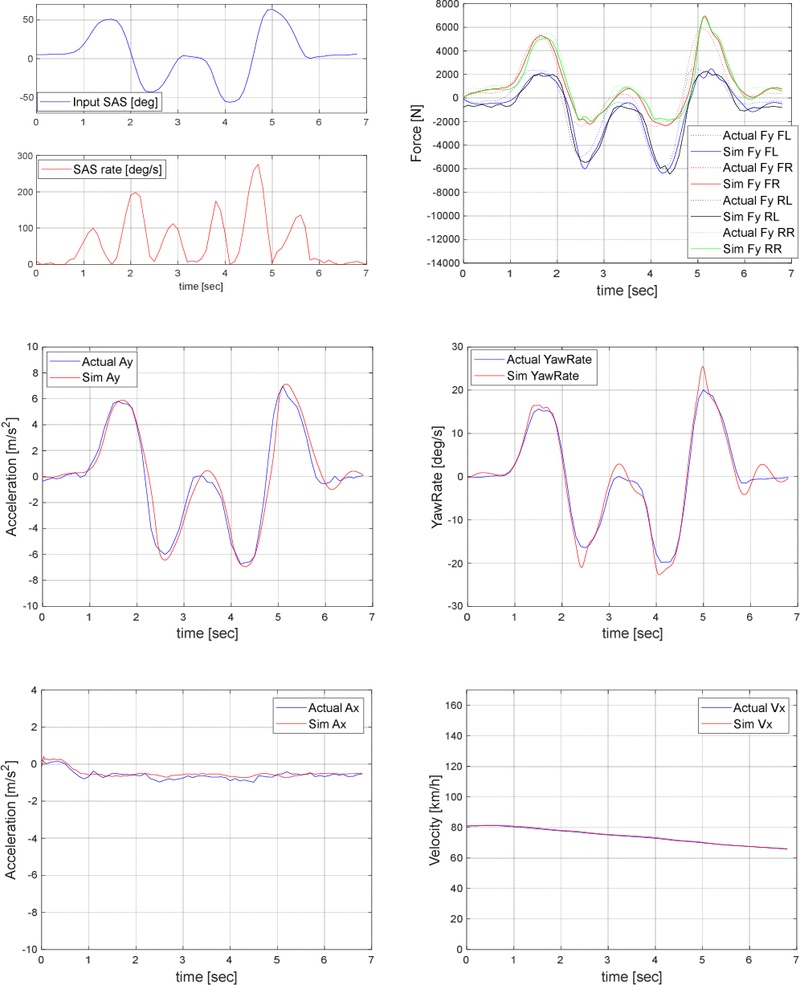
Vehicle model result in the DLC test scenario
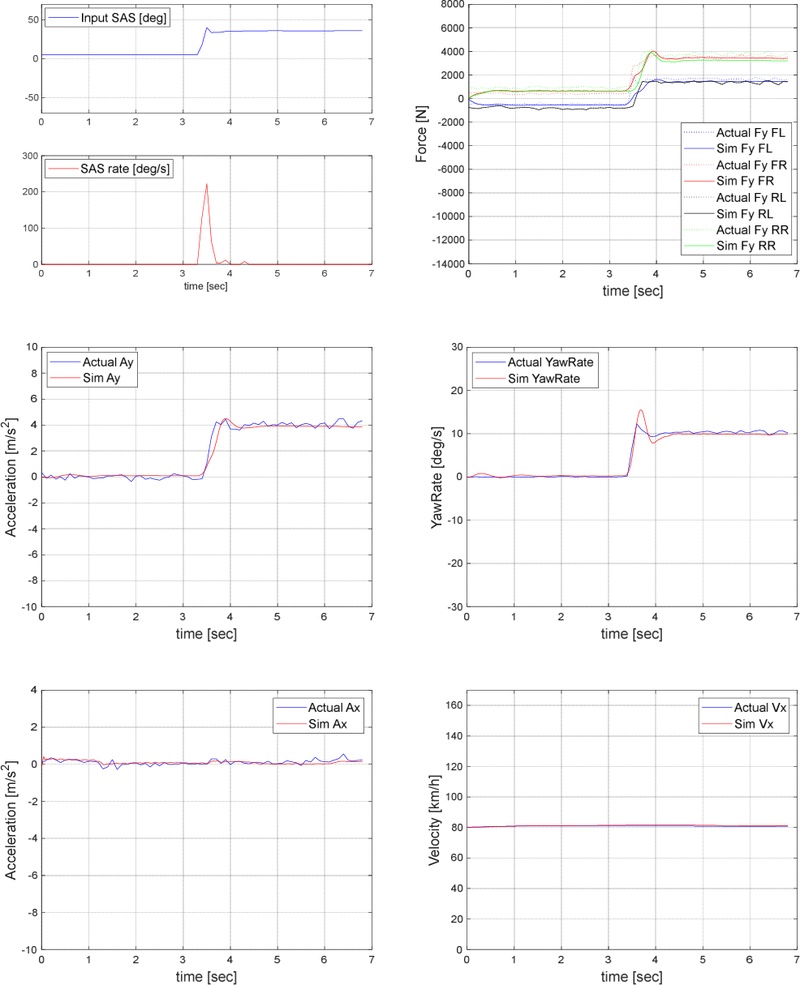
Vehicle model result in J-turn test scenario
In Chapter 2.1, we concluded that the accuracy of vehicle models should be verified using the coefficient of determination method; that is, using mathematical formulas. In Chapter 2.2, we will numerically compare the correlation coefficient and the coefficient of determination results using the actual vehicle model results of the G80 EV to determine the extent to which they differ.
Table 1 shows the accuracy of the vehicle model for each scenario. This table was created to numerically compare the correlation coefficient and coefficient of determination validation results for the vehicle model. As described in Table 1, despite the results being for the same vehicle model, there are numerical differences between the correlation coefficient and coefficient of determination validation methods. Overall, the coefficient of determination validation method consistently shows lower values than the correlation coefficient validation method. This is because, as shown in Equation (14), the coefficient of determination formula is calculated by adding a negative value to the squared correlation coefficient. Therefore, the correlation coefficient can overestimate modeling performance, and the coefficient of determination method provides a more stringent numerical criterion. Furthermore, as explained in Section 2.1, Equation (10), which is the conditional equation of the linear regression function, is the correlation coefficient method, for the validation of a nonlinear vehicle model, it is appropriate to use the coefficient of determination method when verifying a nonlinear vehicle model.

G80 EV modeling result
In conclusion, vehicle models must be verified using the coefficient of determination verification method. When concluding the verification results of the vehicle model, the following conclusions can be drawn by considering only the black-marked portion of the coefficient of determination in Table 1: Considering the minimum value of the coefficient of determination for this vehicle model, a vehicle model with an accuracy of over 94.76 % was designed. This satisfies the empirical criteria of over 90 % for automotive OEMs and related industries, demonstrating the validity of the vehicle model.
3. Problems and Solutions in Using the Coefficient of Determination
To design and verify a vehicle model, the coefficient of determination must be used. However, the problem with the coefficient of determination method is that if invalid data is used, the reliability of the verification results will be reduced. This problem is a phenomenon that can be confirmed when comparing experimental data outside the area of interest with model data.
Therefore, this chapter will explain the potential problems with the use of the coefficient of determination, examine whether the coefficient of determination verification impacts data, and ultimately establish criteria for valid data through test results from three types of vehicles.
3.1 Issues with Using the Coefficient of Determination
To examine the issues with using the coefficient of determination for vehicle modeling verification, we will use the modeling results of the G80 EV. Figs. 2–7 reveal the comparative results of the G80 EV vehicle model. Rows 1 and 2 represent regions of interest, while row 3 represents regions of no interest. The regions of interest represent longitudinal behavior in longitudinal scenarios and lateral behavior in lateral scenarios. Conversely, the regions of no interest represent lateral behavior in longitudinal scenarios or longitudinal behavior in lateral scenarios, representing data with small variations over time. To examine the issues with these regions of no interest, we will expand and explain the content based on the test results for Accel. 50 % in Fig. 2. The third row of graphs in Fig. 2 compares the vehicle test results for Ay and yaw rates with the vehicle model results. The graphs demonstrate that the vehicle model tracks the vehicle test results, which are close to zero. However, the numerical results of the coefficient of determination for this show different results. The gray figures in Table 1 represent the results for the uninterested region. Examining the Determination Ay and Yaw rate columns in the Accel. 50 % row in Table 1 reveals that the vehicle model's accuracy is -27.13 % for Ay and -111.42 % for yaw rate, indicating that there is no relationship between the vehicle model and the vehicle data. This conclusion contradicts the graphical results. This contradiction recurred in other scenarios, suggesting that the coefficient of determination verification for regions of no interest may be problematic.
In conclusion, when verifying a vehicle model using the coefficient of determination, regions of no interest should be excluded. The first evidence supporting this is the inconsistency in the conclusions through the vehicle model described above. The second piece of evidence can also be found in the definition of the coefficient of determination itself. Since the definition of the coefficient of determination is "a measure that indicates the degree to which the variability or variation of one variable is shared by other variables," the definition itself does not presuppose data without variation. The third and final evidence can be confirmed through the formula. If you examine the formula for the coefficient of determination, Equation (1), you will infer that when the denominator approaches zero, that is, the closer the vehicle test data and the mean of the vehicle test data are, the more likely the coefficient of determination value is to diverge, thus increasing the likelihood of obtaining invalid results.
Thus, based on the three points above, we have confirmed that invalid data with low variations, such as data in regions of no interest, need to be identified and excluded when designing vehicle models. However, the remaining question is whether the noise in the vehicle data of the region of no interest can be sufficiently reduced so that the numerator and denominator of the coefficient of determination have a similar range, thereby yielding valid data. In this regard, we will conduct a further analysis of the impact of noise in Section 3.2. Furthermore, if data in the region of no interest must be excluded, we need to analyze what numerical criteria can be used to distinguish it. In Section 3.3, we will present criteria for determining the region of no interest.
3.2 The Impact of Test Data Noise on Modeling Accuracy
In this section, we will examine the influence of noise (high frequency) by filtering to resolve the discrepancy in the coefficient of determination verification results, which show negative values between vehicle test data and vehicle model data in regions of no interest. As previously confirmed, since the coefficient of determination tends to diverge in data with small variations, the value is sensitive to even small noise and fluctuates. Therefore, the purpose of this section is to determine whether removing the influence of noise can transform data in regions of no interest into valid data.
First, to mitigate the influence of noise, data must be prepared by applying a low-pass filter (LPF). Fig. 8 differentiates the data before and after filtering the Ax and yaw rates in the Accel. 100 % scenario.
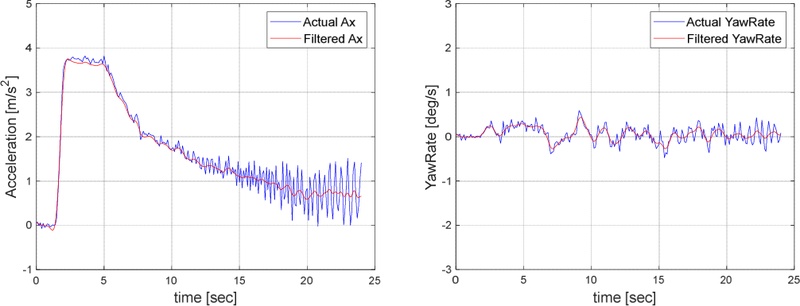
Low-pass filter result of Ax and yaw rate in Accel. 100 % scenario
First, let's compare the coefficient of determination results before and after LPF in the graph of Ax, which is the region of interest. As shown in Table 1, the coefficient of determination of the vehicle test data and the vehicle model before LPF is 95.25 %, and the coefficient of determination after LPF is 97.06 %, demonstrating increased accuracy. However, when designing a vehicle model, using LPF data generally causes data delay, and the boundary between noise and actual values becomes unclear, so the use of filtered data must be maintained at an appropriate level. For reference, if LPF is applied, the LPF application standards for vehicle test data specified in ISO 15037 must be followed.
The most important conclusion is the yaw rate graph, which is a region of no interest. If the coefficient of determination begins to improve in the yaw rate graph through LPF, it establishes criteria for noise filtering, potentially allowing the region of no interest to be used as an indicator for modeling. The coefficient of determination between the vehicle test data and the vehicle model before LPF of the yaw rate data is -181.47 %, as listed in Table 1. However, after LPF, the coefficient of determination between the vehicle test data and the vehicle model drops even further to -356.45 %. This exemplifies the loss of numerical reliability in the region of no interest, as mentioned in Section 3.1, as the denominator of Equation (1) approaches zero and diverges (the fact that the coefficient of determination further drops despite the need for improvement with LPF application can be a counterexample that the coefficient of determination method loses reliability in the region of no interest.) Therefore, the result that can be seen through this counterexample is that as noise is reduced, the possibility that data in regions of no interest can become data in regions of interest decreases.
3.3 Criteria for Determining Valid Data
Before determining whether data is valid, we first examine Equation (1), the formula for calculating the coefficient of determination. As confirmed in Section 3.1, the coefficient of determination method is less reliable for data with low variations. Furthermore, as indicated in Equation (1), to calculate the coefficient of determination, the denominator term (SST) uses the difference between the vehicle test and the mean of the vehicle test. This means that the closer the vehicle test is to the mean, the more likely it is that the reliability of the coefficient of determination will be reduced. However, it is unclear what criteria can be applied to conclude that the vehicle test data is not close to the mean. Therefore, in Section 3.3, we will establish these criteria using three types of vehicle test data.
First, the conclusion regarding the criteria for judging valid data, the standard deviation can be used to establish the criteria. In other words, the criterion that the vehicle test data are not close to the mean of the data can be calculated using the standard deviation, as shown in Equation (16). This is because the definition of standard deviation is ‘a statistic that indicates how far each value in a data set is from the mean.’
| (16) |
However, if we calculate the standard deviation for Ax, Vx, Ay, and yaw rate, we can confirm that there is a difference in scale. That is, absolute comparison is impossible because the scale for each parameter is different. Therefore, a criterion is established by calculating the standard deviation after scaling. Since scaling through standardization naturally calculates all standard deviations as 1, we calculate the standard deviation of the value scaled through normalization (min-max scaling), as in Equation (17).
| (17) |
Here, if minimum (min) and maximum (max) values are derived separately for each scenario, this will also make absolute comparison difficult because the criteria between scenarios will differ. Therefore, it is necessary to assign unified min and max values. This part must be applied based on empirical experience. First, Ax and Ay have a limit of not exceeding 10 m/s2, except in unusual circumstances, so min = -10, max = +10 are applied. Vx cannot have a negative value by the definition of a vehicle's communication signal (except for exceptional circumstances related to noise) and does not exceed 200 km/h, except in extreme circumstances, so min = 0 and max = +200 are applied. Theoretically, yaw rate can be +180 deg/s and -180 deg/s, but these values are physically impossible. In addition, setting min and max to extremely high values will make the distinction between the results ambiguous, so after checking vehicle test data, min = -50 deg/s and max = +50 deg/s were applied instead.
The calculation results for the G80 EV (2023 model), Genesis DH (2015 model),17,18) and Tucson (2015 model)19) vehicles using this valid data judgment criterion calculation method are presented in Tables 2 to 4.
Results of the criteria for judging valid data for the G80 EV
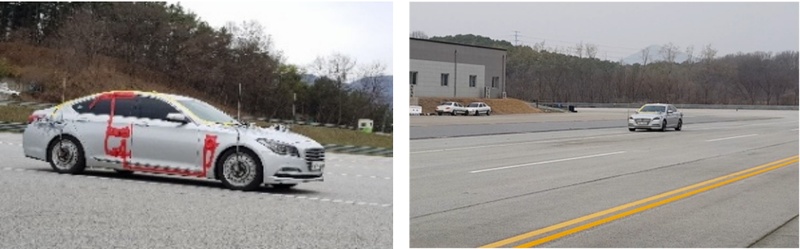
Genesis DH test environment(left), DLC scenario(right)
Tables 2 to 4 list the standard deviations for the results of three types of vehicle tests. In each table, the region of interest is highlighted in blue, whereas the minimum value in the region of interest and the maximum value in the region of no interest are highlighted in yellow, allowing us to conclude the threshold above which the data can be considered valid.
First, Table 2 details the results for the G80 EV. The minimum parameter in the region of interest is the yaw rate in the J-turn scenario, which is 0.0513. The maximum parameter in the region of no interest is the Vx in the DLC scenario, which is 0.0244.
Second, Table 3 presents the results for the Genesis DH. The minimum parameter in the region of interest is the Vx in the Accel. 50 % scenario, which is 0.0388. The maximum parameter in the region of no interest is the Ax in the DLC scenario, which is 0.0214.
Results of Genesis DH valid data judgment criteria

Tucson test environment(left), DLC scenario(right)
Third, Table 4 specifies the results for Tucson. The minimum parameter in the region of interest is the Ax in the Accel. 50 % scenario, which is 0.0432. The maximum parameter in the region of no interest is the Ax in the J-turn scenario, which is 0.0204.
Results of Tucson valid data judgment criteria
According to the calculation results for the three vehicle test types, values lower than 0.0244 correspond to parameters in the region of no interest, whereas values higher than 0.0388 correspond to parameters in the region of interest. Thus, the parameter of the vehicle test data must have a standard deviation of at least 0.0388 to be considered valid data criteria for model validation.
3.4 Verification of Data Decision Criteria for Combined Longitudinal and Lateral Scenarios
This section aims to present the process of verifying the suitability of the criteria for valid data in Section 3.3 for complex scenarios where longitudinal and lateral directions are of interest simultaneously. Fig. 11 shows the results of a Braking-in-Turn test conducted on a G80 EV. The Braking-in-Turn scenario involves applying steering to follow a circular path, and then, upon reaching a target speed, applying a constant braking force of -4 g or more to verify longitudinal and lateral behavior. Therefore, this scenario is suitable for verifying the criteria for valid data for the combined longitudinal and lateral scenarios.
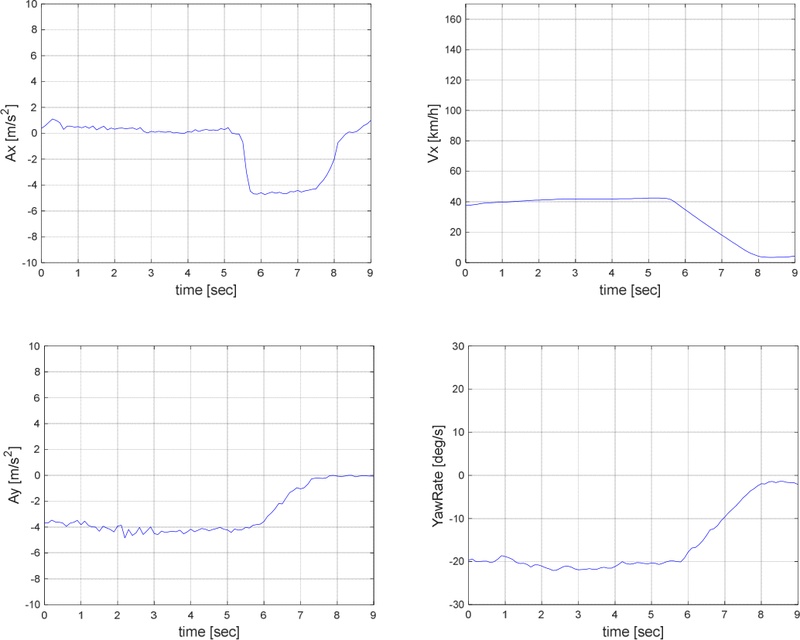
Vehicle test result in Braking-in-Turn test scenario
First, according to the conclusion in Chapter 3.3, the criterion for determining valid data is a standard deviation of 0.0388 or higher. As marked in Table 5, both the longitudinal and lateral directions are regions of interest. The standard deviation values calculated after normalization are Ax = 0.1031, Vx = 0.0720, Ay = 0.0845, and yaw rate=0.0726, respectively. Hence, since all four standard deviation values are calculated to be 0.0388 or higher, we can conclude that all data are valid. Therefore, using the 0.0388 criterion for valid data, we can see that valid data can be determined even through the combined longitudinal and lateral scenarios.
Results of valid data judgment criteria for longitudinal and transverse composite scenarios
4. Conclusion
This paper developed and presented a coefficient of determination-based evaluation criterion to verify the accuracy of vehicle dynamics models. The conclusions derived from the results are summarized below.
The coefficient of determination method should be used to verify the accuracy of vehicle dynamics models. In Chapter 2, correlation coefficients and coefficients of determination were compared, revealing differences in their definitions and mathematical formulations, and illustrating the resulting discrepancies through actual vehicle model cases.
The criterion for valid data when using the coefficient of determination is that the standard deviation calculated after normalization must be at least 0.0388. Chapter 3 provided evidence for this, highlighting potential issues with the coefficient of determination, validating the standard deviation criteria through three types of vehicle tests, and confirming them through complex scenarios.
Subscripts
| R2 : | coefficient of determination |
| yi : | vehicle test data |
| : | vehicle model data |
| : | mean of vehicle test data |
| r : | correlation coefficient |
| Cov(x, y) : | covariance of x and y |
| σy : | standard deviation of y |
| : | standard deviation of |
| ------------ only for formula (6) to (10) below ------------ | |
|---|---|
| : | estimated output data |
| β0 : | y-intercept of the 1st linear equation |
| β1 : | slope of the 1st linear equation |
| xi : | input data |
| yi : | output data |
Acknowledgments
This research was supported by a 2025 research grant from the Ministry of Trade, Industry and Resources and the Korea Planning and Evaluation Institute of Industrial Technology (KEIT) (RS-2024-00402701).
References
-
S. Thorat, R. Pawase, B. Agarkar, S. Chaudhari and K. Kone, “Accelerating the Development of Advanced Driver Assistance Systems Using a System Engineering V-Cycle Based Reconfigurable Unified Model,” International Journal of Vehicle Autonomous Systems, Vol.18, No.2, pp.140-162, 2025.
[https://doi.org/10.1504/IJVAS.2025.146132]

-
D. Hill, J. Op de Beeck, M. Baja, I. Djemili, P. Reuther and I. Sutra, “Use of V-Cycle Methodology to Develop Mechatronic Fuel System Functions,” SAE 2017-01-1614, 2017.
[https://doi.org/10.4271/2017-01-1614]
-
F. Hu and Z. G. Zhao, “Development of Hybrid Electric Vehicle Control System Based on V-Cycle,” Applied Mechanics and Materials, Vol.29, pp.918-922, 2010.
[https://doi.org/10.4028/www.scientific.net/AMM.29-32.918]
-
T. O. Hodson, “Root Mean Square Error (RMSE) or Mean Absolute Error (MAE): When to Use Them or Not,” Geoscientific Model Development Discussions, pp.1-10, 2022.
[https://doi.org/10.5194/gmd-2022-64]
-
T. Chai and R. R. Draxler, “Root Mean Square Error (RMSE) or Mean Absolute Error (MAE),” Geoscientific Model Development Discussions, Vol.7, No.1, pp.1525-1534, 2014.
[https://doi.org/10.5194/gmdd-7-1525-2014]
-
C. J. Willmott and K. Matsuura, “Advantages of the Mean Absolute Error (MAE) Over the Root Mean Square Error (RMSE) in Assessing Average Model Performance,” Climate Research, Vol.30, No.1, pp.79-82, 2005.
[https://doi.org/10.3354/cr030079]
-
J. Tayman and D. A. Swanson, “On the Validity of MAPE as a Measure of Population Forecast Accuracy,” Population Research and Policy Review, Vol.18, No.4, pp.299-322, 1999.
[https://doi.org/10.1023/A:1006166418051]
-
E. Vivas, H. Allende-Cid and R. Salas, “A Systematic Review of Statistical and Machine Learning Methods for Electrical Power Forecasting with Reported MAPE Score,” Entropy, Vol.22, No.12, 2020.
[https://doi.org/10.3390/e22121412]
-
J. J. M. Moreno, A. Palmer Pol, A. Sesé Abad and B. Cajal Blasco, “Using the R-MAPE Index as a Resistant Measure of Forecast Accuracy,” Psicothema, Vol.25, No.4, pp.500-506, 2013.
[https://doi.org/10.7334/psicothema2013.23]
-
D. J. Ozer, “Correlation and the Coefficient of Determination,” Psychological Bulletin, Vol.97, No.2, 1985.
[https://doi.org/10.1037//0033-2909.97.2.307]
- A. D. Bucchianico, “Coefficient of Determination (R²),” Encyclopedia of Statistics in Quality and Reliability, 2008.
-
D. Chicco, M. J. Warrens and G. Jurman, “The Coefficient of Determination R-Squared Is More Informative than SMAPE, MAE, MAPE, MSE and RMSE in Regression Analysis Evaluation,” PeerJ Computer Science, Vol.7, Paper No.e623, 2021.
[https://doi.org/10.7717/peerj-cs.623]
- Y. Dodge, The Concise Encyclopedia of Statistics, Springer Science & Business Media, 2008.
-
Y. Zhang, A. Khajepour and Y. Huang, “Multi-Axle/Articulated Bus Dynamics Modeling: A Reconfigurable Approach,” Vehicle System Dynamics, Vol.59, No.9, pp.1315-1343, 2018.
[https://doi.org/10.1080/00423114.2017.1420205]
- B. J. Pyun, H. J. Choi and D. E. Chang, “A Real-Time Fail-Operational System Simulation Environment for an Electric Vehicle with Steer-by-Wire, Electro-Mechanical Brake and Dual Driving Motor System,” Asia Pacific Automotive Engineering Conference, Vol.22, pp.710-717, 2024.
- J. M. Song, B. J. Pyun, S. U. Pyo, D. H. Jung and H. J. Choi, “Configuring Sequence and Verification Environment for Domain Cooperation Control,” KSAE Annual Conference Proceedings, pp.450-451, 2023.
-
B. J. Pyun, C. W. Moon, C. H. Jeong and D. H. Jung, “Development of High Precision Vehicle Dynamic Model with an Intelligent Torque Transfer System (All-Wheel Drive System),” MATEC Web of Conferences, Vol.167, Paper No.02011, 2018.
[https://doi.org/10.1051/matecconf/201816702011]
-
H. J. Jung, B. J. Pyun and S. B. Choi, “Model Predictive Control of an All-Wheel Drive Vehicle Considering Input and State Constraints,” Int. J. Automotive Technology, Vol.21, No.2, pp.493-502, 2020.
[https://doi.org/10.1007/s12239-020-0046-3]
- B. J. Pyun, J. M. Song, S. M. Bae and H. J. Choi, “Development of a Longitudinal Vehicle Model Using Pure Long Short-Term Memory Based on Vehicle Test Results,” KSAE Spring Conference Proceedings, pp.404-405, 2025.
Appendix
Appendix A (Genesis DH data)
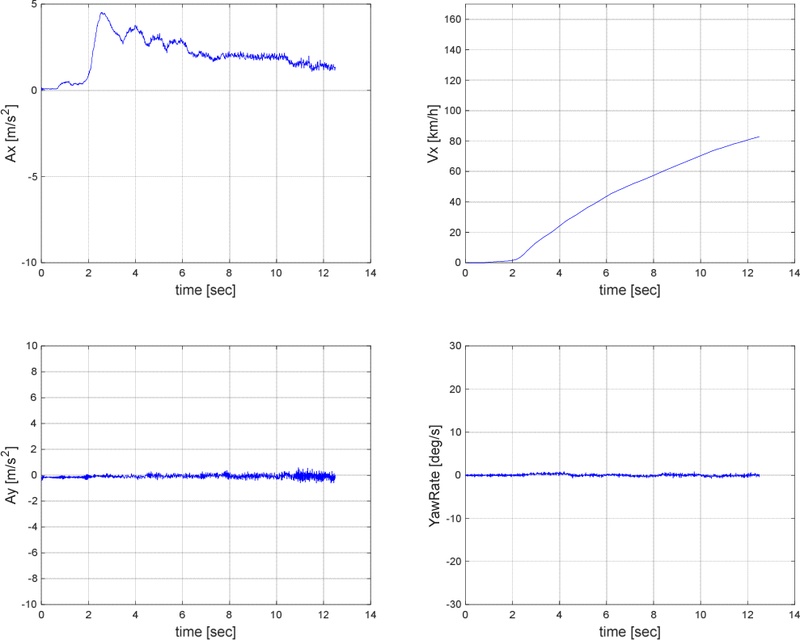
Vehicle test result in Accel. 50 % test scenario
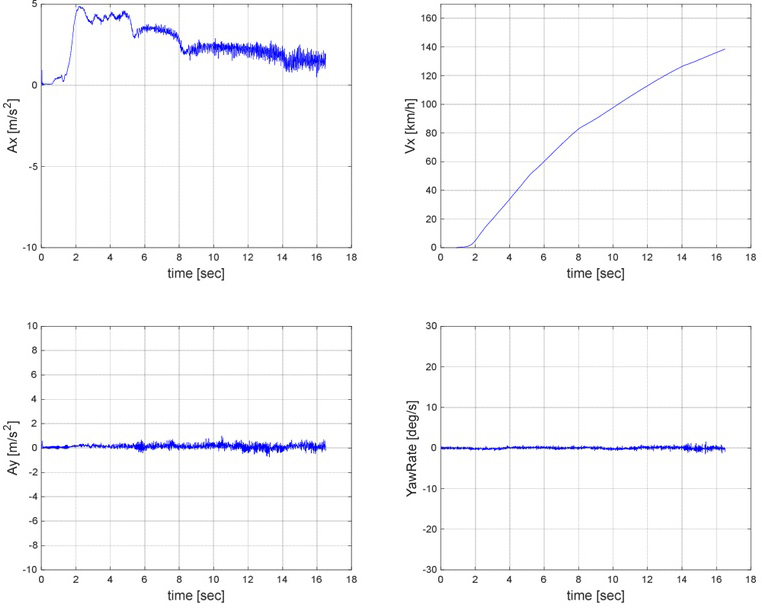
Vehicle test result in Accel. 100 % test scenario
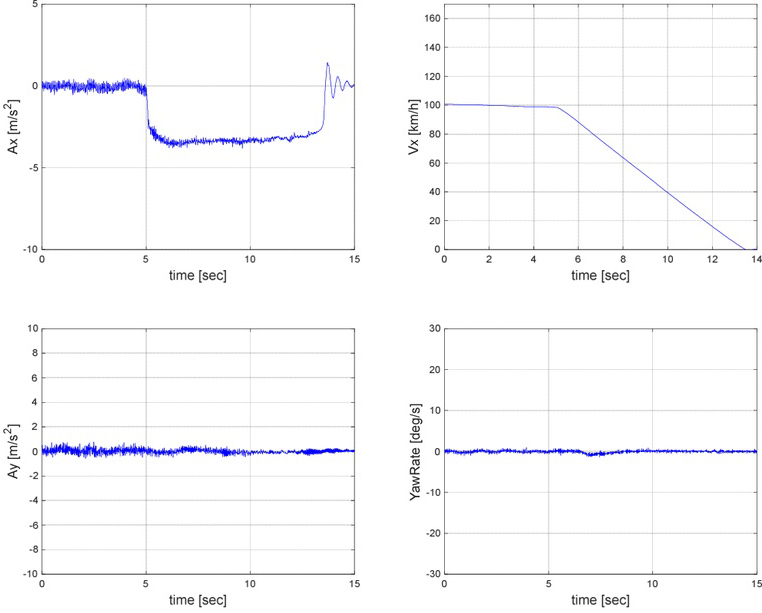
Vehicle test result in Decel. 0.4 g test scenario
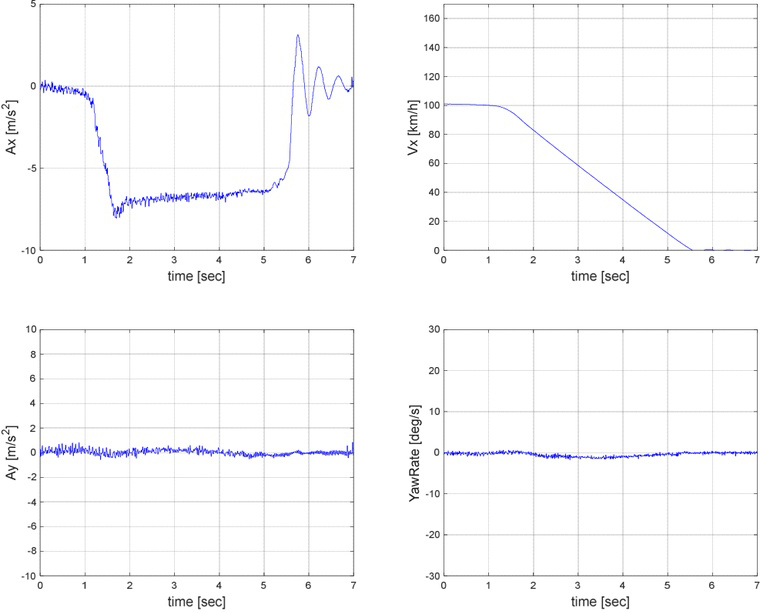
Vehicle test result in Decel. 0.8 g test scenario
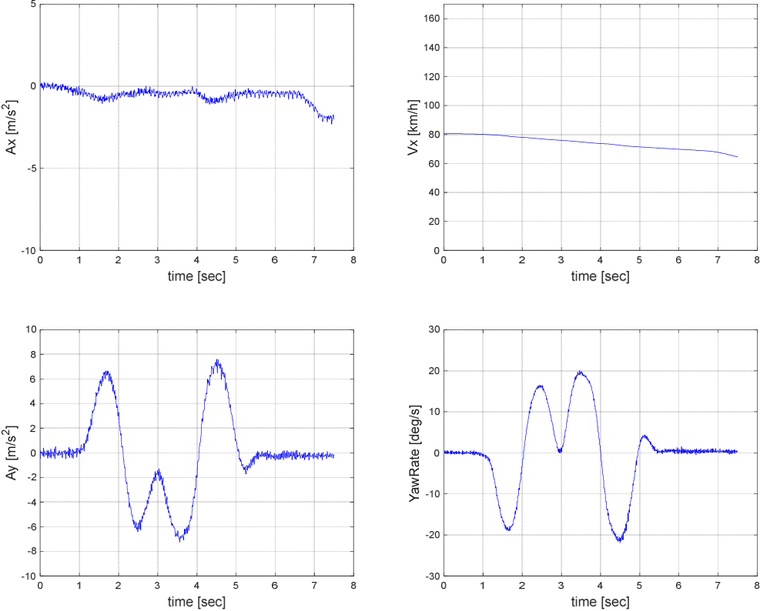
Vehicle test result in DLC test scenario
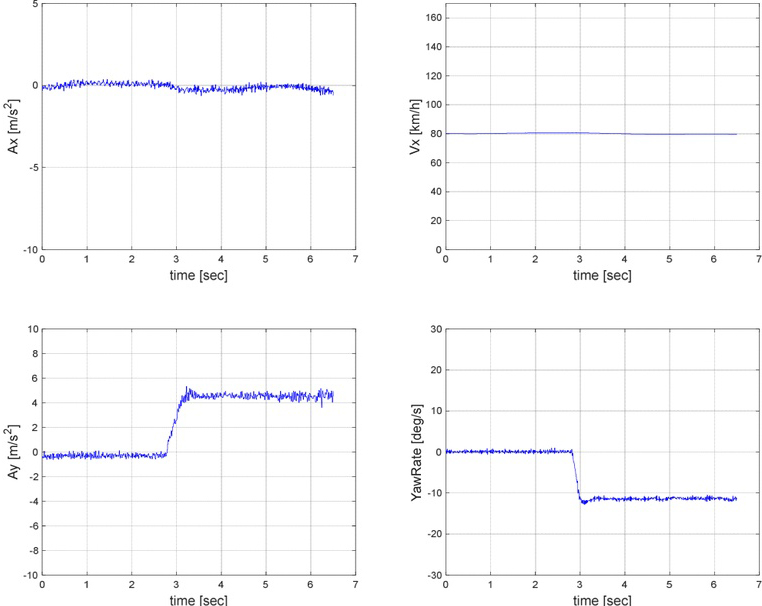
Vehicle test result in J-turn test scenario
Appendix B (Tucson TL data)
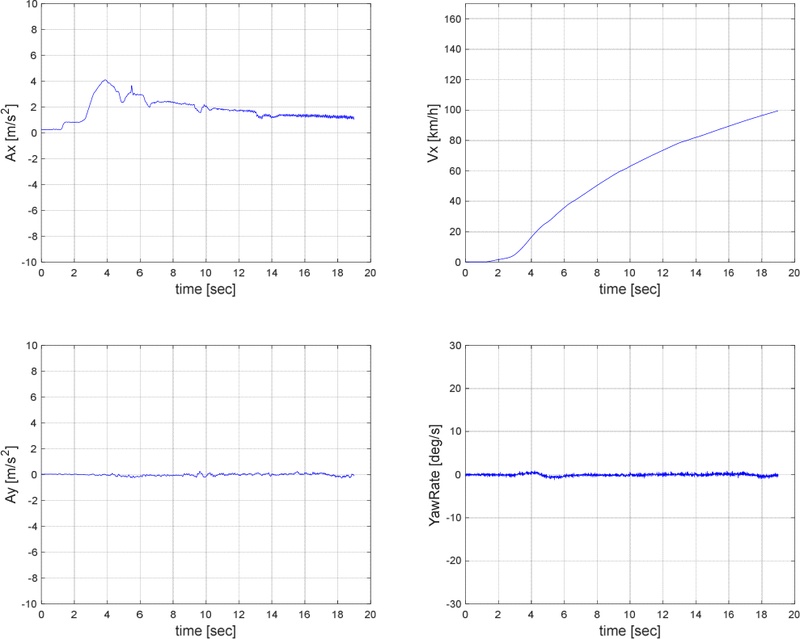
Vehicle test result in Accel. 50 % test scenario
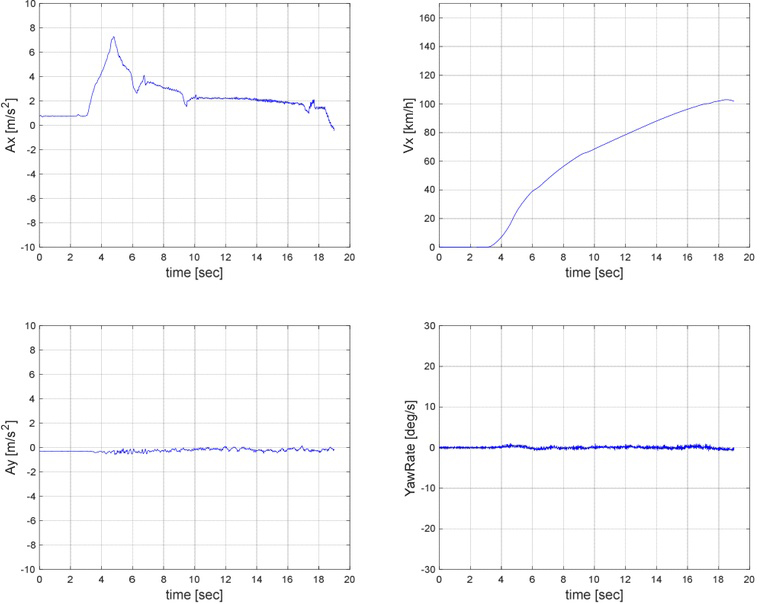
Vehicle test result in Accel. 100 % test scenario
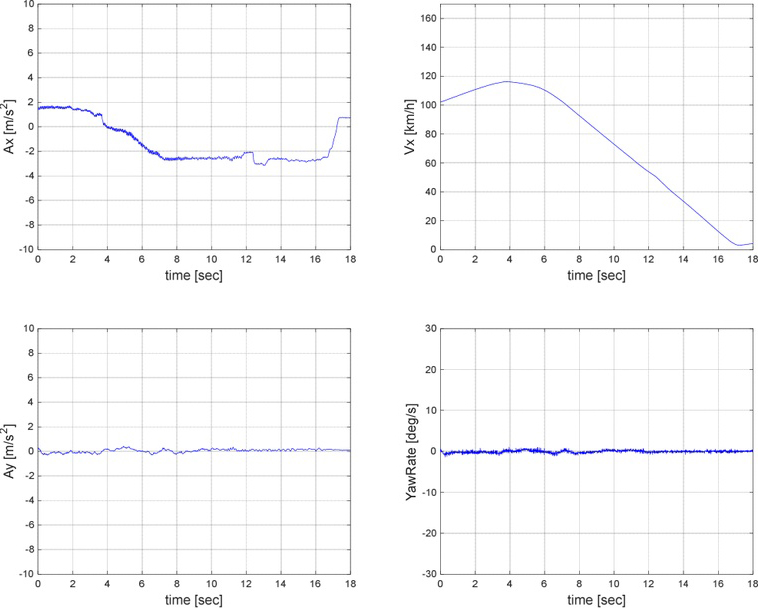
Vehicle test result in Decel. 0.4 g test scenario
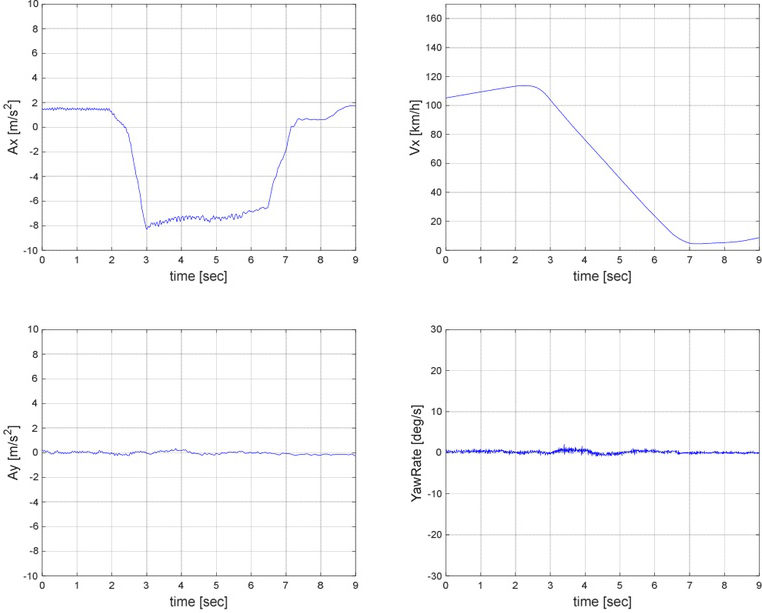
Vehicle test result in Decel. 0.8 g test scenario
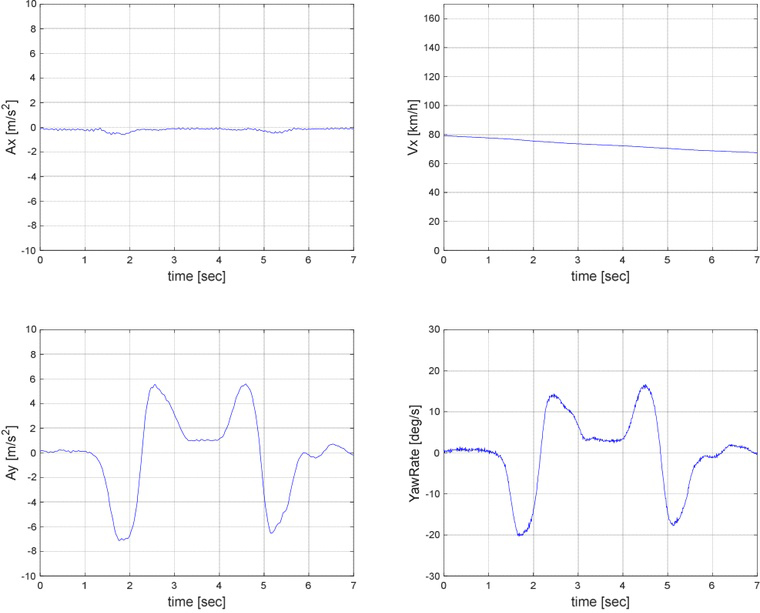
Vehicle test result in DLC test scenario
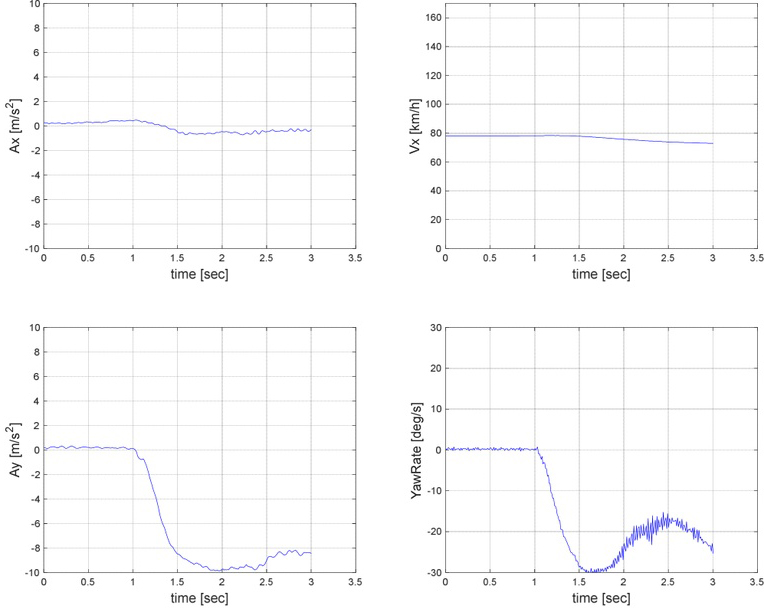
Vehicle test result in J-turn test scenario