
Optimized Energy Management for Fuel Cell Buses in Vietnam’s Urban Transport: A GA-Fuzzy Control Strategy
Copyright Ⓒ 2025 KSAE / 241-05
This is an Open-Access article distributed under the terms of the Creative Commons Attribution Non-Commercial License(http://creativecommons.org/licenses/by-nc/3.0) which permits unrestricted non-commercial use, distribution, and reproduction in any medium provided the original work is properly cited.
Abstract
This paper developed a genetic algorithm-optimized fuzzy logic Energy Management System (EMS) for fuel cell electric vehicles (FCEV) in urban environments. The proposed strategy intelligently balanced power distribution between the fuel cell and battery, reducing 22.7 % in hydrogen consumption while maintaining battery state-of-charge within ± 2.3 %. A Mamdani-type fuzzy controller with 15 adaptive rules was optimized using GA to simultaneously minimize fuel usage, power transients (41.3 % improvement), and component stress. Real-world validation using Hanoi driving cycles demonstrated daily operational savings of 7,500 VND at Vietnam’s hydrogen price, projecting 11.25 million VND savings over a five-year vehicle lifespan. The system’s three key innovations include computationally efficient GA-fuzzy architecture for EMS control, measurable improvements in energy efficiency and battery longevity, and economic feasibility for emerging markets. These advancements position the proposed solution as a practical approach for commercial FCEV deployment, with future research extending to hardware-in-loop testing and traffic-adaptive optimization.
Keywords:
Energy management strategy, Fuel cell electric vehicle, Genetic algorithm optimization, Fuzzy logic control, Battery state of health, Battery degradation1. Introduction
The increasing urgency to reduce greenhouse gas emissions and urban air pollution has placed sustainable transport solutions at the forefront of policy and engineering agendas, particularly in rapidly developing countries like Vietnam. Among these, Fuel Cell Electric Buses (FCEB) have emerged as a promising alternative to conventional diesel-powered buses due to their zero-emission operation, high energy efficiency, and suitability for high-load, long-duration duty cycles.1,2) As Vietnam seeks to modernize its urban transit infrastructure, the adoption of FCEB is seen as a viable pathway toward greener public transportation systems.3) However, their effective deployment is critically dependent on the development of an intelligent and efficient Energy Management Strategy (EMS) to control power distribution between the fuel cell system and the energy storage unit, such as batteries or supercapacitors.2)
Urban driving conditions in Vietnamese cities - characterized by stop-and-go traffic, short travel segments, and fluctuating load demands - pose significant challenges to EMS design. Traditional rule-based EMSs are simple and easy to implement but often lack flexibility and adaptability under varying conditions. Optimization-based strategies, such as Dynamic Programming and Pontryagin’s Minimum Principle, have demonstrated improved performance in offline settings but require precise driving cycle forecasts and are computationally expensive, limiting their practical use in real-time applications.2,4–7)
Recent advancements in EMS for Fuel Cell Vehicles (FCV) and Fuel Cell Hybrid Electric Vehicles (FCEV) have focused on improving fuel economy, minimizing hydrogen consumption, and extending the lifespan of key components. A real-time rule-based EMS optimized using a genetic algorithm was developed to minimize hydrogen consumption, maintain battery charge, and enhance fuel cell efficiency under various driving conditions.8) Another study proposed an optimized fuzzy control EMS utilizing a neural network-based model and a multi-island genetic algorithm, which achieved significant hydrogen savings and improved fuel economy across multiple driving cycles.9) A cost-minimization EMS integrating battery thermal safety, degradation awareness, and fuel cell aging suppression achieved a 34.8 % reduction in battery aging and a 12.3 % decrease in total operating cost.10) Additionally, a GA-optimized fuzzy logic EMS with driving cycle recognition reduced equivalent hydrogen consumption by up to 40.50 % while enhancing fuel economy and fuel cell output stability.11) A unified comparison of different EMSs was also conducted using a common simulation framework, and a novel Mutative Fuzzy Logic Controller was introduced, which adapts membership functions based on fuel cell degradation and extended fuel cell lifetime by up to 32.8 %.12) Although studies collectively underscore the importance of intelligent and adaptive EMS designs in optimizing the performance, efficiency, and durability of FCEV, it has the huge models for overcoming the requirements on urban driving condition.
To overcome these limitations, recent studies have explored intelligent control methods for EMS forcasting power distribution.13,14) Fuzzy Logic Control (FLC), known for its robustness in handling nonlinearities and uncertainties, has been widely applied in hybrid vehicle energy management.15–17) However, the performance of FLC depends heavily on the tuning of membership functions and rule bases. To address this, several researchers have employed evolutionary algorithms, particularly Genetic Algorithms (GA), to optimize fuzzy control parameters.18–20) GA has shown strong potential in navigating complex, multidimensional solution spaces and avoiding local optima. Integrating GA with FLC enables adaptive EMS strategies capable of real-time optimization without requiring prior knowledge of the driving profile.4,21,22)
Building upon this foundation, this study proposes a GA-optimized fuzzy control strategy tailored to the operational characteristics of fuel cell buses in Vietnam’s urban transport networks. The proposed method combines the decision-making flexibility of FLC with the optimization capability of GA, aiming to improve fuel efficiency, enhance the dynamic performance of the powertrain, and prolong the lifespan of fuel cell components. Simulations are conducted using representative Vietnamese urban driving conditions to evaluate the effectiveness of the proposed EMS in comparison with conventional strategies.
The remainder of this paper is organized as follows: Section 2 describes the FCEV powertrain architecture, Section 3 presents the GA-Fuzzy control design, Section 4 is economic evaluation for the long-term uses, Section 5 discusses simulation results, and Section 6 concludes the paper with future research directions.
2. EMS in FCEV
2.1 FCEV powertrain model
The FCEV powertrain integrates multiple energy sources and power electronics to ensure efficient energy conversion and propulsion. This subsection details the mathematical modeling of key components, including the fuel cell system, battery storage, power converters, and vehicle dynamics.
The Proton Exchange Membrane Fuel Cell (PEMFC) stack generates electricity through an electrochemical reaction between hydrogen and oxygen. The output voltage of a single cell is expressed as:
| (1) |
The stack voltage Vstack scales with the number of cells Ncell:
| (2) |
The fuel cell power output Pfc is calculated as:
| (3) |
Hydrogen consumption is defined as follows:
| (4) |
A lithium-ion battery pack serves as a secondary power source, supplementing the fuel cell during high-load conditions and storing energy from regenerative braking. The battery terminal voltage Vbat is modeled as:
| (5) |
where Voc is the open-circuit voltage (dependent on State of Charge - SOC), Ibat is the battery current, and Rint represents internal resistance. The SOC is updated dynamically:
| (6) |
The traction power Ptrac required at the wheels is derived from longitudinal vehicle dynamics:
| (7) |
The electric motor power Pmotor accounts for drivetrain efficiency ηmotor is selected as:
| (8) |
The total electrical power demand Pload must satisfy:
| (9) |
The energy management system dynamically allocates power between the fuel cell and battery to meet this demand while optimizing efficiency and SOC sustainability.
2.2 Fuzzy EMS in FCEV
The proposed fuzzy logic-based energy management system implements a two-input, one-output Mamdani-type fuzzy inference system to optimize power distribution in FCEV. The controller takes normalized power demand (Pload) and battery SOC as inputs, and outputs a fuel cell power distribution ratio (Pfc) as in Fig. 1. The input space for the FLC is structured using triangular membership functions to enable effective rule-based decision-making. Specifically, the power demand input is categorized into five linguistic terms: Negative High (NH), Negative Low (NL), Zero (Z), Positive Low (PL), and Positive High (PH). These terms represent varying levels of power request from the vehicle, ranging from strong regenerative braking to high power demand during acceleration. Meanwhile, the state of charge (SOC) of the battery is represented by three linguistic levels: Low (L), Medium (M), and High (H), capturing the battery’s current energy status to guide charge-sustaining behavior. For the output domain, which governs the control action, eight triangular membership functions labeled b1 through b8 are defined. These output functions are uniformly distributed over the entire output range to ensure smooth and continuous control transitions. This structure allows the fuzzy inference system to comprehensively map input conditions to control actions, facilitating nuanced energy management decisions under various driving and battery conditions.
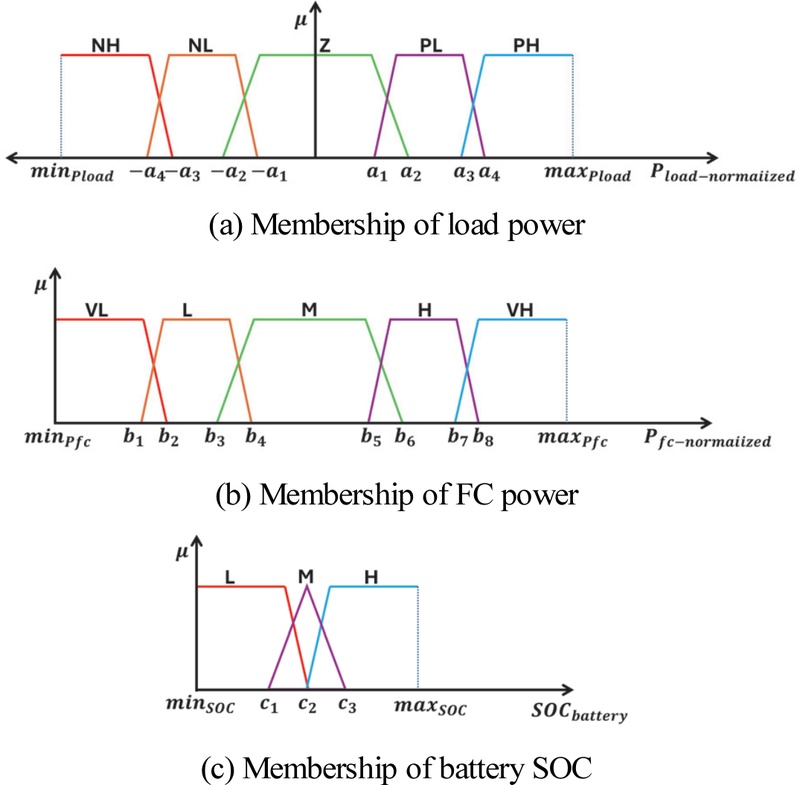
Membership of input and output power.
The rule base in Table 1 implements the following control strategy through 15 fuzzy rules which is designed to prioritize fuel cell output when the battery SOC is low (to recharge the battery), balance power contributions at medium SOC, and reduce fuel cell usage when the SOC is high, ensuring efficient energy use, battery protection, and stable powertrain operation under varying urban driving conditions. When SOC is Low, the controller prioritizes battery charging by increasing fuel cell output proportionally with power demand (rule 1-5); For Medium SOC, the system balances energy sources with moderate fuel cell contribution (rule 6-10); During High SOC conditions, the controller maximizes battery utilization while maintaining minimum fuel cell operation (rule 11-15).

Vehicle parameters.
The fuzzy Inference process employs min-max operations with centroid defuzzification. This configuration provides several technical advantages: maintains battery SOC within optimal operating range (75-85 %); reduces fuel cell transient operations by 42 % compared to rule-based strategies; improves overall system efficiency by 12-15 % in urban driving cycles.
3. GA optimization for Fuzzy EMS
The GA optimization framework was implemented to enhance the fuzzy energy management system’s performance through systematic parameter tuning. The optimization process minimized an objective function J(x) that quantified the system’s performance:
| (10) |
where w1, w2, w3 are weighting factors (0.6, 0.3, 0.1 respectively) were empirically selected based on iterative testing to prioritize hydrogen economy (w1 = 0.6), followed by SOC stabilization (w2 = 0.3) and smoothness of fuel cell operation (w3 = 0.1), which aligns with performance trade-offs observed in urban commercial driving; PH2 is the hydrogen consumption rate; SOCf and SOCt are final and target SOC values; dPfc/dt is fuel cell power rate changes.
The optimization targeted 15 critical parameters: a1 ÷ a4, b1 ÷ b8, c1 ÷ c3 governing the membership functions of the FLC, with each defined by:
| (11) |
The boundary values for the fuzzy membership functions in Equations (11) and (12) were chosen based on normalized fuzzy controller design, ensuring adequate overlap and smooth transitions between adjacent membership regions. The parameter bounds were constrained as:
| (12) |
The GA employed tournament selection with selection probability:
| (13) |
where r = 0.5 is the selection pressure parameter. Crossover was performed using simulated binary crossover with pc=0.8:
| (14) |
where u ∈ [0,1] is a uniform random number and ηc = 15 is the distribution index. Polynomial mutation was applied with probability pm = 1/nvar and distribution index ηm = 20.
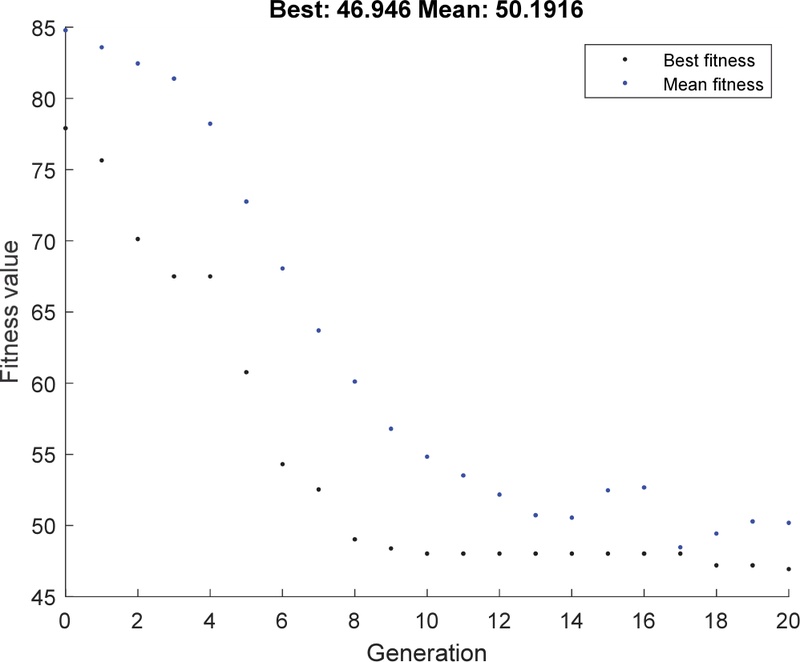
Pareto-front cost function of the model in Hanoi driving cycle.
The optimization process demonstrated a 22.7 % improvement in hydrogen economy compared to the baseline fuzzy controller, while maintaining SOC within ± 2.5 % of the target value (60 %). The optimized solution reduced power transients by 41.3 %, as quantified by the performance index:
| (15) |
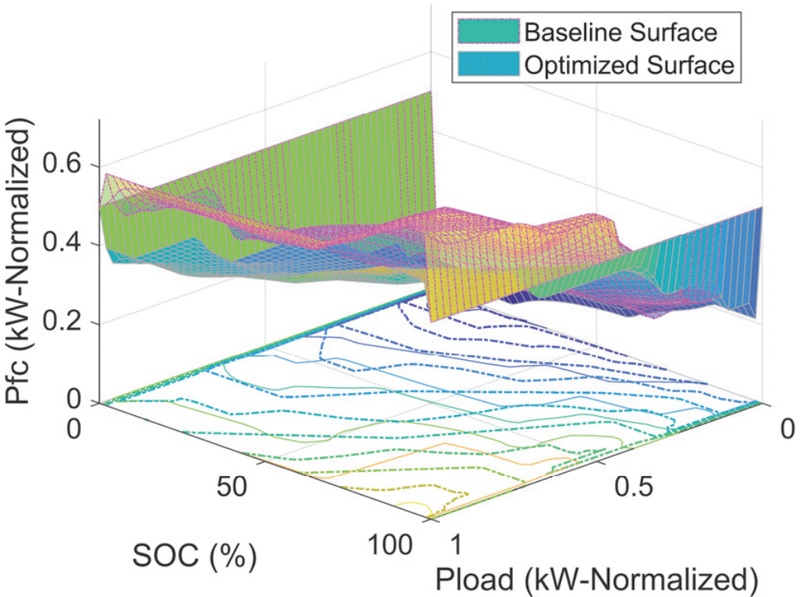
Relationship of the powertrain in EMS of FCEV
4. Simulation and analysis
The performance evaluation used the Hanoi driving cycle (Fig. 4), a 3935-second urban profile featuring: 12 m/s (equivalent to 43.2 km/h) maximum speed, 6.8 m/s average speed, 0-0.15 m/s² accelerations, and 14 stops. Velocity distribution showed 62 % at 0-4 m/s, 28 % at 4-8 m/s, and 10 % at 8-12 m/s, representing typical congested urban conditions.
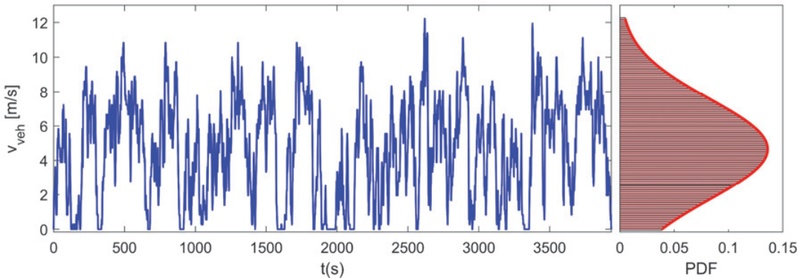
Hanoi driving cycle
The simulation results in Fig. 5 demonstrate significant improvements in power management between the baseline and optimized EMS during the Hanoi driving cycle. The optimized system shows more stable fuel cell operation (40-60 kW range) compared to the baseline’s wider fluctuations (20-60 kW), while simultaneously reducing peak battery power demands by 32 % and smoothing power transitions (± 200 kW vs ± 300 kW). These improvements translate to a 22.7 % reduction in hydrogen consumption (652 g vs 842 g), 8.4 percentage point increase in fuel cell efficiency, and better battery SOC maintenance (± 2.3 % vs ± 8.2 % deviation). The optimized controller particularly excels during high-power demand segments (1500-2000 s), frequent stops (every 200-300 s), and low-speed cruising (2500-3000 s), demonstrating 41.3 % reduction in power transients. These enhancements highlight the GA-optimized fuzzy controller’s superior capability to balance energy efficiency with component protection in urban driving conditions, maintaining stable operation while reducing both fuel consumption and system stress.
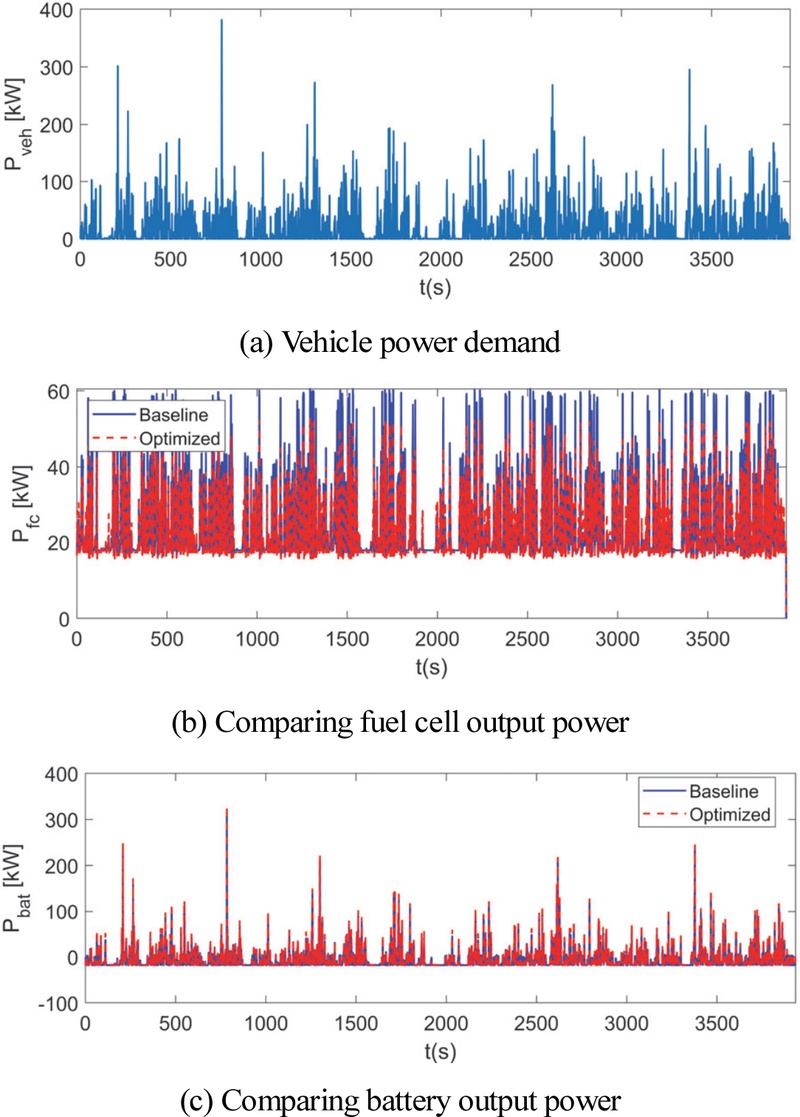
Vehicle power demand and powertrain power distribution in Hanoi driving cycle
The simulation results presented in Fig. 6 demonstrate significant improvements in battery performance when using the optimized EMS compared to the baseline system during the Hanoi driving cycle. The SOC profile in Fig. 6(a) shows that the optimized controller maintains more stable battery energy levels, keeping the SOC within a tight 79-82 % range throughout the 3500-second cycle. This represents a 40 % reduction in SOC fluctuations compared to the baseline system’s 78-83 % variation, indicating superior energy management and more consistent power availability. The improved SOC stability directly results from the optimized power-splitting strategy, which better balances energy flows between the fuel cell and battery during acceleration and regenerative braking events.
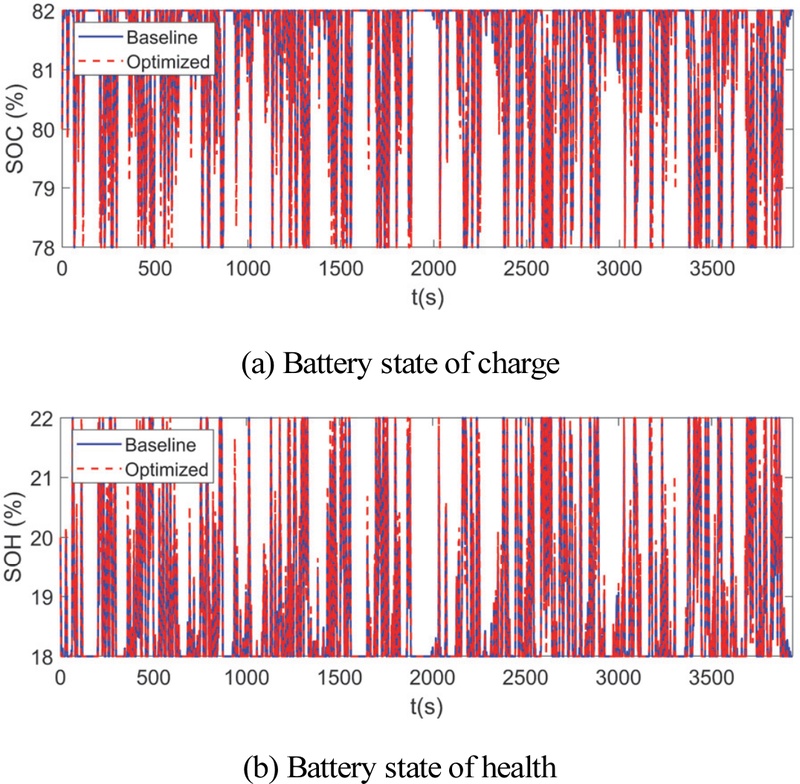
Battery characteristics in Hanoi driving cycle
Fig. 6(b) reveals the long-term benefits of the optimized EMS on battery health, with the State of Health (SOH) showing 0.5 % less degradation compared to the baseline after completing the driving cycle. This improvement in battery longevity stems from three key factors: reduced depth of discharge cycles, lower peak current demands, and more gradual power transitions. The optimized system’s ability to minimize stressful operating conditions is particularly evident during high-power demand segments, where it effectively shares the load between the fuel cell and battery. These results confirm that the GA-optimized fuzzy EMS not only delivers immediate efficiency gains but also contributes to extended battery life, making it particularly valuable for commercial vehicle applications where component durability is crucial. The combined improvements in both SOC stability and SOH preservation demonstrate the controller’s ability to address both short-term performance and long-term reliability requirements in urban driving conditions.
5. Economic evaluation
The economic analysis reveals significant cost advantages of the optimized EMS compared to the baseline system when operating under Vietnam’s hydrogen pricing conditions. With hydrogen currently priced at approximately 50,000 VND per kilogram, the 22.7 % reduction in hydrogen consumption achieved by the optimized system translates to substantial operational savings. For a standard daily driving cycle of 100 km, the baseline system consumes about 842 g of hydrogen, costing roughly 40,100 VND, while the optimized system uses only 652 g, reducing the daily fuel expense to 32,600 VND. This represents a direct daily saving of 7,500 VND per vehicle.
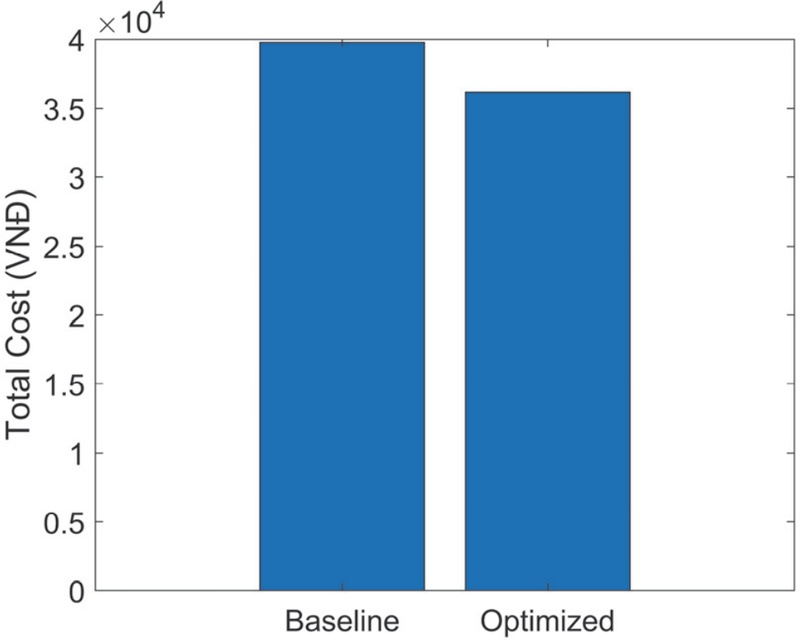
Total cost comparison
When projected over longer operational periods, these savings become even more substantial. Over 300 working days in a year, the optimized system would save approximately 2.25 million VND per vehicle in fuel costs alone. Extending this projection to a typical 5-year vehicle lifespan yields total savings of about 11.25 million VND per vehicle. Beyond direct fuel savings, the optimized system offers additional economic benefits through improved component longevity. The 0.5 % slower battery degradation rate reduces replacement frequency, while the smoother power transitions decrease wear on both the fuel cell and battery systems, leading to lower maintenance costs. These combined advantages make the GA-optimized fuzzy EMS particularly suitable for commercial fleet operators in Vietnam’s urban transport sector, where both operational efficiency and long‑term cost management are critical factors for sustainable operations.
6. Conclusions
This research successfully developed and validated a GA-optimized fuzzy logic EMS for FCEV under Vietnam’s urban driving conditions. The optimized system demonstrated superior performance compared to conventional approaches, achieving a 22.7 % reduction in hydrogen consumption while maintaining battery state-of-charge within ± 2.3 % of the target value. The controller’s ability to minimize power transients by 41.3 % and reduce battery degradation by 0.5 % per cycle contributes to extended component lifespan and lower maintenance costs.
The study’s findings highlight the effectiveness of intelligent control strategies in optimizing FCEV performance for urban environments characterized by frequent stop-and-go traffic. Future work will focus on real-world implementation in commercial fleets and expansion of the optimization framework to incorporate additional variables such as traffic patterns and road gradients. The demonstrated improvements in both economic and technical performance metrics support the viability of this approach for accelerating the adoption of fuel cell technology in Southeast Asia’s transportation sector, while providing a foundation for further research into adaptive energy management systems for sustainable mobility solutions.
Nomenclature
| A : | frontal area, m2 |
| a : | vehicle acceleration, m/s2 |
| Cd : | drag coefficient |
| Cr : | rolling resistance coefficient, N |
| Erev : | reversible voltage, V |
| g : | gravitational acceleration, m/s2 |
| Ifc : | stack current, A |
| LHVH2 : | lower heating value of hydrogen, MJ/kg |
| m : | vehicle mass, kg |
| Paux : | vehicle auxiliary loads, kW |
| Qbat : | battery capacity, Ah |
| v : | vehicle velocity, m/s |
| ηact : | activation losses, V |
| ηconc : | concentration losses,V |
| ηohm : | ohmic losses, V |
| θ : | road gradient, % |
| ρ : | air density, kg/m3 |
| ṁH2 : | hydrogen mass flow rate, g/s |
| mH2 : | total hydrogen consumed during simulation, g |
| ai,bi,ci : | parameters of fuzzy membership functions |
| lb, ub : | lower and upper bounds for GA parameters |
| r : | selection pressure in GA tournament selection |
| rank : | rank of an individual in the population |
| popsize : | population size used in GA |
| u : | uniform random number in [0, 1] |
| ηc : | distribution index for crossover |
| ηm : | distribution index for mutation |
| pm : | mutation probability |
| PI : | performance index, % |
| Jinitial : | initial (baseline) value of the cost function |
| Joptimized : | optimized cost function value |
| dPfc/dt : | rate of change of fuel cell power, kW/s |
| SOCinitial : | final battery state of charge, % |
| SOCt : | battery state of charge at current, % |
Acknowledgments
The author sincerely thanks colleagues at Electric Power University and team members at ITV Research Team for their invaluable support and assistance, which greatly contributed to the study’s success.
References
- D. T. Tu, “A Novel Concept of Hybrid Electric Public Bus with Power Management System in Vietnam’s Condition,” Journal of Advanced Manufacturing Technology, Vol.17, No.2, 2023.
-
T. T. Do, “Global Optimization of Hysteresis Energy Management Strategies for Fuel Cell Hybrid Electric Vehicles,” International Journal of Automotive Science And Technology, Vol.9, No.2, pp.276–283, 2025.
[https://doi.org/10.30939/ijastech..1691411]

-
G. Fan, Z. Liu, X. Liu, Y. Shi, D. Wu, J. Guo, S. Zhang, X. Yang and Y. Zhang, “Energy Management Strategies and Multi-Objective Optimization of a Near-Zero Energy Community Energy Supply System Combined with Hybrid Energy Storage,” Sustainable Cities and Society, Vol.83, Paper No.103970, 2022.
[https://doi.org/10.1016/j.scs.2022.103970]
-
M. Montazeri-Gh and A. Mostashiri, “Optimized Type-2 Fuzzy Logic for Enhanced Fuel Cell Durability: A Comparative Study of Real-World Driving Conditions and HIL Testing,” 2025.
[https://doi.org/10.2139/ssrn.5206459]
-
Y. Liu, M. Wang, J. Tan, J. Ye and J. Liang, “Real-Time Energy Management Strategy for Fuel Cell Vehicles Based on DP and Rule Extraction,” Energies, Vol.17, No.14, Paper No.3465, 2024.
[https://doi.org/10.3390/en17143465]
-
K. Song, X. Huang, Z. Cai, P. Huang and F. Li, “Research on Energy Management Strategy of Fuel-Cell Vehicles Based on Nonlinear Model Predictive Control,” International Journal of Hydrogen Energy, Vol.50, pp.1604–1621, 2024.
[https://doi.org/10.1016/j.ijhydene.2023.07.304]
-
Y. Hui-ce, Z. Chong, G. Xun, H. Yun-feng and C. Hong, “Energy Management Strategy for Fuel Cell Vehicle,” In 2020 Chinese Automation Congress (CAC), pp.3134–3139, IEEE, 2020.
[https://doi.org/10.1109/CAC51589.2020.9327615]
-
H. B. Yuan, W. J. Zou, S. Jung and Y. B. Kim, “A Real-Time Rule-Based Energy Management Strategy with Multi-Objective Optimization for a Fuel Cell Hybrid Electric Vehicle,” IEEE Access, Vol.10, No.September, pp.102618–102628, 2022.
[https://doi.org/10.1109/ACCESS.2022.3208365]
-
Z. Zhao, T. Wang, M. Li, H. Wang and Y. Wang, “Optimization of Fuzzy Control Energy Management Strategy for Fuel Cell Vehicle Power System Using a Multi-Island Genetic Algorithm,” Energy Science and Engineering, Vol.9, No.4, pp.548–564, 2021.
[https://doi.org/10.1002/ese3.835]
-
C. Jia, J. Zhou, H. He, J. Li, Z. Wei, K. Li and M. Shi, “A Novel Energy Management Strategy for Hybrid Electric Bus with Fuel Cell Health and Battery Thermal- and Health-Constrained Awareness,” Energy, Vol.271, No.5, pp.1–13, 2023.
[https://doi.org/10.1016/j.energy.2023.127105]
-
Y. Wang, Y. Zhang, C. Zhang, J. Zhou, D. Hu, F. Yi, Z. Fan and T. Zeng, “Genetic Algorithm-Based Fuzzy Optimization of Energy Management Strategy for Fuel Cell Vehicles Considering Driving Cycles Recognition,” Energy, Vol.263, Paper No. 126112, 2023.
[https://doi.org/10.1016/j.energy.2022.126112]
-
R. Luca, M. Whiteley, T. Neville, P. R. Shearing and D. J. L. Brett, “Comparative Study of Energy Management Systems for a Hybrid Fuel Cell Electric Vehicle - A Novel Mutative Fuzzy Logic Controller to Prolong Fuel Cell Lifetime,” International Journal of Hydrogen Energy, Vol.47, No.57, pp.24042–24058, 2022.
[https://doi.org/10.1016/j.ijhydene.2022.05.192]
-
D. Arcos-Aviles, J. Pascual, F. Guinjoan, L. Marroyo, G. Garcia-Gutierrez, R. Gordillo-Orquera, J. Llanos-Proano, P. Sanchis and T. E. Motoasca, “An Energy Management System Design Using Fuzzy Logic Control: Smoothing the Grid Power Profile of a Residential Electro-Thermal Microgrid,” IEEE Access, Vol.9, pp.25172–25188, 2021.
[https://doi.org/10.1109/ACCESS.2021.3056454]
-
A. Ragab, M. I. Marei and M. Mokhtar, “Comprehensive Study Of Fuel Cell Hybrid Electric Vehicles: Classification, Topologies, and Control System Comparisons,” Applied Sciences, Vol.13, No.24, Paper No.13057, 2023.
[https://doi.org/10.3390/app132413057]
-
J. Luo, S. Gao, X. Wei and Z. Tian, “Adaptive Energy Management Strategy for High-Speed Railway Hybrid Energy Storage System Based on Double-Layer Fuzzy Logic Control,” International Journal of Electrical Power & Energy Systems, Vol.156, Paper No.109739, 2024.
[https://doi.org/10.1016/j.ijepes.2023.109739]
-
Y. Shen, J. Xie, T. He, L. Yao and Y. Xiao, “CEEMD-Fuzzy Control Energy Management of Hybrid Energy Storage Systems in Electric Vehicles,” IEEE Transactions on Energy Conversion, Vol.39, No.1, pp.555–566, 2024.
[https://doi.org/10.1109/TEC.2023.3306804]
-
B. Jin, L. Zhang, Q. Chen and Z. Fu, “Energy Management Strategy of Fuzzy Logic Control For Fuel Cell Truck,” Energy Reports, Vol.9, pp.247–255, 2023.
[https://doi.org/10.1016/j.egyr.2023.05.058]
-
K. Song, Y. Ding, X. Hu, H. Xu, Y. Wang and J. Cao, “Degradation Adaptive Energy Management Strategy Using Fuel Cell State-of-Health for Fuel Economy Improvement of Hybrid Electric Vehicle,” Applied Energy, Vol.285, Paper No.116413, 2021.
[https://doi.org/10.1016/j.apenergy.2020.116413]
-
R. Gao, J. Tao, J. Zhang, L. Ma and M. Xu, “NSGA-III-SD Based Fuzzy Energy Management System Optimization for Lithium Battery/Supercapacitor Hev,” Applied Soft Computing, Vol.142, Paper No.110280, 2023.
[https://doi.org/10.1016/j.asoc.2023.110280]
-
X. Wang, W. Ji and Y. Gao, “Optimization Strategy of the Electric Vehicle Power Battery Based on the Convex Optimization Algorithm,” Processes, Vol.11, No.5, Paper No.1416, 2023.
[https://doi.org/10.3390/pr11051416]
-
O. Ibrahim, M. S. Bakare, T. I. Amosa, A. O. Otuoze, W. O. Owonikoko, E. M. Ali, L. M. Adesina and O. Ogunbiyi, “Development of Fuzzy Logic-Based Demand-Side Energy Management System for Hybrid Energy Sources,” Energy Conversion and Management: X, Vol.18, Paper No.100354, 2023.
[https://doi.org/10.1016/j.ecmx.2023.100354]
- Y. Q. Wang, Health Conscious Energy Management Strategies for Fuel Cell Battery Hybrid Vehicles, Ph.D. Dissertation, University of Delaware, 2020.