
수소가 충전된 고분자에서 수소 장입량과 확산도 측정을 위한 부피 및 압력 분석법 기반의 수소 가스 센서
Copyright Ⓒ 2025 KSAE / 240-02
This is an Open-Access article distributed under the terms of the Creative Commons Attribution Non-Commercial License(http://creativecommons.org/licenses/by-nc/3.0) which permits unrestricted non-commercial use, distribution, and reproduction in any medium provided the original work is properly cited.
Abstract
Hydrogen infrastructure is expanded to realize the hydrogen economy, necessitating precise sensing technology for the safe management of hydrogen, which has a wide explosive range. This study proposed two types of hydrogen gas sensors based on volumetric and pressure analysis. The sensors accurately measured the hydrogen uptake and diffusivity of polymers charged under high-pressure conditions. The performance evaluation showed a stability of 0.2 % and a resolution of 0.12 wt⋅ppm, with a response time of less than one second, allowing precise detection of hydrogen concentrations ranging from 0.1 wt⋅ppm to 1400 wt⋅ppm. The sensors also featured adjustable sensitivity, resolution, and measurement range. Measurement results from both sensors were consistent within the uncertainty range. The proposed system enabled real-time monitoring and characterization of hydrogen gas and is expected to contribute to safe infrastructure operation and the advancement of the hydrogen economy.
Keywords:
Volumetric analysis, Manometric analysis, Hydrogen, Uptake, Diffusivity, Polymer키워드:
부피 분석, 압력 분석, 수소, 장입량, 확산도, 고분자1. 서 론
수소는 가장 가벼운 기체로, 공기 중에서 빠르게 확산하는 성질을 가진다. 이러한 특성으로 인해 누출 시 광범위하게 확산될 가능성이 높으며, 특히 공기 중에서 수소의 농도가 4 %에서 75 %일 경우 폭발 위험이 존재한다.1,2) 따라서, 수소의 안전한 활용을 위해서는 실시간으로 농도를 정확하게 측정할 수 있는 고성능 센서 기술이 필수적이다.
최근 수소 경제가 본격적으로 활성화됨에 따라, 수소의 생산, 저장, 운송, 활용 과정 전반에서 농도를 정밀하게 모니터링하는 기술의 필요성이 더욱 강조되고 있다. 수소 충전소, 배관망, 연료전지 시스템, 수전해 장치, 화학 공정 등 다양한 산업 분야에서 수소 농도를 신속하게 감지하고, 폭발 위험 농도에 도달하기 전에 즉각적인 경보 시스템을 작동시켜 사고를 예방하는 것이 중요하다. 이에 따라, 신뢰성이 높은 수소 센서는 수소 기반 에너지 시스템의 안전성과 효율성을 보장하는 핵심 요소로 자리 잡고 있으며, 안정적인 운영과 사고 예방을 위해 필수적인 기술로 주목받고 있다.3-15)
또한, 수소 사회 구축을 위한 핵심 인프라인 수소충전소와 수소 연료전기차의 보급이 확대되면서, 수소의 안전한 저장과 운송을 위한 수소 차폐 기술의 중요성도 더욱 부각되고 있다. 특히, 고분자 오링과 같은 가스 밀폐 소재의 성능을 정밀하게 평가하는 기술이 필수적이며, 이를 위해 수소 가스의 투과도와 누설량을 정량적으로 측정할 수 있는 신뢰성 높은 센서 기술이 요구된다. 이와 더불어, 밀폐 소재의 효율성을 극대화하려면 수소 환경에서의 재료 물성 변화, 기계적 강도, 내구성, 그리고 물리적⋅역학적 안정성을 정밀하게 분석하는 것이 중요하다.16-39) 따라서, 수소 인프라의 신뢰성을 높이고 장기적인 안정성을 확보하기 위해서는 고분자 소재의 특성을 면밀히 평가할 수 있는 정밀 측정 기술과 함께, 실시간 감지가 가능한 고성능 수소 센서 기술의 개발이 필수적이다.
현재 사용되는 수소 센서 기술은 전기화학식,40-45) 반도체식,46-48) 광학식,49-50) 촉매 연소,51-53) 차압 센서,54-57) 가스 크로마토그래피 센서,58-63) 질량 분석 기반 센서64-71) 등 다양한 방식들의 센서가 존재한다. 이 센서들의 방법은 각각 장단점이 있으며, 사용 환경과 요구 사항에 맞는 센서를 선택하는 것이 바람직하다. 가령, 전기화학식 센서는 높은 정확도를 제공하지만 가격이 비싸고, 응답시간이 길고, 수명이 짧다는 단점이 있고, 반도체식 센서는 가격이 저렴하고 내구성이 뛰어나지만 온도와 습도 변화에 민감하다. 적외선 센서는 높은 선택성을 제공하지만 고가이며, 특정 가스에만 반응하는 특성이 있다. 가스 크로마토그래프와 질량 분석기는 상대적으로 크고 비싸며, 주기적인 유지보수를 요하며 샘플링 속도가 느리다는 단점이 있다. 이러한 기존 센서들은 실시간 수소 모니터링에 있어 제한적이어서 새로운 센싱 기술의 필요성이 부각되고 있다.
본 연구에서는 수소 인프라의 안전성과 효율성을 향상시키기 위해 실시간으로 수소 농도를 정밀하게 감지할 수 있는 두 종류의 센서 시스템을 제안한다. 이는 부피 분석과 압력 분석 기법이며, 이 센서기술은 자체 개발한 확산 분석 프로그램과 온도와 압력 변화의 보상을 통해 정확한 측정과 분석이 가능하게 된다.72-75) 두 센서에서의 얻은 수소 장입량과 확산도의 측정결과는 불확도 내에서 동일함을 보여줌으로 측정결과에 대한 신뢰성을 확인할 수 있었다. 또한 개발된 센서는 민감도와 안정성을 갖추고 있으며, 고압 환경에서도 신뢰성 있는 성능을 발휘한다.
2. 실 험
2.1 시료 준비
본 연구에서는 수소 방출 농도 및 확산 계수를 분석하기 위해 세 가지 고분자 소재를 사용하였으며, 이는 고밀도 폴리에틸렌(High-Density Polyethylene, HDPE), 니트릴 부타디엔 고무(Nitrile Butadiene Rubber, NBR), 에틸렌 프로필렌 디엔 모노머(Ethylene Propylene Diene Monomer, EPDM) 이다.
HDPE는 수소 연료 전지 차량의 타입 Ⅳ 수소 탱크의 라이너 소재로 널리 적용되며, 수소 기체의 확산을 억제하여 탱크의 안전성을 향상시키고 경량화에 기여하는 역할을 한다.
EPDM과 NBR은 고압 가스 저장 탱크의 O-ring 밀폐 소재로 사용되며,76-78) 두 고분자는 모두 뛰어난 내열성과 내구성을 갖추고 있어 고압 수소 환경에서도 안정적인 성능을 유지할 수 있다. 특히, EPDM은 고온에서도 화학적⋅물리적 안정성이 우수하여 수소 환경에서 누출을 방지하고 밀봉 효과를 극대화하는 데 적합하다. 반면, NBR은 우수한 화학적 저항성을 가지며, 다양한 환경에서 안정적인 물성을 유지하는 특징이 있다.
이들 고분자 시료는 60 °C에서 48시간 동안 열처리 과정을 거쳐 탈기(Outgassing)를 진행하였으며, 이를 통해 배합 과정에서 포함된 휘발성 유기 화합물(VOC)과 잔류 수분을 제거하여 순수한 수소 방출량을 측정할 수 있도록 하였다. 실험에 사용된 시료는 두께 T = 2.0 ~ 2.5 mm 인 범위를 가지는 시트 형태로 제작되었다. 본 연구에 사용된 3종 고분자 시료의 구성비와 밀도는 Table 1과 같다.

Composition ratio and density of polymer. Unit : phr(parts per hundred rubber, indicating the weight (g) of each composition per 100 g of polymer matrix)
2.2 고압 수소 충전
상온에서 설정된 압력으로 고압 수소 가스를 주입(충전)하기 위해 스테인리스강(Stainless Steel, SUS 316)으로 제작된 고압 용기를 사용하였다. 수소 충전 과정은 1 MPa에서 10 MPa의 범위에서 진행되었으며, 실험에 사용된 수소 가스의 순도는 99.999 %이다. 시료는 고압 환경에서 24시간 동안 수소 가스를 충전하는 과정을 거쳤으며, 이는 수소가 충분히 흡수되어 평형 상태에 도달하는 데 충분한 시간이다.12,13) 충전이 완료된 후, 밸브를 개방하여 압력을 낮춘 뒤 대기압에 도달한 순간을 기준점(시간 0)으로 설정하고 측정을 시작하였다. 이 시점(시간 0)부터 시료 내부에 저장된 수소가 급격히 방출되기 시작한다. 한편, 이 기준점부터 측정이 시작되기까지 약 5분의 시간이 소요되며, 이 구간을 ‘시간지연(Time delay)’으로 정의하였다.
2.3 부피 분석법
고분자 시료에 고압 수소를 주입(충전)한 후, 수소의 장입량과 확산도를 측정하기 위해 기 개발된 부피측정 기술을 사용하였다.78,79) Fig. 1(a)와 (b)는 상온에서 방출된 수소를 정확하게 정량화하기 위해 사용된 부피 분석 시스템을 나타낸다. 이 시스템은 고압 수소 봄베에서 수소를 시료가 들어 있는 고압 챔버로 공급한 후, 챔버 내에서 시료에 수소를 주입하고 Fig. 1(a), 이후 감압된 시료를 물통(Water container)안에 물이 일부 채워진 세워져 있는 눈금 실린더(Graduated cylinder) 내부의 윗 공간에 넣고 시료에서 방출되는 수소량을 측정하는 방식이다Fig. 1(b).
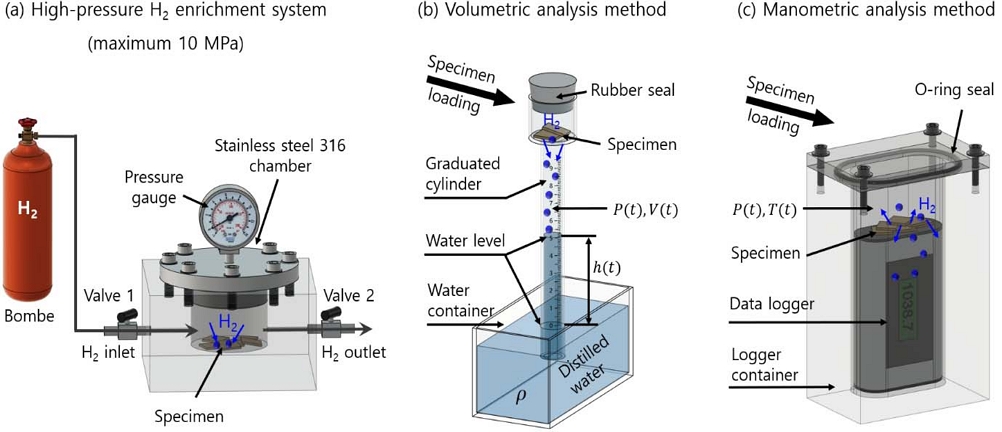
A volumetric and manometric analysis system was used to measure the hydrogen gas released by a specimen after exposure to high-pressure gas and decompression. (a) The specimen is charged with gas in the high-pressure chamber supplied from H2 high pressure bombe. (b) After decompression, the specimen is placed in the upper air space of the graduated cylinder. The cylinder is submerged in a water container and H2 emission measurements are conducted. (c) After decompression, the specimen is placed in the specimen container together with data logger. The blue area in (b) represents the water. The blue circles in (b) and (c) indicate the hydrogen gas emitted from the charged sample
고압 가스를 일정시간 동안 충전하고 난 후 감압 후, 시료는 Fig. 1(b)에서와 같이 실린더의 윗 부분의 공간에 놓고 Rubber seal을 이용하여 밀봉한다. 이때부터 시료에서 방출된 수소는 실린더 내 물의 수위를 점차적으로 감소시킨다. 이로 인해 실린더 내부의 기체의 압력(P)과 부피(V)는 경과 시간에 따라 변화하고 다음과 같이 표시할 수 있다.80-82)
| (1) |
실린더의 빈 공간의 시간에 따른 변화하는 내부 압력 P(t)는 대기압[Po (t)]과 수력 압력, [ρgh(t)]의 차이로 표현할 수 있다. 여기서 PO는 실린더 외부의 압력, g는 중력 가속도, ρ는 증류수의 밀도를 나타낸다. h(t)는 시간에 따른 눈금 실린더 내 물의 수위를 나타낸다. 식 (1)의 두 번째에서 V(t)는 시간에 따라 변하는 실린더 내부의 기체의 부피이고, Vo는 실린더 내부의 기체와 물이 차지하는 총 부피로, 물 탱크의 수위를 기준으로 측정된다. Vh (t)는 시간에 따른 실린더 내 물이 차지하는 부피를 나타내며, Vₛ는 시료의 부피이다. 실린더 내의 기체는 PV = nRT의 이상 기체 법칙을 따른다. 여기서 R은 기체 상수(8.20544 × 10⁻⁵ m³⋅atm/(mol⋅K))이고, T는 실린더 내 기체의 온도, n은 실린더에서 시료에서 방출된 수소 기체의 몰 수와 이미 잔존하는 공기의 몰수의 합이다.
고분자 시료에서 방출된 수소 기체의 양은 시간에 따른 물 수위 변화 [Vh (t)]를 측정하여 정량화 할 수 있다. 즉, 수소 가스 방출에 의한 물의 수위 감소값[Vh (t)]이 시료에서 방출된 수소 가스 부피[ΔV(t)]에 해당한다. 이로부터 방출된 수소 가스 몰 수 [Δn(t)]는 이상 기체 법칙에 의해 다음과 같이 표현된다.81,82)
| (2) |
식 (2)의 Δn(t)로부터 시료에서 방출된 단위 질량당 수소 질량비 [C(t)] 다음과 같이 변환된다.
| (3) |
여기서 수소 가스의 몰 질량 mH2[g/mol]은 2.016 g/mol이고, msample[g]은 시료의 질량이다. 식 (2)와 (3)에서 시간에 따른 방출 수소 몰 수 ∆n(t)는 방출된 수소 질량비 C(t)로 변환되었으며, 이때 변환 계수는 이다. Δn(t)와 C(t)는 실험실 환경에서의 온도와 압력 변화에 영향을 받는데, 정확한 측정을 위해 이러한 변화를 보상하는 것이 필요하다. 이러한 보상은 식 (2)와 (3)에서 온도와 압력 측정 데이터를 실시간 측정 후에 입력하여 프로그램을 통한 계산으로 자동으로 수행된다. 한편 수소 가스의 방출량은 디지털 카메라를 사용한 이미지 분석 알고리즘을 적용하여 물 수위 변화를 모니터링함으로써 측정하였다.
2.4 압력 분석법
Fig. 1(a)와 (c)는 상온에서 시편으로부터 방출된 가스의 방출량과 확산도를 측정하기 위해 사용된 압력 분석장치를 보여준다. 이 장치는 Fig. 1(a)에서와 같이 수소 가스를 공급하기 위한 고압 봄베, 봄베로부터 수소를 공급받아서 시료에 일정 시간 동안 충전시키기 위한 스텐레스 스틸(Stainless steel, SUS 316)로 제작한 충전용 챔버이고, Fig. 1(c)는 ELP로 정의한 상용 데이터 로거와 충전 시료가 들어있는 직육면체 형태의 용기로 구성되어 있다. ELP 센서는 압력과 온도를 측정하기 위해 사용되며, 대기압과 온도를 동시에 기록할 수 있는 상용 데이터 로거(EL-SIE-6+, Lascar Electronics, UK)이다.
스테인리스 스틸 챔버에서 수소를 충전 및 감압 후, 시편은 Fig. 1(c)의 직육면체형의 용기로 옮겨진 후 오링을 이용한 실링을 통해 밀폐시킨다. 이때 용기내의 시편에서 수소 가스가 방출되면서 용기 내부의 압력은 시간이 지남에 따라 증가한다. 즉, 용기 내부의 가스의 압력(P)과 온도(T)는 시간이 지남에 따라 변하게 된다. 용기 내부의 기체는 이상 기체 상태 방정식인 PV = nRT를 따르며, 여기서 R은 기체 상수(8.20544×10⁻⁵ m³⋅atm/(mol⋅K))이고, n은 시편 용기 내부의 기체(공기와 수소)의 몰 수를 나타낸다. 따라서, 용기에서 총 가스 압력[P(t)]과 총 몰 수[n(t)]의 관계는 아래와 같이 표현된다.81)
| (4) |
여기서 T0 V0, P0는 각각 시편이 들어 있는 용기 내부 공기의 초기 시간에서의 온도, 초기 부피, 초기 압력을 나타낸다. P(t)는 초기 공기 압력 (P0)와 시편에서 방출된 수소로 인해 시간에 따라 증가하는 압력 변화 [ΔP(t)]의 합으로 표현되며, 즉, P(t)=Po+ΔP(t)로 나타낼 수 있다. n0는 초기 공기의 몰 수이며, Δn(t)는 시간에 따른 방출 수소 가스에 의한 몰 수의 증가분이다. 따라서 용기 안의 가스의 총 몰수는 n(t)=n0+Δn(t)으로 된다. a(t)는 초기 온도 T0에 대한 시간에 따른 온도의 변화율을 나타낸다.
한편 식 (4)의 Δn(t)는 시편의 단위 질량당 방출된 가스 농도 [ΔC(t)]로 식 (3)을 통해 변환된다. 아래는 압력 분석법에 대해 식 (3)을 다시 정리하였다.
| (5) |
Δn(t)와 ΔC(t)는 실험실 환경에서의 온도와 압력 변화에 영향을 받는데, 정확한 측정을 위해 이러한 변화를 보상하는 것이 필요하다. 이러한 보상은 앞의 부피 분석법과 동일하게 식 (4)와 (5)에서 온도와 압력 측정 데이터를 실시간 측정 후에 입력하여 프로그램을 통한 계산으로 자동으로 수행된다.
2.5 장입량 및 확산도 분석 프로그램
수소 가스가 충전된 시료에서 감압 후에 탈착되는 수소는 Fick's 확산 제 2법칙을 따른다고 가정할 때, 방출된 가스의 농도 CE (t)는 다음과 같이 계산된다.83)
| (6) |
식 (6)은 초기에 일정하고 균일한 수소 농도를 가지고 있고, 또한 시료 표면에서 일정한 농도를 가진 평판 모양의 고분자 시료에 적용되는 Fick's 확산 제 2법칙의 해이다.
T는 시트형 시료의 두께를 나타낸다. 식 (6)은 무한급수로서 수 많은 항들이 포함된다. C∞와 D를 정확하게 계산하기 위하여 최적화 알고리즘을 기반으로 기 개발된 전용 확산 분석 프로그램을 사용하였다.73)
Fig. 2(a)는 확산 분석 프로그램을 이용하여 수소의 장입량(C∞)과 확산도(D)의 분석 예시를 보여준다. 먼저 시간에 따른 수소 방출량 데이터를 입력한 후, 왼쪽 아래에 시트형 모양 시료의 두께(Thickness)를 입력한다. 이후, 오른쪽 중간에 위치한 Curve fitting을 실행한다. 그러면 오른쪽 아래의 Parameter list에 보인 것과 같이 식 (5)에서 구한 각각의 시간에서의 방출 수소량을 식 (6)에 대입하여 최소 자승법으로 각 매개변수를 최적화하여 수소 확산계수와 수소 장입량을 얻을 수 있다. 즉, D=1.980×10⁻¹⁰ m2/s, C∞=117.2 wt⋅ppm을 얻는다. 오른쪽 맨아래 값은 offset 값이며, 이것은 시간지연 동안 빠져나간 수소량 37.60 wt⋅ppm을 의미하는데 이는 프로그램을 통해 보상이 된다. 한편 Fig. 2(b)는 Fig. 2(a)의 분석결과를 다시 보여준다. 열린 사각형은 프로그램에 입력된 수소 방출량 데이터를 나타내며, 쇄선은 해당 데이터에 대한 식 (6)의 피팅 결과를 나타낸다. 곡선은 시간지연을 보정한 최종 결과를 보여준다.
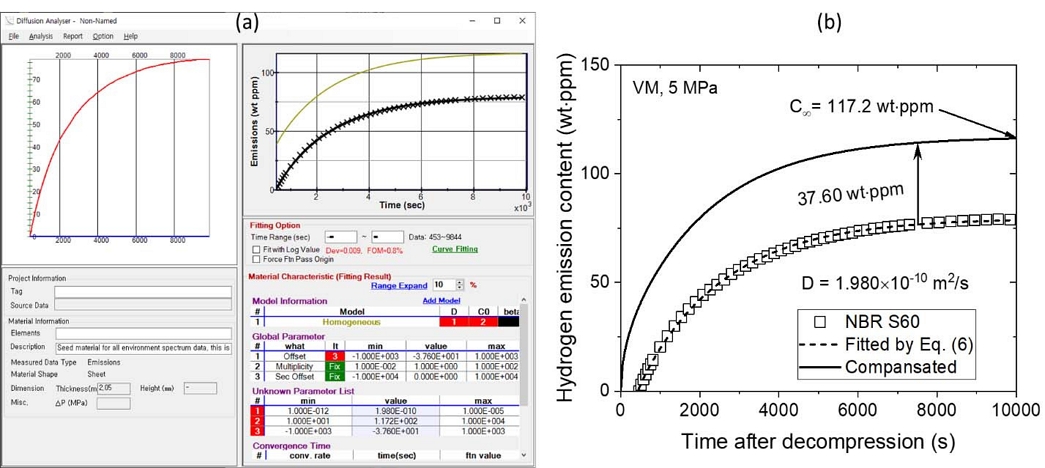
(a) An application of the diffusion analysis program for determining H2 uptake and diffusivity based on Eq. (6). (b) The results are replotted to illustrate the hydrogen uptake (C∞) and diffusivity (D) obtained using the diffusion analysis program
3. 결과 및 고찰
3.1 수소 장입량 및 확산도 측정 결과
고압에서 수소 가스를 충전한 시편을 감압한 후, 방출된 수소 장입량과 확산도는 부피분석과 압력분석 방법을 사용하여 측정하였다. Fig. 3과 Fig. 4는 각각 앞서 기술한 부피 분석법과 압력 분석법에 의한 절차에 의해 측정한 시트형 HDPE, NBR S60과 EPDM H60의 세 종류의 고분자 시료에서 수소 가스에 대한 측정 및 분석 결과를 나타내었다. 먼저 부피 분석법의 경우에 해당하는 Fig. 3(a)~(c)의 왼쪽에는 감압 후 경과시간에 따른 수소 가스의 방출부피(회색 채워진 원)이고, 오른쪽에는 경과 시간에 따른 수소 가스 방출 질량 농도(검은색 빈 사각형)에 해당된다. 한편 압력 분석법에 해당하는 Fig. 4(a)~(c)의 왼쪽에는 감압 후 경과시간에 따른 용기내 가스의 증가된 압력(회색 채워진 원)이고, 오른쪽에는 경과 시간에 따른 수소 가스 방출 질량 농도(검은색 빈 사각형)에 해당된다. Fig. 3과 Fig. 4의 오른쪽의 곡선은 확산 분석 프로그램을 통해 확산 파라미터 D와 C∞는 계산된 것을 나타낸다. 즉, 식 (6)을 사용하여 분석한 결과를 나타내며, 확산도(D)와 총 가스 흡수량(C∞)은 파란색 화살표로 표시된다.
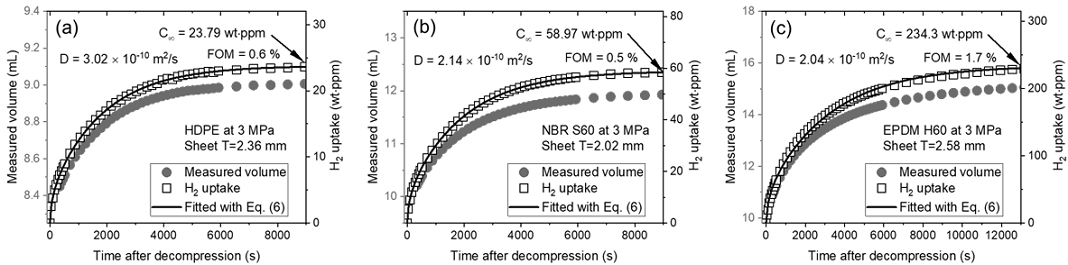
Diffusion parameters of sheet-shaped (a) HDPE, (b) NBR S60 and (c) EPDM H60 specimens were determined using the volumetric analysis method. (a) to (c): The measured hydrogen gas volume (gray filled circle) was derived from the water level, and the emitted hydrogen mass concentration (black open square) was obtained from the measured gas volume, expressed in units of wt⋅ppm for the three specimens. The data indicated by black open squares were compensated for the time delay period. The curve line represents the fitted results based on Eq. (6), with H2 diffusivity (D) and the total H2 uptake (C∞) indicated by the black arrow. Here, T is the thickness of the sheet-shaped specimen
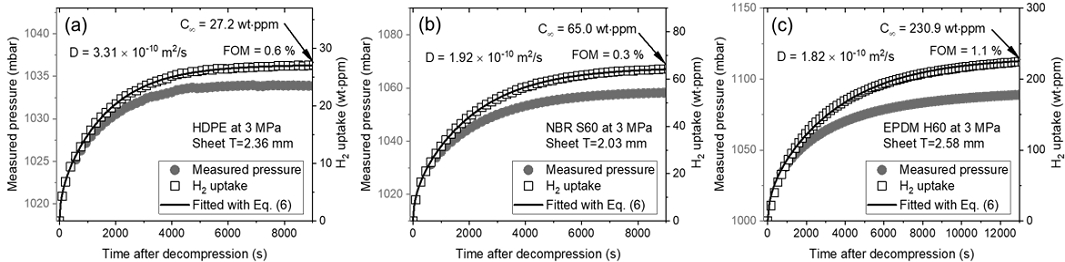
Diffusion parameters of sheet-shaped (a) HDPE, (b) NBR S60 and (c) EPDM H60 specimens were determined using the manometric analysis method. (a) to (c): The measured hydrogen pressure (gray filled circle) was measured from the data logger, and the emitted hydrogen mass concentration (black open square) was obtained from the measured gas pressure, expressed in units of wt⋅ppm for the three specimens. The data indicated by black open squares were compensated for the time delay period. The curve line represents the fitted results based on Eq. (6), with H2 diffusivity (D) and the total H2 uptake (C∞) indicated by the black arrow. Here, T is the thickness of the sheet-shaped specimen
수소의 장입 거동은 재료 내부로의 흡수와 재료 표면에서의 흡착으로 분류된다. 식 (6)은 단일 가스 방출 거동을 설명하는 모델이다. Fig. 3 (a)~(b)에서 보인 바와 같이 HDPE와 NBR S60에서 시간에 따른 수소 가스의 가스 방출 거동이 FOM = 0.6 % 이하로 단일 가스 방출 거동에 매우 잘 맞음이 관찰되었다. 특히 HDPE에서의 단일 모드 가스 방출은 가스가 비정질상으로 확산되기 때문이다.32) 반면, Fig. 3(c)에서 나타난 EPDM 시료의 수소 가스 방출 거동은 FOM = 1.7 %로 단일 모드와는 다소 다른 양상을 보였다. 이는 EPDM 내 카본블랙 필러의 흡착 효과가 추가적으로 작용했기 때문으로 판단되며, 이에 대한 논의는 다음 장에서 자세히 다룬다.
3.2 장입량과 확산도의 압력 의존석 분석 결과
Fig. 5는 부피분석과 압력분석방법으로 얻어진 세 종류의 고분자 시료에 대한 수소 장입량과 확산도를 압력의 함수로 나타낸 것이다. HDPE, NBR S60에 해당하는 Fig. 5(a), (c)에서는 노출된 압력에 대한 가스 장입량은 선형적으로 비례한다. Fig. 5 (a), (c)에서 검은색 직선과 쇄선은 가스 장입량 데이터에 선형으로 피팅되었으며, 제곱상관계수(Sqaured correlation coefficient) R² 값이 0.98이상으로 우수한 선형성을 보여준다. 이는 HDPE와 NBR S60이 모든 가스 분자를 분해하거나 화학 반응을 겪지 않고 헨리의 법칙84)을 따르며 분자 상태로 흡수함을 나타낸다. 즉, 수소가 해리되지 않고 분자 형태로 고분자 내부로 확산됨을 의미한다. 이 현상은 수소 분자가 고분자 매트릭스에 흡수되기 때문으로 해석된다.
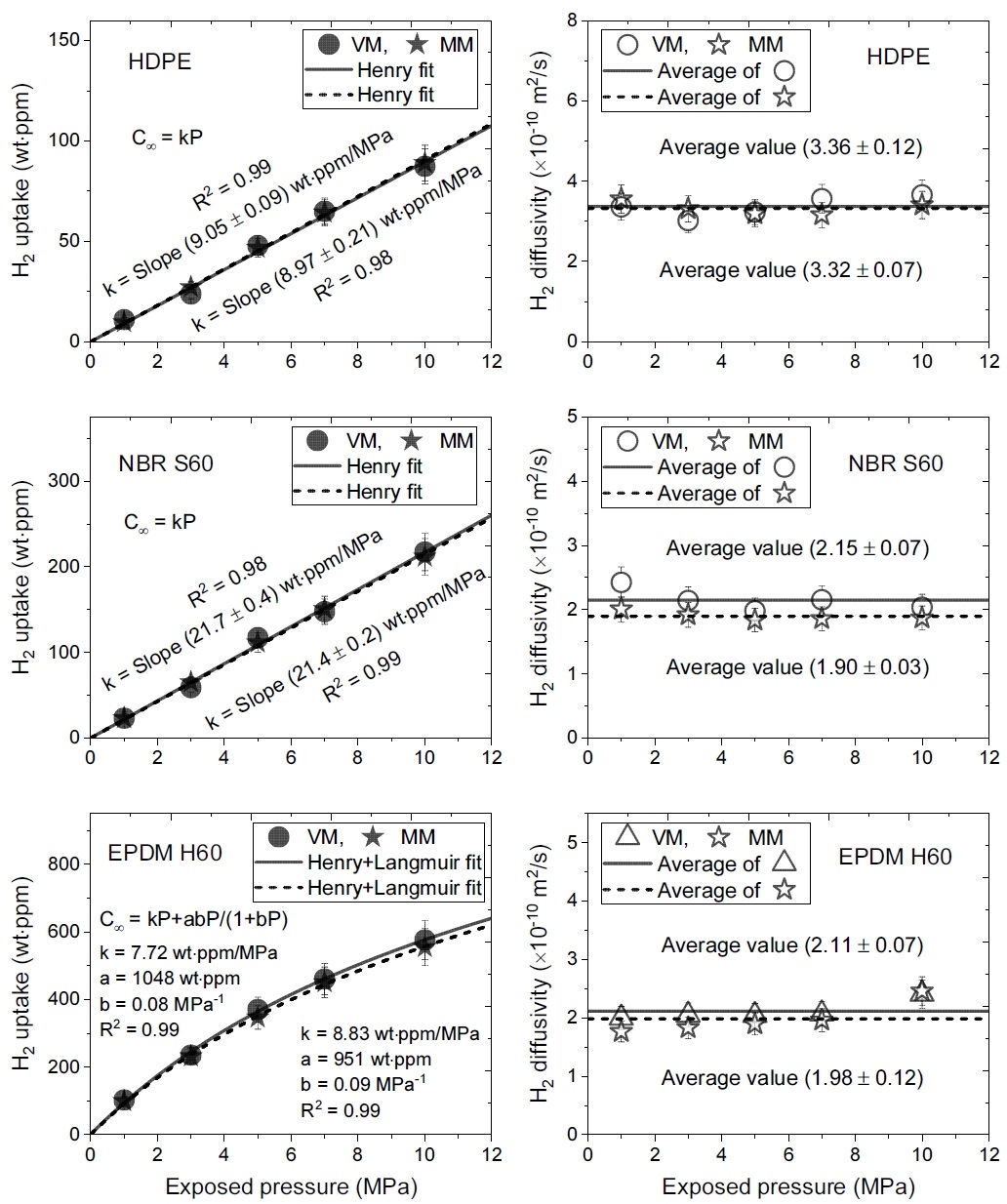
(a) H2 uptake and (b) diffusivity versus exposed pressure for HDPE in volumetric measurement (VM) and manometric measurement (MM). (c) H2 uptake and (d) diffusivity versus exposed pressure for NBR-S60 in volumetric and manometric analysis. (e) H2 uptake and (f) diffusivity versus exposed pressure for EPDM H60 in volumetric and manometric analysis
반면 Fig. 5(e)에서는 카본 블랙 필러가 함유된 EPDM H60의 수소 장입량은 어떤 압력 이상에서 Henry 법칙에서 벗어나는데 이는 카본 블랙 필터 표면에 흡착된 수소에 기인한다. 모든 카본 블랙 충전제가 포함된 EPDM 복합체에서 이중 흡착이 관측된다. 시료가 압력이 증가함에 따라 수소 장입량의 이중 모드 흡착 거동은 아래와 같이 표시된다.85-87)
| (7) |
여기서 C∞는 총 수소 장입량을 나타낸다. 첫 번째 항은 메트릭스의 수소 흡수를 설명하는 헨리 법칙을 나타내며, 헨리 법칙 계수 k가 포함된다. 두 번째 항은 충전제의 수소 흡착과 관계되는 Langmuir 모델을 나타낸다. 여기서 a는 최대 흡착량(또는 용량 매개변수), b는 흡착 평형 상수(또는 Langmuir 구멍 친화도 매개변수) 이다. 식 (7)에 따른 피팅을 하여 구한 k, a, b, R2을 Fig. 5(e)에 나타내었다. R2은 0.99로 실험값이 식 (7)과 잘 부합함을 보여준다.
3종 고분자 시료의 경우에 해당하는 Fig. 5(b), (d)와 (f)에서는 확산도가 노출된 압력에 따라 큰 변화를 보이지 않는다. 따라서 확산도는 다섯 개의 측정 결과에 대한 평균값으로 나타내며, 검은색 수평선으로 표시하였다. Fig. 5의 에러바는 계산된 확장 불확도를 나타낸다.88-90) Fig. 5에서 부피 분석법과 압력 분석법에서 얻은 수소 장입량과 확산도의 결과는 이전 연구에서 분석한12,72-74,81) 불확도 10 % 내에서 서로 잘 일치함을 보여준다.
한편, 용해도 S는 Fig. 5(a), (c), (e)에서 압력에 대한 수소 장입량의 기울기로부터 얻어지는데 아래와 같이 구해진다.60,73)
| (8) |
mg는 수소 가스의 몰 질량으로 2.016 g/mol이며, d는 시료의 밀도이다. HDPE, NBR, EPDM 시료에서 부피 분석과 압력 분석 기반 수소 센서시스템을 사용하여 측정된 수소 가스의 용해도와 확산도는 Table 2에 정리하여 나타내었다. 두 센서에서 수소 용해도와 확산도의 결과는 불확도 10 % 내에서 서로 잘 일치하였으며, 이는 두 센서의 측정 결과가 동일하다는 것을 입증한다.
H2 solubility and diffusivity for three polymers
3.3 수소 센서 시스템의 성능 평가
부피분석법과 압력분석법 기반 수소 가스 센서 시스템의 성능을 평가했다. 성능 평가 결과는 Table 3에 나타내었으며, 성능(Performance) 평가 항목은 민감도 (Sensitivity), 분해능(Resolution), 안정도 (Stability), 측정 범위(Measuring range), 응답 시간(Response time) 및 성능 지수(Figure of Merit, FOM)가 포함된다. 부피분석법 기반한 센서의 민감도는 실린더 1 mL의 부피변화에 해당하는 질량 농도 변화로 정의된다. 부피분석법 기반 센서에서의 민감도는16.43 wt⋅ppm/mL이였다. 반면에, 압력분석법 기반한 센서의 민감도는 용기 내부의 데이터 로거의 1 hPa의 압력변화에 해당하는 질량 농도 변화로 정의된다. 압력분석법 기반 센서에서의 민감도는11.96 wt⋅ppm/hPa이였다. 일반적으로 민감도가 높은 센서는 더 나은 분해능을 가진다. 부피 분석법의 경우 분해능은 최소 측정 가능한 부피인 0.005 mL에 해당하는 0.08 wt⋅ppm의 질량 농도로 결정되었다. 압력 분석법의 경우 분해능은 최소 측정 가능한 압력인 0.01 hPa에 해당하는 0.12 wt⋅ppm의 질량 농도로 결정되었다. 두 센서에 대한 민감도와 분해능을 더욱 향상시키기 위해서는 눈금 실린더의 내부 부피, 시료 용기의 내부 부피 줄이거나 시료 수를 증가시킬 수 있다.
Performance comparisons for two sensor systems with volumetric and manometric analysis sensing system
센서 시스템의 안정도는 시료에서 가스 방출이 종료된 후 24시간 동안 측정된 표준 편차로 정량화되었다. 이 표준 편차는 두 센서 모두 질량 농도의 0.2 % 미만으로 나타났다. 측정 범위는 실린더의 시료 질량에 따른 최대 허용 농도로 정의된다. 부피분석법과 압력 분석법에 기반 수소 센서의 측정 범위는 각각1500 wt⋅ppm과 1400 wt⋅ppm 이하였으며, 이는 시료 질량과 실린더와 용기의 내부 부피를 증가하여 측정 범위를 더 증가 시킬수 있다. 시료에서 가스가 방출함에 따라 실린더 내부의 부피와 용기내부의 압력은 모두 1초 이내에 즉각적으로 변한다. 따라서 두 센서의 반응시간은 1 초 이내로 판단된다. 성능지수는 측정된 데이터와 식 (6)를 사용해 계산된 이론값 간의 표준 편차로 정의된다. 부피분석법과 압력 분석법 기반 센서의 성능지수 값은 각각 0.4 %와 0.6 % 미만으로 나타나고, 이론값과 측정값 간의 좋은 일치를 보인다. 성능 테스트 결과를 바탕으로 부피분석법과 압력 분석법 기반 센서의 사양은 비교적 우수하여 수소 센서로서 현장에서 적용할 수 있다는 것을 보여준다. 특히 부피 분석법 기반의 수소 센서가 민감도, 분해능 및 FOM에서 다소 우수한 성능을 보인다.
4. 결 론
본 연구에서는 수소 인프라의 안전성을 확보하고 재산을 보호하는 중요한 역할을 하는 두 가지 수소 센싱 시스템을 제시하였다. 첫 번째 시스템은 눈금 실린더, 이미지 분석 알고리즘, 디지털 카메라를 활용한 부피 분석법 기반의 센서로, 두 번째 시스템은 상용 데이터 로그와 시료 용기를 사용한 압력 분석법 기반의 센서이다. 또한, 두 시스템 모두 공통적으로 전용 확산 분석 프로그램을 적용하여, 고압 조건 하에서 수소가 충전된 시료의 수소 장입량과 확산도를 정확하고 효과적으로 분석할 수 있다.
이 두 수소 센서 시스템은 0.1 wt⋅ppm의 낮은 수소 농도 감지 한계, 최대 1500 wt⋅ppm까지의 측정 범위, 0.2 %의 뛰어난 안정성, 그리고 1초 이내의 빠른 응답 속도 등 다양한 성능 지표에서 우수한 결과를 보였다. 또한, 두 시스템 모두 프로그램 보상을 통해 온도와 압력 변화에 거의 영향을 받지 않기 때문에 실제 현장 환경에서의 적용이 가능하다. 이 시스템들은 수소의 실시간 측정과 고분자 시료에서의 가스 확산 특성화를 효과적으로 평가할 수 있다.
특히, 두 센서에서 측정된 수소 장입량과 확산도의 결과는 불확도 내에서 일치함을 보여 주었으며, 이는 센서의 측정 신뢰성을 입증한다. 본 연구에서 개발된 수소 센싱 기술은 다음과 같은 주요 특징을 가진다:
- - 효율적이고 저비용의 간단한 기술: 수소 센싱 시스템은 고분자에서 수소 충전량 및 확산도를 측정하는 데 있어 간단하고 효율적인 방법이며 무 전원에서 작동한다.
- - 온도 및 압력 변화에 거의 무관: 두 방법은 온도 및 압력 변화에 거의 영향을 받지 않으며, 다양한 크기와 형태의 시료에 적용할 수 있는 기술이다.
- - 정확한 분석 가능: 전용 확산 분석 프로그램을 통해 정확한 수소 정량 분석이 가능하다.
- - 조정 가능한 민감도 및 측정 범위: 두 시스템은 민감도, 분해능 및 측정 범위를 필요에 맞게 조정할 수 있다.
- - 시각적 수소 방출 모니터링: 부피 분석법은 물 수위 변화를 통해 가스 방출을 실시간으로 시각적으로 모니터링할 수 있는 기능을 가진다.
이 기술은 특히 고압 수소 환경에서 고무 소재의 수소 확산 특성을 정확하게 측정하는 데 유용하며, 수소 충전소, 수소 연료 전지 자동차, 수소 배관 등의 안전한 운영을 위한 중요한 기술로 판단된다. 또한, 고분자 소재의 가스 투과 및 차폐 특성을 평가하고 안전성을 강화하는 데 기여할 수 있어, 향후 수소 기반 인프라의 효율적이고 안전한 운영을 지원하는 데 역할을 할 것으로 기대된다.
References
-
Y. Li, G. Zhang, T. Ma, L. Zhou, X. Chen, C. Zhang, C. Huang and Q. Zhao, “Explosive Characteristics of Premixed Hydrogen-Air Subjected to Various Concentration Gradients,” Fuel, Vol.381, Part B, Paper No.133482, 2025.
[https://doi.org/10.1016/j.fuel.2024.133482]

-
Z. Wang, Y. Hu, W. Wang, X. Zhang, B. Wang, H. Tian, Y. Wang, J. Guan and H. Gu, “Fast and Highly-Sensitive Hydrogen Sensing of Nb₂O₅ Nanowires at Room Temperature,” International Journal of Hydrogen Energy, Vol.37, No.5, pp.4526–4532, 2012.
[https://doi.org/10.1016/j.ijhydene.2011.12.004]
-
H. Xie, Q. Yu, H. Lu, Y. Zhang, J. Zhang and Q. Qin, “Thermodynamic Study for Hydrogen Production from Bio-Oil via Sorption-Enhanced Steam Reforming: Comparison with Conventional Steam Reforming,” International Journal of Hydrogen Energy, Vol.42, No.48, pp.28718–28731, 2017.
[https://doi.org/10.1016/j.ijhydene.2017.09.155]
-
R. M. Dell, “Hydrogen as an Energy Vector in the 21st Century,” in Electrochemistry in Research and Development, R. Kalvoda and R. Parsons (Eds.), Springer US, Boston, MA, pp.73–93, 1985.
[https://doi.org/10.1007/978-1-4684-5098-9_11]
-
J. K. Jung, I. G. Kim, K. S. Chung and U. B. Baek, “Analyses of Permeation Characteristics of Hydrogen in Nitrile Butadiene Rubber Using Gas Chromatography,” Materials Chemistry and Physics, Vol.267, Paper No.124653, 2021.
[https://doi.org/10.1016/j.matchemphys.2021.124653]
-
C. W. Nam, H. C. Kim, J. K. Kim, M. J. Park and Y. J. Nam, “A Study on Hydrogen Supply Valve for Hydrogen Aircraft,” Transactions of KSAE, Vol.31, No.7, pp.567–573, 2023.
[https://doi.org/10.7467/KSAE.2023.31.7.567]
-
J. K. Jung and J. H. Lee, “High-Performance Hydrogen Gas Sensor System Based on Transparent Coaxial Cylinder Capacitive Electrodes and a Volumetric Analysis Technique,” Scientific Reports, Vol.14, Paper No.1967, 2024.
[https://doi.org/10.1038/s41598-024-52168-3]
-
C. Ma and A. Wang, “Optical Fiber Tip Acoustic Resonator for Hydrogen Sensing,” Optics Letters, Vol.35, No.12, pp.2043–2045, 2010.
[https://doi.org/10.1364/OL.35.002043]
-
S. M. Jang, S. H. Oh, Y. K. Kim and H. K. Suh, “Analysis of Flow Characteristics of High-Pressure Hydrogen Gas with Changes in the Internal Shape of Hydrogen Shut-Off Valve,” Transactions of KSAE, Vol.33, No.2, pp.147–156, 2025.
[https://doi.org/10.7467/KSAE.2025.33.2.147]
-
Z. Li, Z. Yao, A. A. Haidry, T. Plecenik, L. Xie, L. Sun and Q. Fatima, “Resistive-Type Hydrogen Gas Sensor Based on TiO₂: A Review,” International Journal of Hydrogen Energy, Vol.43, No.45, pp.21114–21132, 2018.
[https://doi.org/10.1016/j.ijhydene.2018.09.051]
-
H. M. Kang, M. C. Choi, J. H. Lee, Y. M. Yun, J. S. Jang, N. K. Chung, S. K. Jeon, J. K. Jung, J. H. Lee, J. H. Lee, Y. W. Chang and J. W. Bae, “Effect of the High-Pressure Hydrogen Gas Exposure in the Silica-Filled EPDM Sealing Composites with Different Silica Content,” Polymers, Vol.14, No.6, Paper No.1151, 2022.
[https://doi.org/10.3390/polym14061151]
-
J. K. Jung, I. G. Kim and K. T. Kim, “Evaluation of Hydrogen Permeation Characteristics in Rubbery Polymers,” Current Applied Physics, Vol.21, pp.43–49, 2021.
[https://doi.org/10.1016/j.cap.2020.10.003]
-
J. K. Jung, I. G. Kim, K. T. Kim, U. B. Baek and S. H. Nahm, “Novel Volumetric Analysis Technique for Characterizing the Solubility and Diffusivity of Hydrogen in Rubbers,” Current Applied Physics, Vol.26, pp.9–15, 2021.
[https://doi.org/10.1016/j.cap.2021.03.005]
-
H. Kang, J. Bae, J. Lee, Y. Yun, S. Jeon, N. Chung, J. Jung, U. Baek, J. Lee, Y. Kim and M. Choi, “The Synergistic Effect of Carbon Black/Carbon Nanotube Hybrid Fillers on the Physical and Mechanical Properties of EPDM Composites after Exposure to High-Pressure Hydrogen Gas,” Polymers, Vol.16, No.8, Paper No.1065, 2024.
[https://doi.org/10.3390/polym16081065]
-
J. K. Jung, K. T. Kim, N. K. Chung, U. B. Baek and S. H. Nahm, “Characterizing the Diffusion Property of Hydrogen Sorption and Desorption Processes in Several Spherical-Shaped Polymers,” Polymers, Vol.14, No.7, Paper No.1468, 2022.
[https://doi.org/10.3390/polym14071468]
-
S. Nishimura, “Fracture Behaviour of Ethylene Propylene Rubber for Hydrogen Gas Sealing under High Pressure Hydrogen,” International Polymer Science and Technology, Vol.41, No.6, pp.27–34, 2014.
[https://doi.org/10.1177/0307174X1404100606]
-
J. Yamabe and S. Nishimura, “Hydrogen-Induced Degradation of Rubber Seals,” in Gaseous Hydrogen Embrittlement of Materials in Energy Technologies, R. P. Gangloff and B. P. Somerday (Eds.), Woodhead Publishing, Sawston, UK, pp.12–18, 2012.
[https://doi.org/10.1533/9780857093899.3.769]
- N. Aibada, R. Manickam, K. Gupta and P. Raichurkar, “Review on Various Gaskets Based on the Materials, Their Characteristics and Applications,” International Journal of Textile Engineering and Processes, Vol.3, pp.12–18, 2017.
-
R. R. Barth, K. L. Simmons and C. W. San Marchi, Polymers for Hydrogen Infrastructure and Vehicle Fuel Systems: Applications, Properties and Gap Analysis, Sandia National Laboratories, 2013.
[https://doi.org/10.2172/1104755]
-
M. Honselaar, G. Pasaoglu and A. Martens, “Hydrogen Refuelling Stations in the Netherlands: An Intercomparison of Quantitative Risk Assessments Used for Permitting,” International Journal of Hydrogen Energy, Vol.43, No.27, pp.12278–12294, 2018.
[https://doi.org/10.1016/j.ijhydene.2018.04.111]
-
Y. Wang, Y. Pang, H. Xu, A. Martinez and K. S. Chen, “PEM Fuel Cell and Electrolysis Cell Technologies and Hydrogen Infrastructure Development – A Review,” Energy & Environmental Science, Vol.15, No.6, pp.2288–2328, 2022.
[https://doi.org/10.1039/D2EE00790H]
-
H. Fujiwara, H. Ono, K. Onoue and S. Nishimura, “High-Pressure Gaseous Hydrogen Permeation Test Method – Property of Polymeric Materials for High-Pressure Hydrogen Devices (1),” International Journal of Hydrogen Energy, Vol.45, No.53, pp.29082–29094, 2020.
[https://doi.org/10.1016/j.ijhydene.2020.07.215]
-
J. K. Jung, Y. I. Moon, K. S. Chung and K. T. Kim, “Development of a Program for Analyzing Dielectric Relaxation and Its Application to Polymers: Nitrile Butadiene Rubber,” Macromolecular Research, Vol.28, pp.596–604, 2020.
[https://doi.org/10.1007/s13233-020-8080-6]
-
I. Profatilova, F. Fouda-Onana, M. Heitzmann, T. Bacquart, A. Morris, J. Warren, F. Haloua and P.-A. Jacques, “Detrimental Impact of Trace Amount of Tetrachlorohexafluorobutane Impurity in Hydrogen on PEM Fuel Cell Performance,” International Journal of Hydrogen Energy, Vol.65, pp.837–843, 2024.
[https://doi.org/10.1016/j.ijhydene.2024.04.055]
-
N. C. Menon, A. M. Kruizenga, K. J. Alvine, C. San Marchi, A. Nissen and K. Brooks, “Behaviour of Polymers in High-Pressure Environments as Applicable to the Hydrogen Infrastructure,” Proceedings of the ASME 2016 Pressure Vessels and Piping Conference (PVP 2016), N. C. Menon, A. M. Kruizenga, K. J. Alvine, C. San Marchi, A. Nissen and K. Brooks (Eds.), Vancouver, BC: American Society of Mechanical Engineers, pp.6B–2016B, 2016.
[https://doi.org/10.1115/PVP2016-63713]
-
Y. I. Moon, J. K. Jung, G. H. Kim and K. S. Chung, “Observation of the Relaxation Process in Fluoroelastomers by Dielectric Relaxation Spectroscopy,” Physica B: Condensed Matter, Vol.608, Paper No.412870, 2021.
[https://doi.org/10.1016/j.physb.2021.412870]
-
S. U. Zhanguo, W. Zhang, A. Abdulwahab, S. Saleem, Y. Yao, A. Deifalla and M. Taghavi, “Comparison of Gasoline and Hydrogen Pathways in Order to Reduce the Environmental Hazards of a Solar-Hydrogen Refueling Station: Evaluation Based on Life Cycle Cost and Well-to-Wheel Models,” Process Safety and Environmental Protection, Vol.173, pp.317–331, 2023.
[https://doi.org/10.1016/j.psep.2023.03.015]
-
J. K. Jung, J. H. Lee, S. K. Jeon, U. B. Baek, S. H. Lee, C. H. Lee and W. J. Moon, “H₂ Uptake and Diffusion Characteristics in Sulfur-Crosslinked Ethylene Propylene Diene Monomer Polymer Composites with Carbon Black and Silica Fillers after High-Pressure Hydrogen Exposure Reaching 90 MPa,” Polymers, Vol.15, No.1, Paper No.162, 2023.
[https://doi.org/10.3390/polym15010162]
-
J. K. Jung, U. B. Baek, S. H. Lee, M. C. Choi and J. W. Bae, “Hydrogen Gas Permeation in Peroxide-Crosslinked Ethylene Propylene Diene Monomer Polymer Composites with Carbon Black and Silica Fillers,” Journal of Polymer Science, Vol.61, No.6, pp.460–471, 2023.
[https://doi.org/10.1002/pol.20220494]
-
B.-L. Choi, J. K. Jung, U. B. Baek and B.-H. Choi, “Effect of Functional Fillers on Tribological Characteristics of Acrylonitrile Butadiene Rubber after High-Pressure Hydrogen Exposures,” Polymers, Vol.14, No.5, Paper No.861, 2022.
[https://doi.org/10.3390/polym14050861]
-
C. H. Lee, J. K. Jung, S. K. Jeon, K. S. Ryu and U. B. Baek, “Nuclear Magnetic Resonance Study of O-Ring Polymer Exposed to High-Pressure Hydrogen,” Journal of Magnetics, Vol.22, No.3, pp.478–482, 2017.
[https://doi.org/10.4283/JMAG.2017.22.3.478]
-
J. H. Lee, Y. W. Kim and J. K. Jung, “Investigation of the Gas Permeation Properties Using the Volumetric Analysis Technique for Polyethylene Materials Enriched with Pure Gases under High Pressure: H₂, He, N₂, O₂ and Ar,” Polymers, Vol.15, No.19, Paper No.4019, 2023.
[https://doi.org/10.3390/polym15194019]
-
J. H. Lee, Y. W. Kim, D. J. Kim, N. K. Chung and J. K. Jung, “Comparison of Two Methods for Measuring the Temperature Dependence of H₂ Permeation Parameters in Nitrile Butadiene Rubber Polymer Composites Blended with Fillers: The Volumetric Analysis Method and the Differential Pressure Method,” Polymers, Vol.16, No.2, Paper No.280, 2024.
[https://doi.org/10.3390/polym16020280]
-
J. H. Lee, Y. W. Kim, N. K. Chung, H. M. Kang, W. J. Moon, M. C. Choi and J. K. Jung, “Multiphase Modeling of Pressure-Dependent Hydrogen Diffusivity in Fractal Porous Structures of Acrylonitrile Butadiene Rubber–Carbon Black Composites with Different Fillers,” Polymer, Vol.311, Paper No.127552, 2024.
[https://doi.org/10.1016/j.polymer.2024.127552]
-
C. H. Lee, J. K. Jung, K. S. Kim and C. J. Kim, “Hierarchical Channel Morphology in O-Rings after Two Cycling Exposures to 70 MPa Hydrogen Gas: A Case Study of Sealing Failure,” Scientific Reports, Vol.14, Paper No.5319, 2024.
[https://doi.org/10.1038/s41598-024-55101-w]
-
J. K. Jung, J. H. Lee, J. S. Jang, N. K. Chung, C. Y. Park, U. B. Baek and S. H. Nahm, “Characterization Technique of Gases Permeation Properties in Polymers: H₂, He, N₂ and Ar Gas,” Scientific Reports, Vol.12, Paper No.3328, 2022.
[https://doi.org/10.1038/s41598-022-07321-1]
-
Y. Moon, H. Lee, J. Jung and H. Han, “Direct Visualization of Carbon Black Aggregates in Nitrile Butadiene Rubber by THz Near-Field Microscope,” Scientific Reports, Vol.13, Paper No.7846, 2023.
[https://doi.org/10.1038/s41598-023-34565-2]
-
G. H. Kim, Y. I. Moon, J. K. Jung, M. C. Choi and J. W. Bae, “Influence of Carbon Black and Silica Fillers with Different Concentrations on Dielectric Relaxation in Nitrile Butadiene Rubber Investigated by Impedance Spectroscopy,” Polymers, Vol.14, No.1, Paper No.155, 2022.
[https://doi.org/10.3390/polym14010155]
-
J. K. Jung, C. H. Lee, U. B. Baek, M. C. Choi and J. W. Bae, “Filler Influence on H₂ Permeation Properties in Sulfur-Crosslinked Ethylene Propylene Diene Monomer Polymers Blended with Different Concentrations of Carbon Black and Silica Fillers,” Polymers, Vol.14, No.3, Paper No.592, 2022.
[https://doi.org/10.3390/polym14030592]
-
Z. Huang, W. Yang, Y. Zhang, J. Yin, X. Sun, J. Sun, G. Ren, S. Tian, P. Wang and H. Wan, “Miniaturized Electrochemical Gas Sensor with a Functional Nanocomposite and Thin Ionic Liquid Interface for Highly Sensitive and Rapid Detection of Hydrogen,” Analytical Chemistry, Vol.96, No.45, pp.17960–17968, 2024.
[https://doi.org/10.1021/acs.analchem.4c02561]
-
A. Hinojo, E. Lujan, J. Abella and S. Colominas, “Development and Characterization of Electrochemical Hydrogen Sensors Using Different Fabrication Techniques,” Fusion Engineering and Design, Vol.204, Paper No.114483, 2024.
[https://doi.org/10.1016/j.fusengdes.2024.114483]
-
W. M. Seleka, K. E. Ramohlola, K. D. Modibane and E. Makhado, “Conductive Chitosan/Polyaniline Hydrogel: A Gas Sensor for Room-Temperature Electrochemical Hydrogen Sensing,” International Journal of Hydrogen Energy, Vol.68, pp.940–954, 2024.
[https://doi.org/10.1016/j.ijhydene.2024.04.240]
-
C. Wang, J. Yang, J. Li, C. Luo, X. Xu and F. Qian, “Solid-State Electrochemical Hydrogen Sensors: A Review,” International Journal of Hydrogen Energy, Vol.48, No.80, pp.31377–31391, 2023.
[https://doi.org/10.1016/j.ijhydene.2023.04.167]
-
T. Cowen, S. Grammatikos and M. Cheffena, “Molecularly Imprinted Polymer Nanoparticle–Carbon Nanotube Composite Electrochemical Gas Sensor for Highly Selective and Sensitive Detection of Methanol Vapour,” Analyst, Vol.149, No.8, pp.2428–2435, 2024.
[https://doi.org/10.1039/D4AN00045E]
-
E. Gorbova, G. Balkourani, C. Molochas, D. Sidiropoulos, A. Brouzgou, A. Demin and P. Tsiakaras, “Brief Review on High-Temperature Electrochemical Hydrogen Sensors,” Catalysts, Vol.12, No.12, Paper No.1647, 2022.
[https://doi.org/10.3390/catal12121647]
-
A. Alaghmandfard, S. Fardindoost, A. L. Frencken and M. Hoorfar, “The Next Generation of Hydrogen Gas Sensors Based on Transition Metal Dichalcogenide–Metal Oxide Semiconductor Hybrid Structures,” Ceramics International, Vol.50, No.17, pp.29026–29043, 2024.
[https://doi.org/10.1016/j.ceramint.2024.05.259]
-
S.-K. Kwon, J.-N. Kim, H.-G. Byun and H.-J. Kim, “Low-Power and Cost-Effective Readout Circuit Design for Compact Semiconductor Gas Sensor Systems,” Electrochemistry Communications, Vol.169, Paper No.107834, 2024.
[https://doi.org/10.1016/j.elecom.2024.107834]
-
Y. Li, Z. Yuan, H. Ji, F. Meng and H. Wang, “Response Surface Method Analysis of Gas-Sensitive Properties: Investigating the Influence of External Environment on the Performance of Semiconductor Gas Sensors,” IEEE Transactions on Industrial Electronics, Vol.71, No.9, pp.11661–11670, 2024.
[https://doi.org/10.1109/TIE.2023.3329254]
-
R. Xie, S. Guan and Z. Tan, “A Gas Sensor Scheme for CO Based on Optical-Feedback Linear-Cavity Enhanced Absorption Spectroscopy,” Optics Communications, Vol.574, Paper No.131105, 2025.
[https://doi.org/10.1016/j.optcom.2024.131105]
-
M. Basso, V. Paolucci, V. Ricci, E. Colusso, M. Cattelan, E. Napolitani, C. Cantalini and A. Martucci, “Sol-Gel Pt–VO₂ Films as Selective Chemoresistive and Optical H₂ Gas Sensors,” ACS Applied Materials & Interfaces, Vol.16, No.42, pp.57558–57570, 2024.
[https://doi.org/10.1021/acsami.4c13003]
-
X. Zhang, B. Ojha, H. Bichlmaier, I. Hartmann and H. Kohler, “Extensive Gaseous Emissions Reduction of Firewood-Fueled Low Power Fireplaces by a Gas Sensor-Based Advanced Combustion Airflow Control System and Catalytic Post-Oxidation,” Sensors, Vol.23, No.10, Paper No.4679, 2023.
[https://doi.org/10.3390/s23104679]
-
D. Del Orbe Henriquez, I. Cho, H. Yang, J. Choi, M. Kang, K. S. Chang, C. B. Jeong, S. W. Han and I. Park, “Pt Nanostructures Fabricated by Local Hydrothermal Synthesis for Low-Power Catalytic-Combustion Hydrogen Sensors,” ACS Applied Nano Materials, Vol.4, No.1, pp.7–12, 2020.
[https://doi.org/10.1021/acsanm.0c02794]
-
S. Tamura and N. Imanaka, “Low-Temperature Operable Catalytic Combustion-Type CO Gas Sensors,” Bunseki Kagaku, Vol.70, No.6, pp.327–334, 2021.
[https://doi.org/10.2116/bunsekikagaku.70.327]
-
M. Wang, J. Liu, Y. Bai, D. Zheng and L. Fang, “Flow Rate Measurement of Gas–Liquid Annular Flow through a Combined Multimodal Ultrasonic and Differential Pressure Sensor,” Energy, Vol.288, Paper No.129852, 2024.
[https://doi.org/10.1016/j.energy.2023.129852]
-
X. Shi, C. Tan and F. Dong, “Oil–Gas–Water Three-Phase Flow Pattern Identification through Parallel Decision Trees with Differential Pressure and Ultrasonic Sensors,” IEEE Transactions on Instrumentation and Measurement, Vol.73, Paper No.7508515, 2024.
[https://doi.org/10.1109/TIM.2024.3470252]
-
Q. Yang, N. Jin, Y. Deng and D. Wang, “Water Holdup Measurement of Gas–Liquid Flows Using Distributed Differential Pressure Sensors,” IEEE Sensors Journal, Vol.21, No.2, pp.2149–2158, 2021.
[https://doi.org/10.1109/JSEN.2020.3019602]
-
Y.-R. Deng, N.-D. Jin, Q.-Y. Yang and D.-Y. Wang, “A Differential Pressure Sensor Coupled with Conductance Sensors to Evaluate Pressure Drop Prediction Models of Gas–Water Two-Phase Flow in a Vertical Small Pipe,” Sensors, Vol.19, No.12, Paper No.2723, 2019.
[https://doi.org/10.3390/s19122723]
-
J. K. Jung, I. G. Kim, K. S. Chung, Y.-I. Kim and D. H. Kim, “Determination of Permeation Properties of Hydrogen Gas in Sealing Rubbers Using Thermal Desorption Analysis Gas Chromatography,” Scientific Reports, Vol.11, Paper No.17092, 2021.
[https://doi.org/10.1038/s41598-021-96266-y]
-
J. K. Jung, I. G. Kim, K. S. Chung and U. B. Baek, “Gas Chromatography Techniques to Evaluate the Hydrogen Permeation Characteristics in Rubber: Ethylene Propylene Diene Monomer,” Scientific Reports, Vol.11, Paper No.4859, 2021.
[https://doi.org/10.1038/s41598-021-83692-1]
-
J. K. Jung, K.-T. Kim and K. S. Chung, “Two Volumetric Techniques for Determining the Transport Properties of Hydrogen Gas in Polymer,” Materials Chemistry and Physics, Vol.276, Paper No.125364, 2022.
[https://doi.org/10.1016/j.matchemphys.2021.125364]
-
R. Slater, K. Tharmaratnam, S. Belnour, M. K.-H. Auth, R. Muhammed, C. Spray, D. Wang, B. de Lacy Costello, M. García-Fiñana, S. Allen and C. Probert, “Gas Chromatography–Sensor System Aids Diagnosis of Inflammatory Bowel Disease, and Separates Crohn’s from Ulcerative Colitis, in Children,” Sensors, Vol.24, No.15, Paper No.5079, 2024.
[https://doi.org/10.3390/s24155079]
-
J. K. Jung, I. G. Kim, K. T. Kim, K. S. Ryu and K. S. Chung, “Evaluation Techniques of Hydrogen Permeation in Sealing Rubber Materials,” Polymer Testing, Vol.93, Paper No.107016, 2021.
[https://doi.org/10.1016/j.polymertesting.2020.107016]
-
F. Hardoyono and K. Windhani, “Combination of Metal Oxide Semiconductor Gas Sensor Array and Solid-Phase Microextraction Gas Chromatography–Mass Spectrometry for Odour Classification of Brewed Coffee,” Flavour and Fragrance Journal, Vol.38, No.6, pp.451–463, 2023.
[https://doi.org/10.1002/ffj.3759]
-
R. Kendler, F. Dreisbach, R. Seif, S. Pollak and M. Petermann, “Method for Estimating Vapour Pressures Based on Thermogravimetric Measurements with a Magnetic Suspension Balance,” Thermochimica Acta, Vol.664, pp.128–135, 2018.
[https://doi.org/10.1016/j.tca.2018.05.001]
-
W. Schabel, P. Scharfer, M. Kind and I. Mamaliga, “Sorption and Diffusion Measurements in Ternary Polymer–Solvent–Solvent Systems by Means of a Magnetic Suspension Balance—Experimental Methods and Correlations with a Modified Flory–Huggins and Free-Volume Theory,” Chemical Engineering Science, Vol.62, No.8, pp.2254–2266, 2007.
[https://doi.org/10.1016/j.ces.2006.12.062]
-
J. K. Jung, I. G. Kim, S. K. Jeon and K. S. Chung, “Characterizing the Hydrogen Transport Properties of Rubbery Polymers by Gravimetric Analysis,” Rubber Chemistry and Technology, Vol.94, No.4, pp.688–703, 2021.
[https://doi.org/10.5254/rct.21.79880]
-
X. Zhu, W. Ahmed, K. Schmidt, R. Barroso, S. J. Fowler and C. F. Blanford, “Validation of an Electronic VOC Sensor Against Gas Chromatography–Mass Spectrometry,” IEEE Transactions on Instrumentation and Measurement, Vol.73, pp.1–8, 2024.
[https://doi.org/10.1109/TIM.2024.3485428]
-
L. Quercia, I. Khomenko, R. Capuano, M. Tonezzer, R. Paolesse, E. Martinelli, A. Catini, F. Biasioli and C. Di Natale, “Optimization of Gas Sensor Measurements by Dynamic Headspace Analysis Supported by Simultaneous Direct Injection Mass Spectrometry,” Sensors and Actuators B: Chemical, Vol.347, Paper No.130580, 2021.
[https://doi.org/10.1016/j.snb.2021.130580]
-
Y. R. Shaltaeva, B. I. Podlepetsky and V. S. Pershenkov, “Detection of Gas Traces Using Semiconductor Sensors, Ion Mobility Spectrometry, and Mass Spectrometry,” European Journal of Mass Spectrometry, Vol.23, No.4, pp.217–224, 2017.
[https://doi.org/10.1177/1469066717720795]
-
J. A. Imonigie, R. N. Walters and M. M. Gribb, “Rapid Isothermal Gas Chromatography–Mass Spectrometry Method for Validating a Small Ion Mobility Spectrometer Sensor,” Instrumentation Science and Technology, Vol.34, No.6, pp.677–695, 2006.
[https://doi.org/10.1080/10739140600964010]
-
C. Pérès, F. Begnaud and J.-L. Berdagué, “Standard Gas Addition: A Calibration Method for Handling Temporal Drifts of Mass Spectrometry-Based Sensors,” Analytical Chemistry, Vol.74, No.10, pp.2279–2283, 2002.
[https://doi.org/10.1021/ac0111558]
-
J. H. Lee and J. K. Jung, “Development of Image-Based Water Level Sensor with High-Resolution and Low-Cost Using Image Processing Algorithm: Application to Outgassing Measurements from Gas-Enriched Polymer,” Sensors, Vol.24, No.23, Paper No.7699, 2024.
[https://doi.org/10.3390/s24237699]
-
J. K. Jung, I. G. Kim, S. K. Jeon, K.-T. Kim, U. B. Baek and S. H. Nahm, “Volumetric Analysis Technique for Analyzing the Transport Properties of Hydrogen Gas in Cylindrical-Shaped Rubbery Polymers,” Polymer Testing, Vol.99, Paper No.107147, 2021.
[https://doi.org/10.1016/j.polymertesting.2021.107147]
-
J. K. Jung, J. H. Lee, S. K. Jeon, N. H. Tak, N. K. Chung, U. B. Baek, S. H. Lee, C. H. Lee, M. C. Choi, H. M. Kang, J. W. Bae and W. J. Moon, “Correlations between H₂ Permeation and Physical/Mechanical Properties in Ethylene Propylene Diene Monomer Polymers Blended with Carbon Black and Silica Fillers,” International Journal of Molecular Sciences, Vol.24, No.3, Paper No.2865, 2023.
[https://doi.org/10.3390/ijms24032865]
-
J. K. Jung, K.-T. Kim and U. B. Baek, “Simultaneous Three-Channel Measurements of Hydrogen Diffusion with Light Intensity Analysis of Images by Employing Webcam,” Current Applied Physics, Vol.37, pp.19–26, 2022.
[https://doi.org/10.1016/j.cap.2022.02.005]
-
R. Karpeles and A. V. Grossi, “EPDM Rubber Technology,” in Handbook of Elastomers, CRC Press, pp.863–894, 2000.
[https://doi.org/10.1201/9781482270365-42]
-
J. K. Jung, “Review of Developed Methods for Measuring Gas Uptake and Diffusivity in Polymers Enriched by Pure Gas under High Pressure,” Polymers, Vol.16, No.5, Paper No.723, 2024.
[https://doi.org/10.3390/polym16050723]
-
J. K. Jung, K. T. Kim, U. B. Baek and S. H. Nahm, “Volume Dependence of Hydrogen Diffusion for Sorption and Desorption Processes in Cylindrical-Shaped Polymers,” Polymers, Vol.14, No.4, Paper No.756, 2022.
[https://doi.org/10.3390/polym14040756]
-
J. K. Jung, S. K. Jeon, K.-T. Kim, C. H. Lee, U. B. Baek and K. S. Chung, “Impedance Spectroscopy for In Situ and Real-Time Observations of the Effects of Hydrogen on Nitrile Butadiene Rubber Polymer under High Pressure,” Scientific Reports, Vol.9, Paper No.13035, 2019.
[https://doi.org/10.1038/s41598-019-49692-y]
-
J. K. Jung, Y. I. Moon and K. S. Chung, “Dielectric Relaxation in a Fluoroelastomer and Ethylene Propylene Diene Monomer Observed by Using Impedance Spectroscopy,” Journal of the Korean Physical Society, Vol.76, pp.416–425, 2020.
[https://doi.org/10.3938/jkps.76.416]
-
J. K. Jung, J. H. Lee, Y. W. Kim and N. K. Chung, “Development of Portable Gas Sensing System for Measuring Gas Emission Concentration and Diffusivity Using Commercial Manometric Sensors in Gas-Exposed Polymers: Application to Pure Gases, H₂, He, N₂, O₂ and Ar,” Sensors and Actuators B: Chemical, Vol.418, Paper No.136240, 2024.
[https://doi.org/10.1016/j.snb.2024.136240]
-
J. K. Jung, C. H. Lee, M. S. Son, J. H. Lee, U. B. Baek, K. S. Chung, M. C. Choi and J. W. Bae, “Filler Effects on H₂ Diffusion Behavior in Nitrile Butadiene Rubber Blended with Carbon Black and Silica Fillers of Different Concentrations,” Polymers, Vol.14, No.4, Paper No.700, 2022.
[https://doi.org/10.3390/polym14040700]
- J. Crank, The Mathematics of Diffusion, Oxford: Clarendon Press, 1979.
-
R. Sander, “Compilation of Henry’s Law Constants (Version 4.0) for Water as Solvent,” Atmospheric Chemistry and Physics, Vol.15, No.8, pp.4399–4981, 2015.
[https://doi.org/10.5194/acp-15-4399-2015]
-
C. H. Lee, S.-H. Park, J. K. Jung, K.-S. Ryu, S. H. Nahm, J. Kim and Y. Chen, “¹¹B Nuclear Magnetic Resonance Study of Boron Nitride Nanotubes Prepared by Mechano-Thermal Method,” Solid State Communications, Vol.134, No.6, pp.419–423, 2005.
[https://doi.org/10.1016/j.ssc.2005.01.052]
-
J. K. Jung, K. T. Kim, J. H. Lee and U. B. Baek, “Effective and Low-Cost Gas Sensor Based on a Light Intensity Analysis of a Webcam Image: Gas-Enriched Polymers under High Pressure,” Sensors and Actuators B: Chemical, Vol.393, Paper No.134258, 2023.
[https://doi.org/10.1016/j.snb.2023.134258]
-
D. D. Do, H. D. Do and K. N. Tran, “Analysis of Adsorption of Gases and Vapors on Nonporous Graphitized Thermal Carbon Black,” Langmuir, Vol.19, No.14, pp.5656–5668, 2003.
[https://doi.org/10.1021/la020191e]
-
J. K. Jung, A. Faisal, Y. S. Lee and K.-T. Kim, “Calibration of Voltage Transformer Test Set Using an Error Simulator,” Measurement Science and Technology, Vol.26, No.9, Paper No.095004, 2015.
[https://doi.org/10.1088/0957-0233/26/9/095004]
-
J. K. Jung, A. Faisal, Y. S. Lee and K.-T. Kim, “Fabrication of Capacitor–Resistor Bank for Calibrating Commercial Capacitance and tan δ Measuring Bridges,” IEEE Transactions on Instrumentation and Measurement, Vol.64, No.6, pp.1564–1569, 2015.
[https://doi.org/10.1109/TIM.2015.2416457]
-
J. K. Jung, E. So, S. H. Lee and D. Bennett, “Comparison of Systems between KRISS and NRC to Evaluate the Performance Characteristics of a 400-kV Capacitive Voltage Divider,” IEEE Transactions on Instrumentation and Measurement, Vol.60, No.7, pp.2634–2641, 2011.
[https://doi.org/10.1109/TIM.2011.2126190]